Feedback and Contact

A Report of the 16th Indian Science Fiction Conference

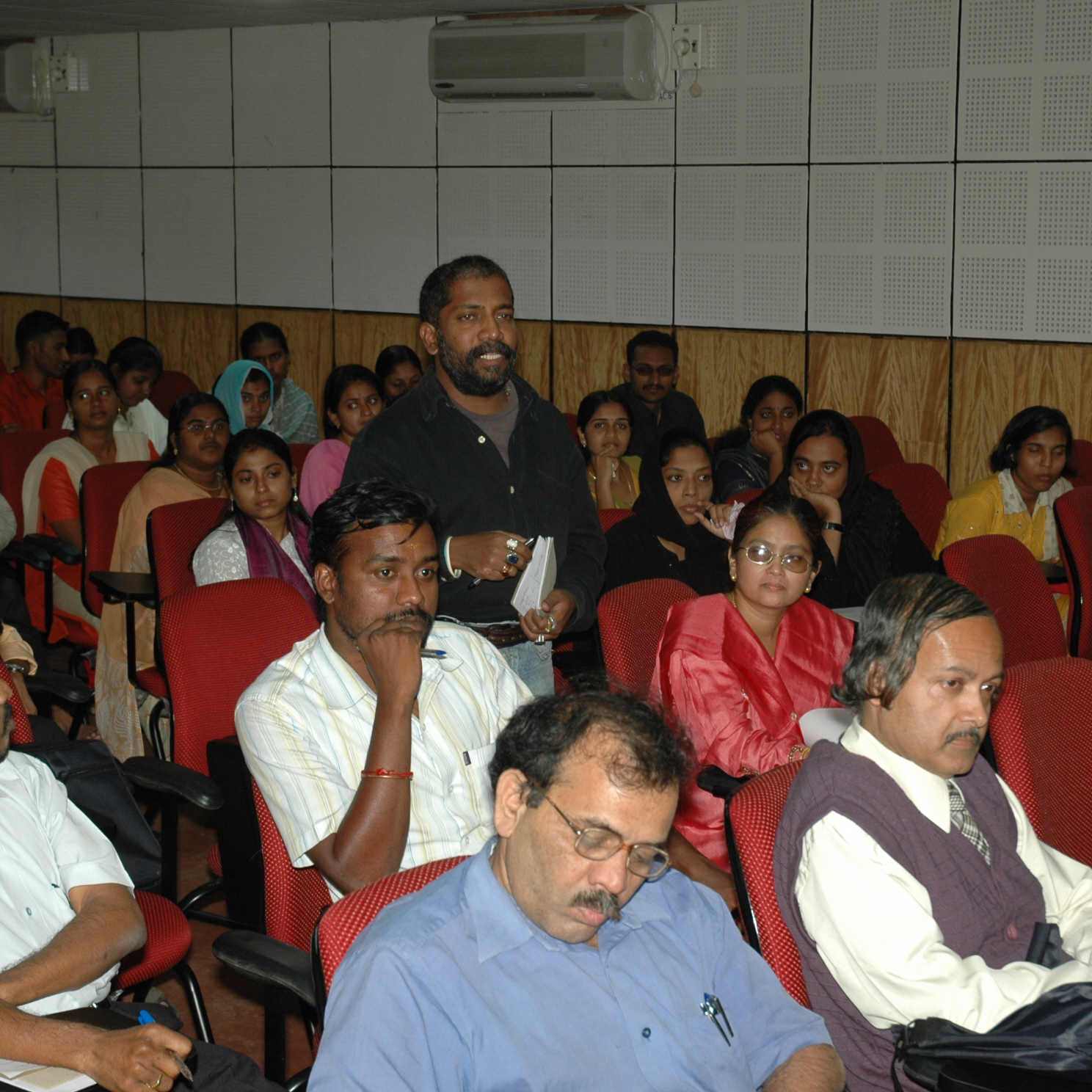
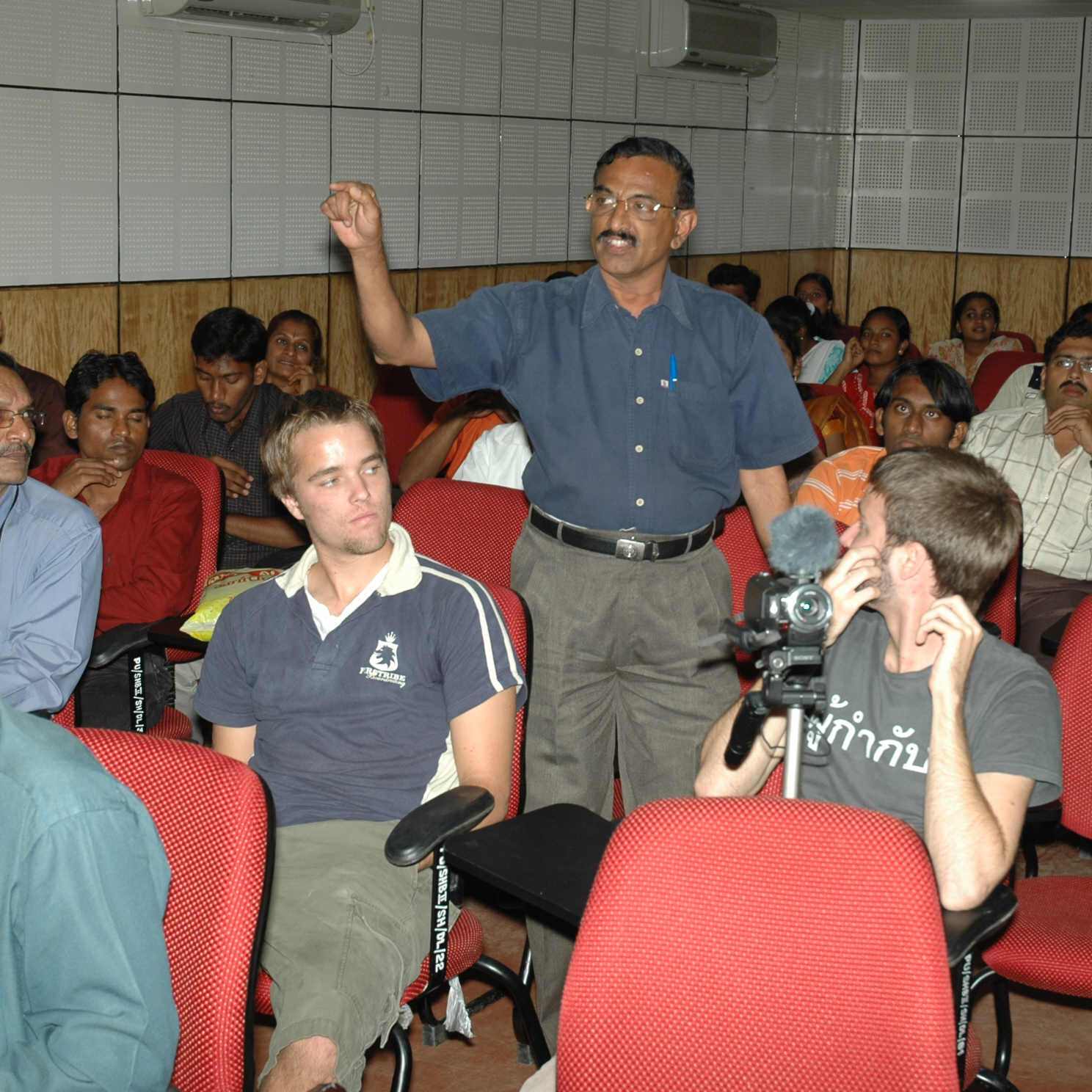
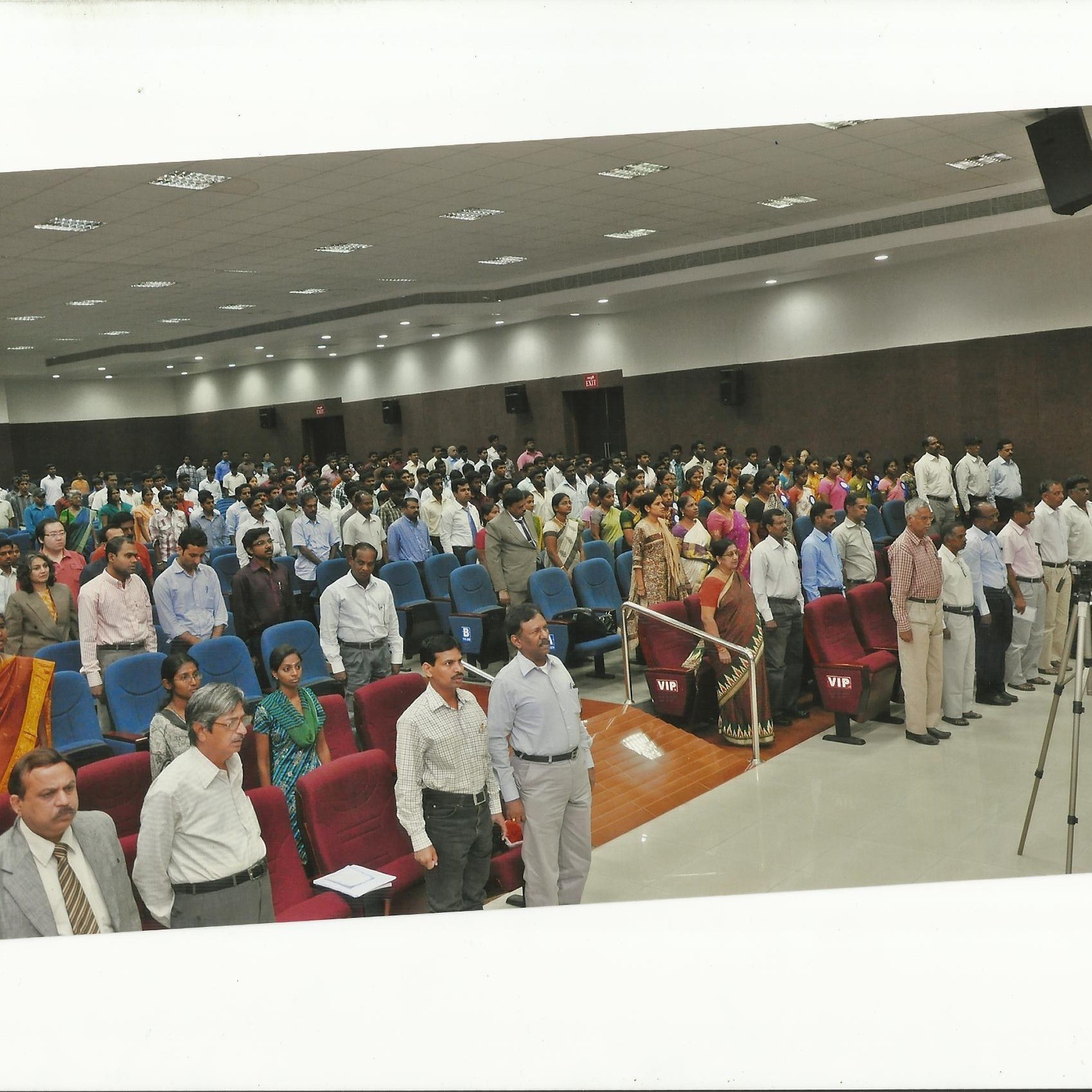
The sixteenth Indian Science Fiction Conference was organized by Indian Association for Science Fiction Studies and KMG college of Arts and Science, Gudiayattam, Vellore District, Tamil Nadu state, India at KMG College on March 25 & 26, 2017.

It was attended by one hundred participants comprising of students of KMG College, student delegates from Tamil Nadu, delegates from different parts of India, Resource Persons from Kerala, Maharashtra, Karnataka, Tamil Nadu and from California, the USA.

As per the Indian tradition, the invocation by undergraduate English major students of KMG College attracted the crowd.  Dr.Peruvalluthi who is the Professor of English, Dean (CDC), Registrar in Charge, Thiruvalluvar University, Vellore inaugurated the conference by lighting the lamp spoke about the state of Science Fiction globally and cited from history how the writers like Tamil language Sujatha have contributed to the genre by producing a number of SF stories. The professor presented a paper on Arthur C Clarke’s work under the title “Childhood’s End: Mythology Revisited”. Initially, he highlighted the works of the author and then focused on analyzing the characters in the novel. Also, he said “In this novel of epic dimension, Clarke has attempted to address the predicament of humanity as a whole ranging from the past to the present and into the future.” The paper reader has observed that the entire novel is divided into three parts namely, the transition of the past, the golden age period of culmination in the present and the future is shown as the both spiritual and cultural era.

Further, the professor has explained the mythical aspect of the novel under the headings “the quest, water symbolism, color, shadow archetype, trickster, wise old man, the whale, archiypal woman, initiation, and others”. The interesting part of the study is that the paper reader has taken up the psychoanalytical method adopted by Carl Jung in substantiating his argument. The paper concludes by quoting the text, “the primordial experience is the source of his creativeness; it cannot be fathomed, and requires mythological imagery it give a form.” By which Childhood’s End has expanded the vision of humanity.

In his annual report the General Secretary of IASFS Dr.Srinarahari explained the numerous Indian Science Fiction activities which are taking place in the country like the establishment of online Marathi language Science Fiction fans club Sci-fi Khatta in Maharashtra state. He explained how three dozen active members are writing and posting the SF stories, the group interacting on the others’ stories commenting upon the structure, theme, characterization, point of view, relevance of the Gedenken experiment and highlighting the elements of science and others. The forum is active every day in discussion, modification, editing the stories. But it is limited to the interaction in the vernacular language Marathi. Identically, he added the activities of the Bengali language Science Fiction fans who are also contributing stories online website: www.kalpabishwa.com. He informed the gathering that he was negotiating both the language groups to make a common platform with English as a language of communication so that their thought process could be shared globally. The major hitches are that it lacks funding, resource persons and dedicated team.

The report highlights the efforts of Sami Ahmed Khan who has edited an online magazine Muse India which came out with a special feature on “Indian Science Fiction” on May 17, 2015. The special issue contained the works of Vandana Singh, Anil Menon, Arvind Mishra and Srinarahari. Meanwhile, Srinarahari is helping the Italian movie maker Matteo Primiterra in his study of Assamese Science Fiction at Guwahati. The report was concluded by complimenting Dr. Zeashan Heider Zaidi who was awarded the Best SF writer by Print Media Working Association on 10.02. 2017.

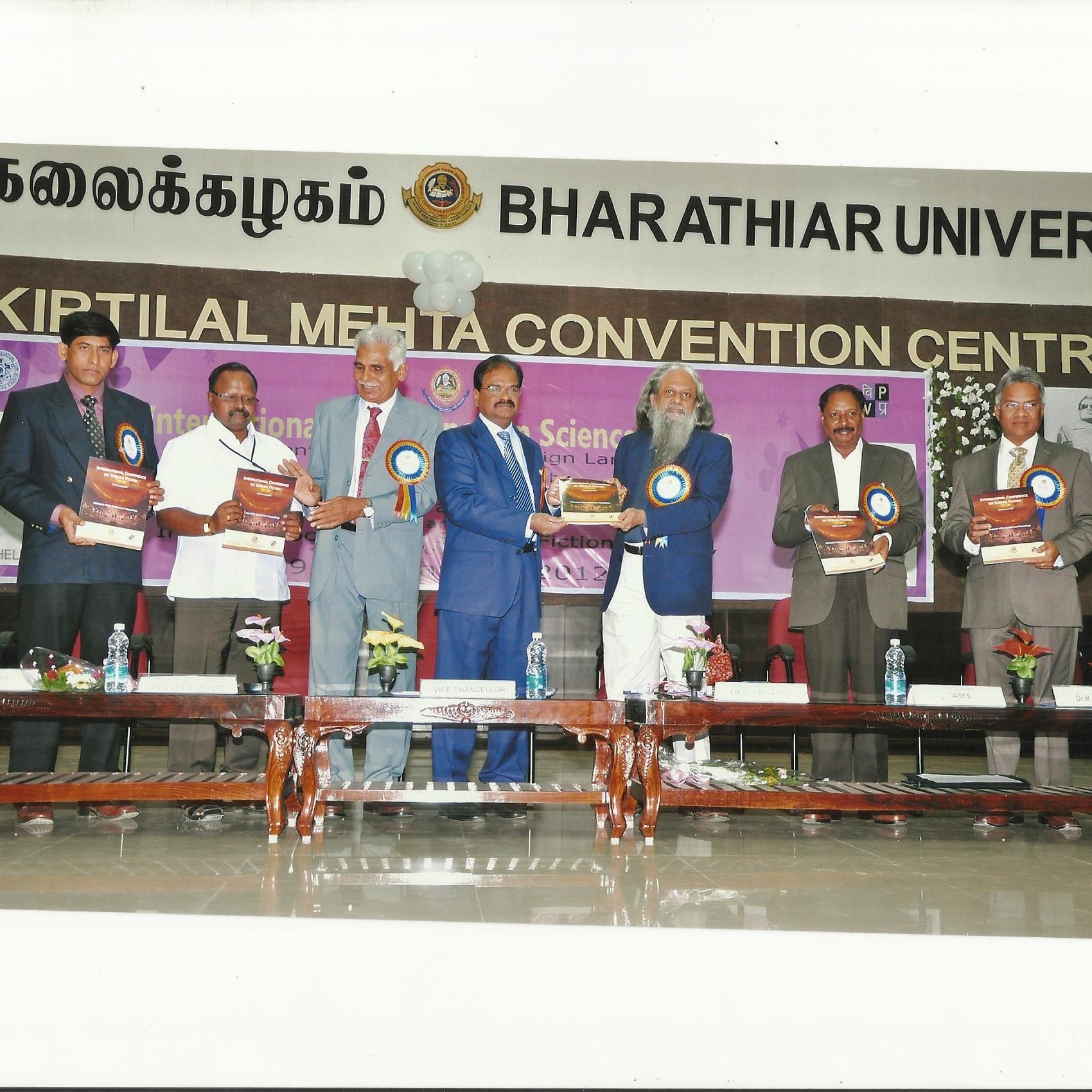
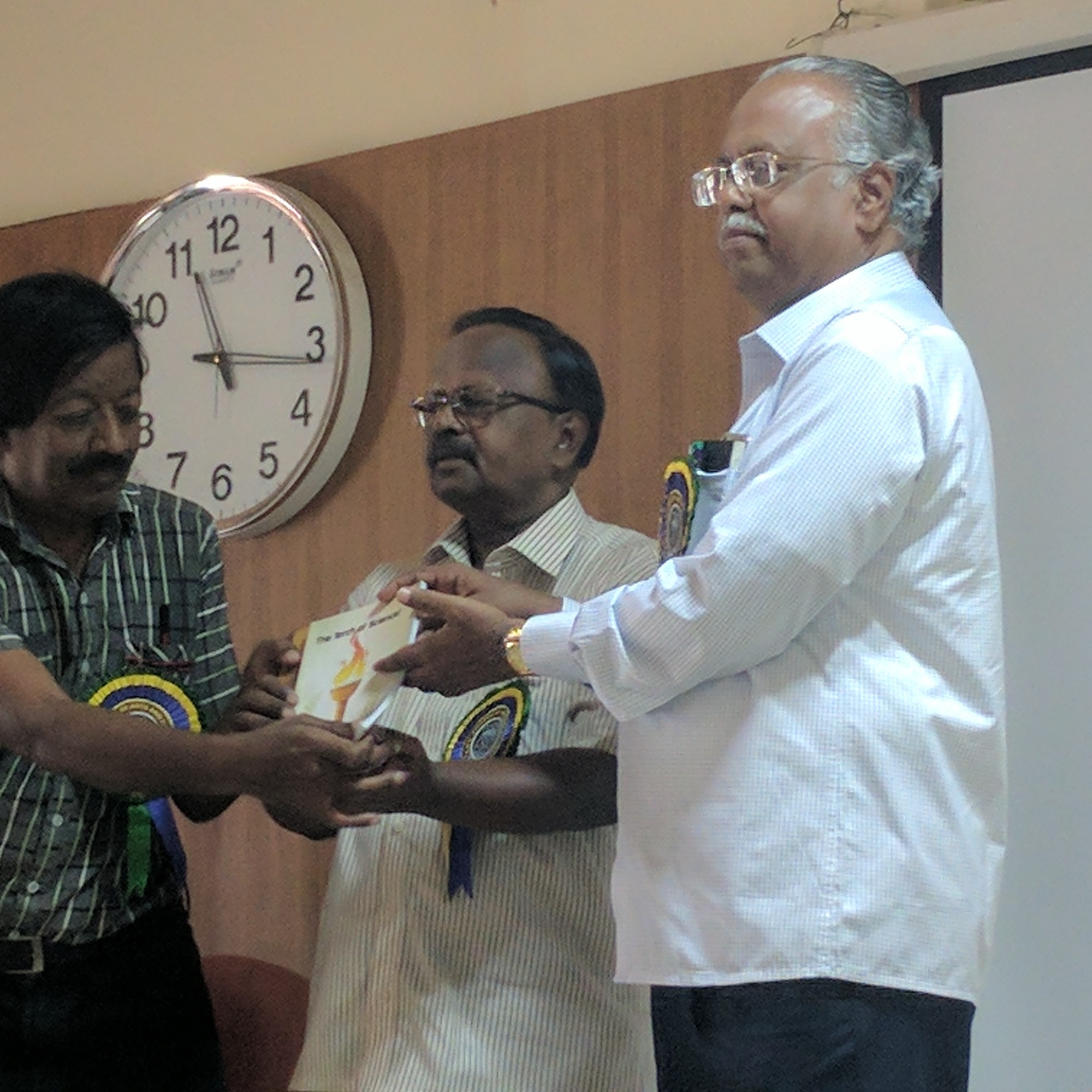
Science Fiction for Sci-fi Fans (SF in Print and Eye SF) by Dr. Srinarahari and an anthology of seven SF short stories Space Station by Mohan Sanjeevan were released during the event.

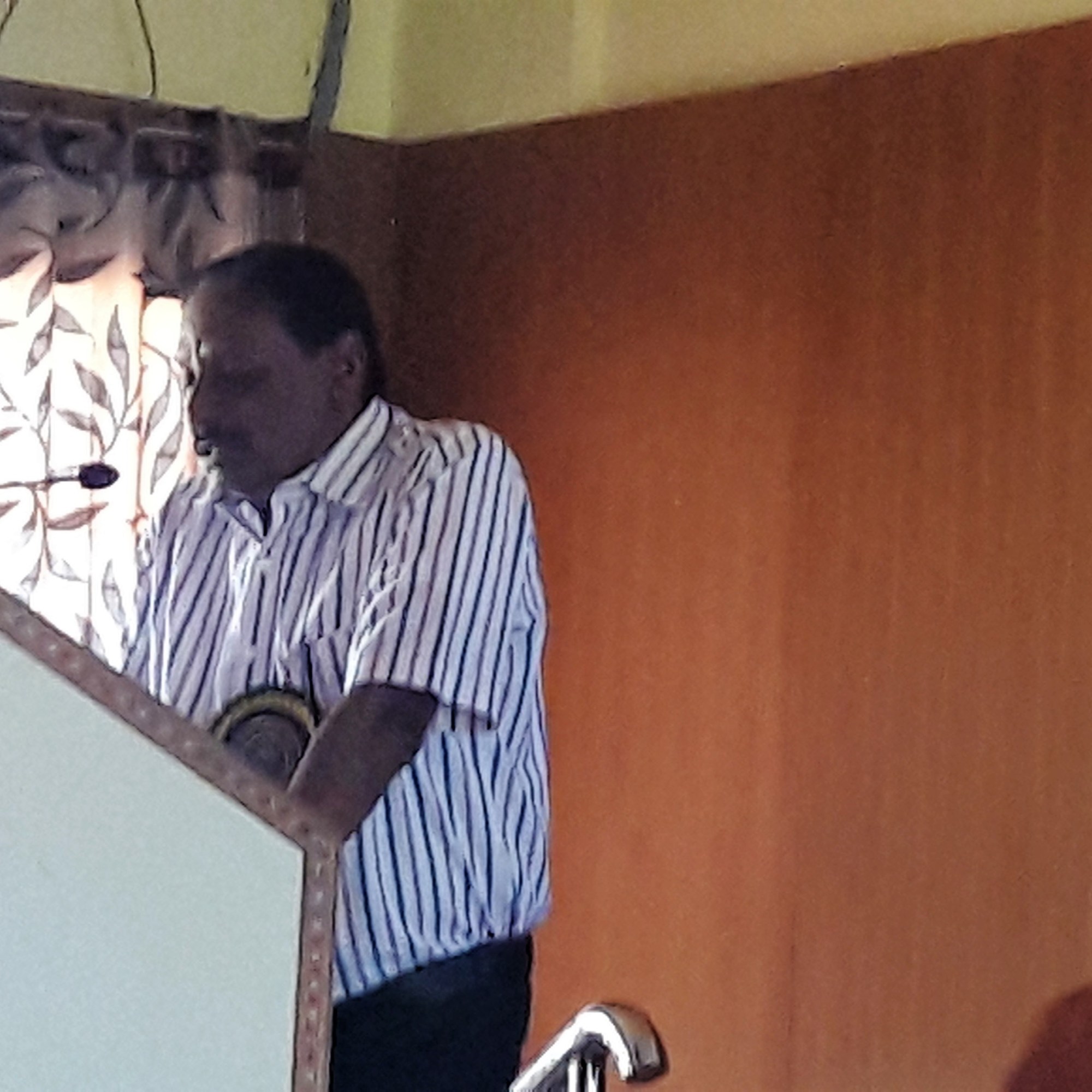
In his Presidential speech Dr. Purushothaman reiterated that there were only twelve participants in the first IASFS conference held in Chennai in 1998. The second conference had fourteen participants. Later the number improved gradually in the Pune conference to reach 400 hundred paper presentations in a span of four days.

Further, the President explained how Science Fiction stories are captivating the readers’ interest. It begins with the element of ‘sense of wonder’ and ‘amazement’ and then dealt with the element of answering to the question of what is human. He explained the sequences of incidents in “the Bicentennial Man” by Isaac Asimov. The protagonist Andrew robot had a desire to become ‘human’. It had to undergo an operation changing its form from metallic to organic form. But it realizes that it has to change its brain pattern. Ultimately, it realizes that to become human one has to become ‘mortal’.  

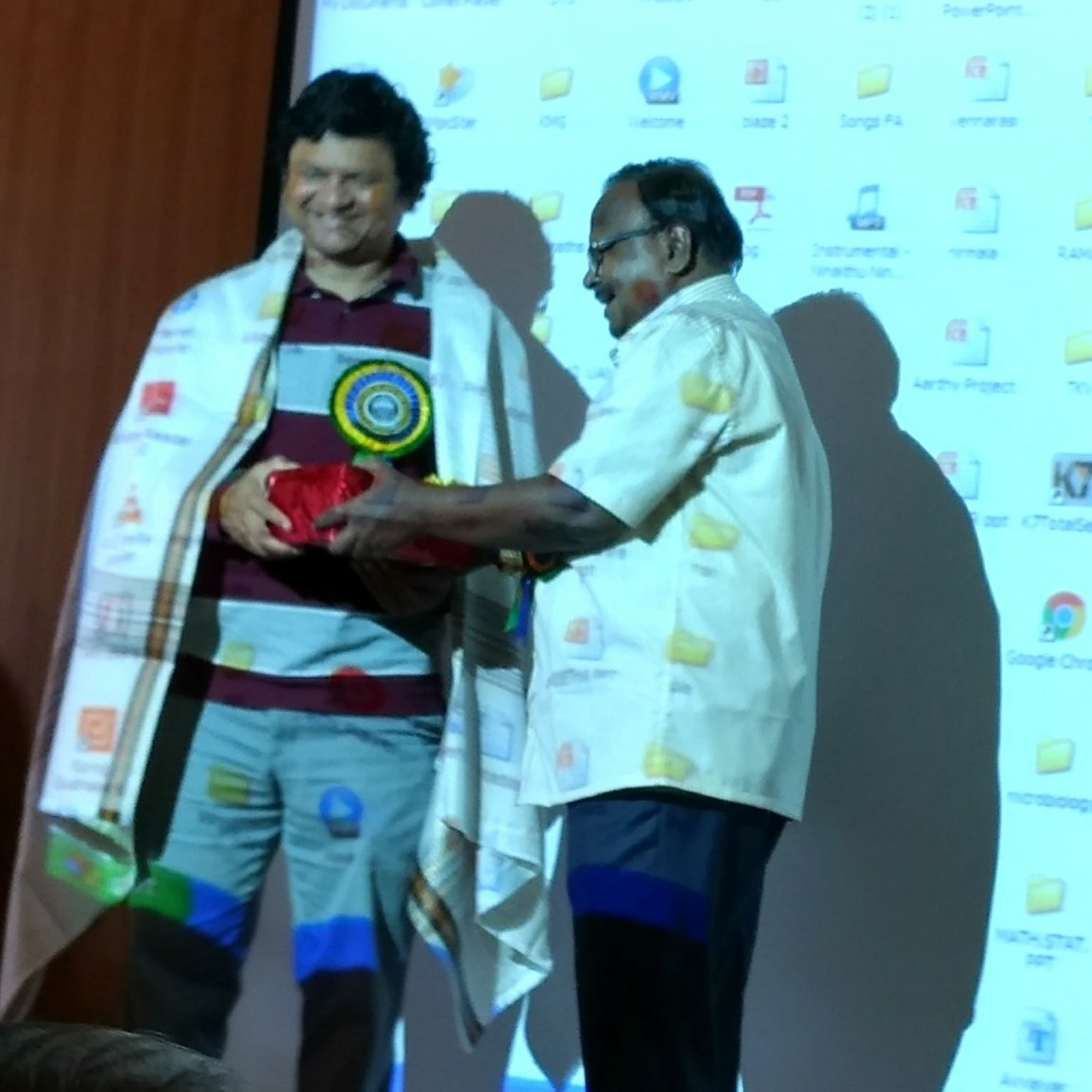
A retired scientist Nellai S Muthu who has served in Indian Satellite Research Center in his keynote address traced the ideas and the concepts of science from the mythical epic Kamba Ramayana to the philosophy and vision of the  ‘missile-scientist’ and the past President of India Dr. Abdul Kalam. He named the science popularization programs in the region and condemned the non-science advertisements in the name of science.  The scientist also quoted science fiction anthologies written by him and the Tamil writer Sujatha’s works in highlighting the status of Tamil language Science Fiction. Furthermore, he dealt with the science ideas in Tamil movies including Endhiran. Dr.Jayashri Rani the Principal of the KMG College of Arts and Science welcomed the gathering and Dr.Gajapathy honored the chief guest Dr. Peruvalluthi.

During the first plenary session Dr.Ashish Mahabala who is a senior Data Scientist with the center for Data-Driven Discovery at Caltech, California, spoke on “American Science Fiction”. His presentation focused on Contemporary American movies, Television Serials, Science Fiction Organizations, Conferences, Writing, Editing and Markets. The Astro-Physicist gave a detail account of the SF & Politics, Climate Change: Fact and Fiction, Fancy Dress, Writing, Panel discussion, ideas to develop stories forum, Redy Player one by Ernest Clinets, Writers of the Future, the Expanse TV serial, the idea of inertia, the chief who took Thatcher and Indira Gandhi as models, a musical parody band upon Star Treck, the Los Angeles Science Fantasy Society, highlighting the presence of Larry Niven, Forest J, as well as described in detail about the huge library, fiction Trivia and others.

Mr. Sunil Sule who was a captain of a ship and now teaching Navigation in Mumbai Colleges is a prolific writer of Science Fiction. During the second plenary session he drew the point the wrong depiction of science in literature, advertisements, popular magazines, TV serials, in children’s program, and in whats app messages. He also pointed out that in these forms of communication how the names of NASA, AIMS, and a few eminent scientists to boost up the sale of certain products. He explained how pseudo-science and wrong depiction of the facts would create a negative impact on the people. He called for the experts to react to this kind of a wrong depiction where they come across.

Mr.Ponnivalavan screened his Tamil science fiction film Mr. Muniswami 1.2.4 during the post lunch session. It depicts the innocent security guard in a hospital named Raju falls in love with the beautiful lady doctor. Luckily he is chosen for an experiment by her and her senior Neuro surgeon. They assure him that by administering a medicine and by operation, he could become smart and the most intelligent man in the community.  Raju agrees for proposal to become an intelligent man as he dreams that the act may yield him the benefit of possessing the lady doctor as his life partner. It is astonishing that he becomes over smart in all aspects as he could read a number of books, sets the Rubik Cube in 20 seconds, suggest diagnostic methods for complicated cases. Ultimately, he expresses his wish to the doctor. But she says discloses that the experiment has failed and the senior doctor is much worried about that. She demonstrates how he has begun to forget things. Reversing the process, he again becomes a security guard and daily he smiles at her whenever she passes the hospital gate. Though the theme is found in Tamil sf story of Sujatha in the sixties, often it reminds of Pygmalion by Bernard Shaw, English movie My Fair Lady, and a Marathi play Thi Phula Rani and Kannada play Hoo Hudugi.

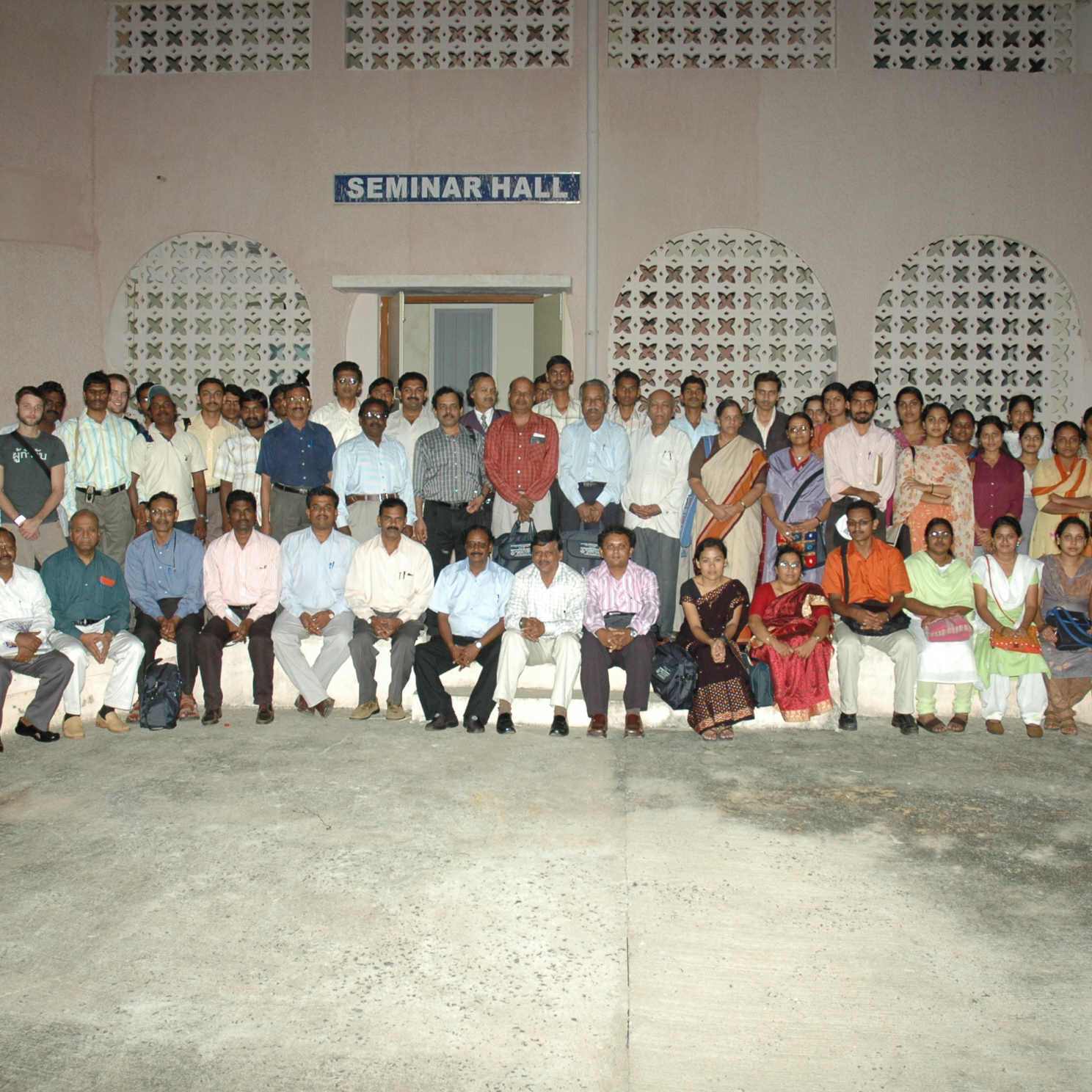
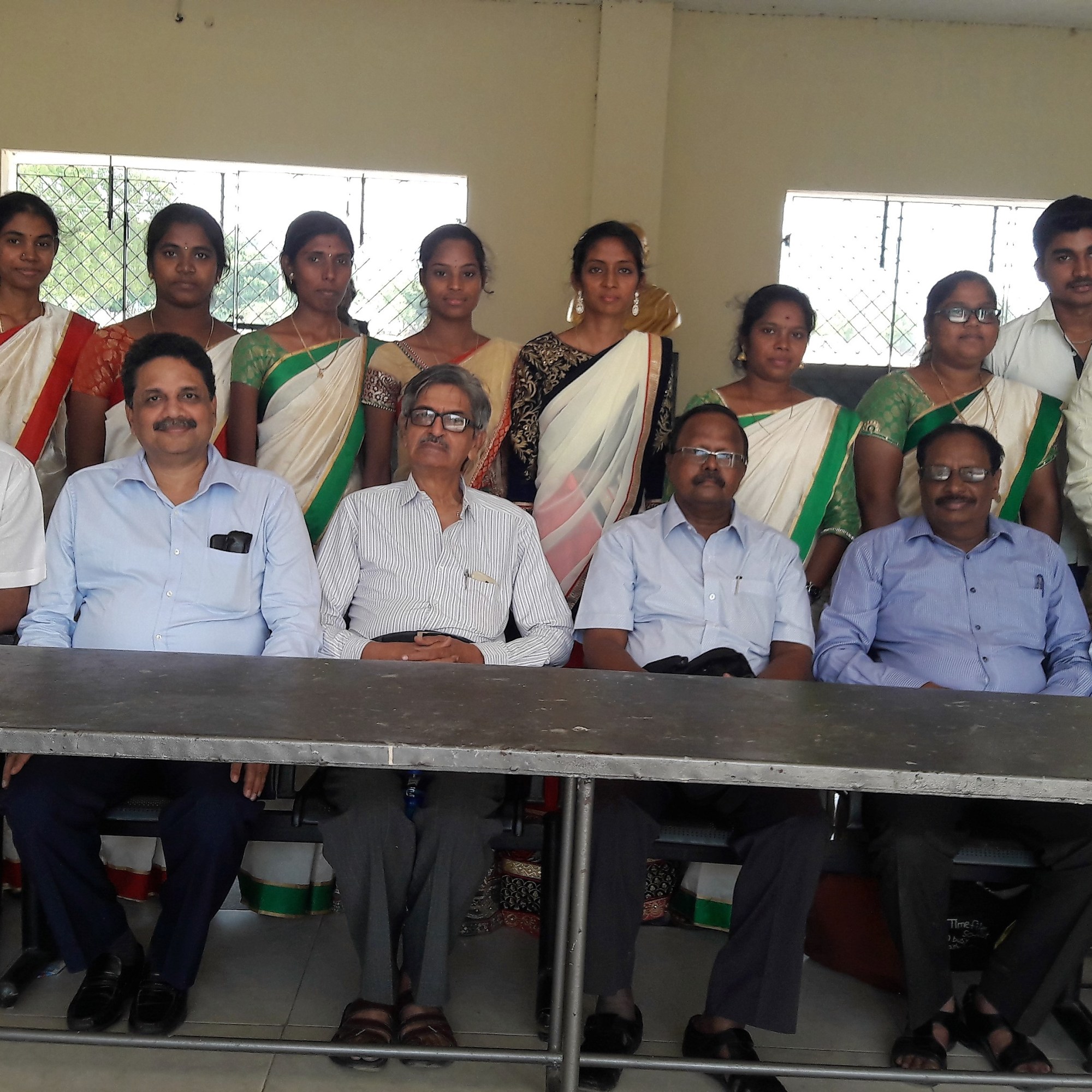
Eight student delegates presented papers on various works of Global Science Fiction including two papers on the movies Transformers and Passengers. A group photo session of all the participants marked the end of the day.

The second day session began with the SF writers reading their stories. Mr. Sharad Puranik   from Maharashtra state where Marathi is the spoken language read a story stressing the impact of science on the loss of human values and relationships. Mr. Sule read a story which is set in a college campus where the concern of each professor was innovative. By the coordination of  Bio-Geo departmental heads, the story brings out that a possibility of a emergence of new species in combination of rats and pigs which could be made use of in substituting JCBs to demolish the buildings. 

The chairperson Dr. Palanivel who has headed the English departments in various Universities of Tamil Nadu narrated a number of incidents how the reading of science fiction influences a reader in solving innumerable human problems. He dealt with Ray Bradbury’s Fahrenheit 451 in detail. Also, he highlighted how he had conceived the Asimovian foundation trilogy in a philosophical way. He explained elaborately about the research which is going on in English departments on various issues of science fiction. Dr. Sangeetha read her paper on Isaac Asimov’s “Three Laws of Robotics”. Mohan Sanjeevan read a paper about “Space Sync”. Meanwhile, to break the monotony of series of paper reading activity, Mr. Sule showed his creation of Sci-toons. He has made use of bats, astronauts and turtles in all his slides. After the feedback given by the delegates and participants, Dr.Purushothaman gave his valedictory address. Dr.Srinarahari in his vote of thanks thanked the management team, Administrators like Director, Principal and Vice-Principal, heads of the departments, faculty members, office staff, sub staff, food & accommodation committees of the KMG college of Arts and Science, media persons and above all the involvement of all the delegates in making the 16th Indian Science Fiction Conference of Indian Association for Science Fiction Studies a grand success.

– Dr Srinarahari M H
5 Things You Can Do to Get Your Child Interested in Science Fiction

A child used to be in the company of all the members of the family like father, mother, sister, brother, cousin, grandparents, great grandparents till the end of the first half of the twentieth century. It extended to a decade or more in some families. If an event like a marriage taking place in a rural place, the neighbors used to help in cooking and extending hospitality to the guests of the villages. There was totally ‘Oneness’ seen in ‘mini India’. There used to be dances, music, and all sorts of entertainment for a period of more than a week. 

When time and money replaced the earlier ‘pleasure concept’ of the people, youngsters left the villages in seeking jobs, villagers left fearing the rate of interest and the harassment of the money lenders. The wrong notion of more money in cities made everyone the culprits of urbanization. As a result, there is a reduction in the number of young farmers in the villages and rushed to areas where the super industrial era gave assurance of a better life in the cities and metros.

As a result, there was nucleus the family is broken. There was a considerable reduction in the members of the family. The people sought pleasure in buying spree, shopping, and in spending money for entertainment. It lead people to earn by unfair means, accumulate wealth, leading a showy life, developed false prestige. It resulted in extra- marital relationships, divorces, living together culture, and ultimately resulting in single mother families.

 Ambience in which the present day children live:

The present day trend is that most of the children are confined to spend their time at home. There is not even a single serial on any television Channel which could be watched with children as most of them beam love, love triangle, murder, kidnap, demanding ransom, corruption, cheating,  cold wars, tears, family politics and many more.  On the part of the children they have to watch substandard cartoons, most of them beam foreign cartoons in Indian languages which do not depict Indian scenario. Since, they are beamed throughout the day, children may become sofa vegetables.  What sort of impact the above cited scenes will create on the psyche of the children? 

  1. What is Science Fiction?

We have analyzed the Indian scenario in the past and the present times. Historical novels deal with the past, contemporary novels and fiction deal with the present.  On the other hand, Science Fiction deals with the future. The time range may extend from a few years from now to many centuries. . Spatially,  It is not a story of a known world of contemporary times but it may be a story of a  galaxy which is many light years from the Earth. In other words -“That which has not happened yet”. It is not a cock and bull story but is based on Science/Technology. There is no science Fiction story without science element in it. it may deal with Darwin’s theory of Evolution as you may narrate a story where  Vasanth (could be boy/girl)visits robot land to encounter a series of hurdles in bringing back Earth most intelligent humanoid robots for the  service of humanity.  Therefore, Science fiction in simple terms is the study of impact of science and technology on the society. The impact may be good or bad as in the case of the use of cell phones.

2. Narration:

As Aristotle has layed down the principle of storytelling, a Science Fiction will also have a “beginning, middle and the end”. As in mainstream fiction there may be flash back effects. However, follow my own acronym “TIP AS Resolution” for narrating stories that is, every story must have a Title, Initial Incident, Point of view, Attempts, solution. A good story is one which answers for all the questions before the end. Certain issues are resolved at the end even after the solution for the main theme is provided. In Charles Dickens’ novel David Copperfield (1850), Mr.Micauber throughout the novel aspires “something will turn up” and at the end his case is resolved by informing the readers that he has got a job in Australia.

3. Themes:

A story will have many ideas and the main idea is called a theme. Science Fiction may deal with a few themes as listed here: Aging and Mortality, Aliens, Alternative Universe, Ancient Astronauts, Androids, Better Brain, Biological Engineering, Brain Wash, Children of the Wild, Clones, Crime and Punishment, Cryonics, Cyborgs, Dreams of the Future, Drugs, Energy Time Travel, Flying Saucers, Genetic Engineering, Halo caust & Catastrophe: Warfare, Future Weapons, Chemical & Biological Warfare, Nuclear Halo-caust, Intelligent Machines, Journey into Space, Machines and Leisure, Men and Supermen, Mutations, Natural Disaster: A New Ice Age, Plague, Pollution, New organs for Old, Over Population, Famine, Pantropy: New men for New World, Powers  of  the Mind: Mental  Science,  Psionics  & Telepathy, Society, Telekinesis: Mysteries – past & present  Vanished Civilizations.

4. Tips to narrate the Science Fiction Stories:

Science Fiction (SF) stories differ from the mainstream fiction as they are “Have not happened yet”. In this regard, a thorough preparation is required. First of all, a science idea has to be chosen as, if you take out the science idea from the story, the story will fall. Sometimes it is a thought experiment. Consult scientists and experts, experiment it several times, and then select them. A story is extrapolated to several years from now and several light years from now. A structure can be taken which balances the plot. The antagonist is depicted as intelligent as the protagonist. A semblance of harmony is seen on either side with regard to the introduction of the characters. As James Gunn puts it “mainstream has minimized plot as mere incident…Only proper concern is how character should react to repetition. There is “thinness of character” in Science fiction whereas “plot remains at the heart of Science Fiction”.   In many cases, idea is the character in Science Fiction stories. Have dialogues. Above all there should be a story. The element of curiosity should be there throughout the story. To make it spicy, Let there be fun. To cite an example, in Isaac Asimov’s Naked Sun (1956) the protagonist Elijah Bailey wants to get up from his chair. He asks the humanoid robot Daneel Olivaw to “Give me a hand”. The robot takes out its arm from its body and gives it. There should be an element of suspense till the end. So far I have not come across any Science Fiction tragedies. So have a happy ending.

5. Writing itself is a very difficult task. Hence, we value writers. First, one has to have a mental picture. Later one has to jot down the points, choose the names of the characters, their relationship has to be defined, then the places of their plot, transport system, communication ways, dialogues, who will narrate the action has to be thought of, ‘then a draft has to be prepared. That has to be read by us. Ask questions to ourselves whether it conveys proper meaning, Question ourselves whether the story is worth telling? Whether the story answers to all the questions –whether the incidents are plausible. Then write down the list of titles. Read the story before the listeners whose age group is nearly equal to the audience of the desired age group. Listen carefully to the questions asked by the listeners. Try to find the answer within the story. Otherwise modify the same. There is nothing like final until you desire to publish. Prepare the second draft. Read and go to bed. Suddenly you may wake up and make corrections in the midnight. That is natural as the characters, incidents, narration, the science, the plot, the theme, and the end should really bother you. After a week, you can prepare the third draft. Patience yields good result. Professor Lankesh has written somewhere that he learnt writing only after he tore off the first written one thousand and five hundred pages. I too has made seventy six drafts before finalizing one of my writings.

As Francis Bacon says “Practice makes a man perfect”. Read stories written by eminent Science Fiction writers like Jules Verne, Mary Shelley, H.G Wells,Robert Silverberg, Heinlein, Arthur C Clarke, Isaac Asimov, Ursula Le Guin, James Tiptree Junior, Jayanth Narlikar, Bal Phondke, Laxman Londhe, Meghashri Dalavi, Jawadekar, Mandakini Gogte,Arun Manday, Rekha S Baijal, Sujatha, Rajashekhar Bhoosnurmutt, Arvind Mishra, Devendra Mewari, Gokulanand Mahapathra, Sathyajith Ray, Dilip M Salwe, Dinesh Chandra Goswami, Mehandale,KRK Mohan and others.Watch Sci-fi – movies like Metropolis, I Frankenstein, Interstellar, Martian, ET, Jurassic Park, Gravity, Endhiran, Mr.Muniswami 1.2.4, Ra One, serials like Star Wars and Shaktiman.L let us begin to review certain themes: In Bal Phondke’s “Nathicharami” a male and female robot approach a swamiji requesting him to get their marriage done. In Sanjay Havanur’s “The Lift” the question of negative impact of travelling to future is depicted. In Arun Manday’s “Ruby” the depiction of a gynoid attempting to respond to human emotions.In Srinarahari’s “Connect” deals with the solution to waste management of the Earth by dumping them on the 39th Planet by applying the formula G=m1m2/d2.

To facilitate the prospective story tellers/writers, here are a few hints for time travel stories: A scientist invents a Time Machine and vanishes with it; A Scientist travels to the past with his time machine and find out that by stamping on a butterfly results in winning of the rival candidate in the present day election; a scientist returns to the present after travelling to future as a insane person; Enemy country spy confiscates the time machine but does not return to the present at all due to wrong use of the  button; a man lands to the present from the future and decides to remain here supposing that it is the paradise.

Another popular Science Fiction theme is on Robots: Space expedition by robots to discover the congenial atmosphere for man on another planet but it never returns as there was lack of planning in its make to survive in a radioactive atmosphere.  The impact on the citizens and king of the desire  of a robot which wants to rule the country; A humanoid robot got a human brain transplanted and behaving like human, lately discovered that it was not a human being; How a robot outwits a human being in an interview; Lastly, it is not ours till we try it. Please take your pen and start writing science Fiction story today.

About the Author

About Dr Srinarahari

Dr. Srinarahari is the Secretary – General of Indian Association for Science Fiction Studies®, Bangalore, India. He is the Vice President of Asian Science Fiction Association. He has organized 14 National and 5 International Science Fiction Conferences. He is an SF writer, critic and reports for the number one SF magazine of the world namely Locus.  Conducting SF Writing Short Story Workshop to the children of the age group 13-15 is acknowledged as a pioneer attempt. Also, he has conducted similar workshops for Scientists, Science Fiction Writers, Women writers, Research scholars, PG and UG students, Senior citizens, Working Women and Housewives. The workshop products are published in the form of books. He has been compared to Thomas Clareson of the USA for his effort in bringing together people of all walks of life to be involved in Indian Science Fiction association activities. Academia.org has his several articles which reflect the holistic approach to the Indian Science Fiction Studies.

Dr. Srinarahari has obtained B.Sc., B.Ed., Diploma in Marathi, MA in English literature. He has been awarded doctoral degree for “The Robotistic Works of Isaac Asimov: A Study” by Kuvempu University, Karnataka state.After serving for 40 years in Government of Karnataka he retired as Principal. Now, he has been working as Principal of Animaster Design and Animation College, Bengaluru, India for the last 5-7 years. He can be reached over email: doctorhari567@gmail.com.

First International Science Fiction Conference: Pune Maharashtra: 1st and 2nd Feb. 2012

Indian Association for Science Fiction Studies in collaboration with the host the Department of English had organized the First World Conference on ‘Science Fiction Studies’ in India on 1st and 2nd February 2013. The world conference was the first largest event in the Golden Jubilee Celebrations of Bharati Vidyapeeth. The Conference was inaugurated at the auspicious hands of renowned Scientist and Chief Mentor, Indian Space Research Organization, Bengluru Padma shri Dr. Y S Rajan and Dr. Christina De Coursey from Hong Kong Polytechnic University, Hong Kong was the guest of honour for the function. Dr. Vishwajit Kadam, Secretary, Bharati Vidyapeeth was in chair. The organizing President Dr. R. S. Zirange introduced the theme of the conference. Dr. V A Rankhambe introduced the chief guests. Principal K D Jadhav welcomed all the dignitaries and scholars in his welcome address. The Conference proceedings which consists 141 research abstracts had been released at the hands of Dr. Vishwajeet Kadam.

This conference was organized in association with Vigyan Parishad, New Delhi, Marathi Vidnyan Parishad, Mumbai and Indian Association for Science Fiction Studies, India. There were 257 delegates participated in the conference from 15 states of India and 5 countries of the world.

Prof. Dr. Y S Rajan enlightened the audience with his thoughtful inaugural address. He said, “Over the last six decades, we have failed to make our people friends of science. He said and called for efforts by science fiction writers to bring people closer to science through their imaginative Stories, Novels and Serials.

According to Rajan, Science and its applications used in the Nehruvian sense are too precious to be overlooked. There is a greater need to apply Science to solve economic and social problems in more practical ways. He said “In India, Sci-Fi writers have the unique advantage of the country’s culture and heritage as embedded in Indian Languages, epics, mythologies, folklore literature and living traditions”.

While giving Chair Person’s address Dr. Vishwajeet Kakam visualized the Bharati Vidyapeeth and its academic activities and continuous progress. He concluded by congratulating the Department of English for having thought on this interdisciplinary theme of the conference.

In the First Plenary Session Dr. Christina De Coursey, the prime speaker, spoke on ‘Virtuosity in Verne: Scientific and Antiquarian Models of Knowledge in Journey to the Centre of the Earth’.She deliberated on the 19th century historical context in which Verne was writing to interpret two inter-related Victorian versions of scholarship, the scientific and the antiquarian. The triumph of Darwin has tended to mean that contemporary scholars see 19th century science and humanities as competing epistemologies. Yet at the time Verne was writing, the supremacy of science, and even its separation from humanistic models of knowing, was neither fixed nor complete. In the 19th century, the term “science” covered a broad range of knowledge, including history, linguistics, politics and philosophy.

Dr. De Coursey related Verne’s literary representation of virtuoso scholars to scholarly practices and personas of that time, and through this build a more accurate picture of the human practice of knowledge Verne sought to express and celebrate.

While offering his Chairperson’s remark Dr. Palnivel, Former Professor and Head, Department of English, Bharatihar University, Coimbatore expressed happiness about the scientists and humanitarians are coming together for the welfare of the mankind. He said that teachers of English Literature need to go in for a paradigm shift in teaching SF. We must get away from the esoteric impulse to mystify SF and rather use its plots as concrete contexts to make students become responsive and sensitive to theories in Sciences so that they think about the way they are impacting life on this earth, probably elsewhere too. In recent times biological fantasies have dominated creative imagination, in fiction as well as in movies, and may offer us a meaningful start to achieve the goal.

The Second Plenary Session was chaired by Dr. A P Deshpande, Honorary Secretary, Marathi Vidnyan Parishad. The Chief Speaker, Mr. Samar Nakhate, noted Film Critic and Former Dean, FTII, Pune talked about the image making, image creation, reality, logical imagination, fantasy and fact. Being a film critic he presented some video clips to justify his stand on Science Fiction. In his lively and cheerful talk he surveyed the whole genre of Science Fiction Films.

Dr. A P Deshpande, in his Chair Person’s remark deliberated that history of science fiction writing is about 100 years old in Maharashtra, however it really picked up after 1970. Film and television can make a forceful effect on the minds of people, even on illiterate mind. Although not directly propagating a science fiction but channels like; Discovery, National Geography etc. are the examples, how science can be brought forward to people in an interesting way. In fact these channels are, providing seeds for science fiction.

The Third Session of the first day was devoted to paper presentation. Paper Presentation Sessions had been observed in six different classrooms simultaneously. Overall 60 papers were presented on the first day.

This session was followed by the Screening of the Science Fiction Film Total Recall. After the film Mr. Samar Nakhate, noted Film Critic commented upon the scientific elements of the film and its pedagogical implications.

The Second Day began with the second paper-reading session of the World Conference. The First Plenary Session was chaired by Dr. M H Shrinarhari, Secretary, Indian Association for Science Fiction Studies, India. The Prime Speaker of the session Mr. Niranjan Ghate, noted Marathi Science Fiction Writer pondered on his own shaping as a Science Fiction Writer. He said that his popular science writing has helped him handling new themes in his Sci-Fi stories. Unfortunately, there is no good criticism of SF in Marathi. SF is not taught anywhere. Marathi professors do not understand science in SF while science professors do not understand literary style. Writing SF is a balancing act, a tight rope walk maintaining balance between science and literature but it brings tomorrow, today with all its problems

While offering the Chair Person’s remarks Dr. Shrinarhari appreciated Mr. Niranjan Ghate. He talked about Computer, Internet, Space travel and its application while teaching Science Fiction in Classroom situations. He concluded by briefing about the contribution of Indian Association for Science Fiction Studies.

The Second Plenary Session of the Day was engaged by Dr. Abhay Rajput, Head, Library, Information and Publication Division, Indian Institute of Tropical Meterology, Pune. He deliberated on Science Poetry as a Genre of Science Communication. Science poetry presents science in a creative, imaginative and innovative way that can be interesting and entertaining while taking the message of science across. Science poetry communicates through metaphor, and imagery created through the intelligent and creative use of words. As humans, we learn through images rather than words. Therefore, poetic images of science can have a lasting impact on our understanding of science and of course, on our memory. Further, poetic expressions coupled with emotions and feelings can even make the experience more enjoyable and memorable

The Session was chaired by Dr. S G Deshpande, Head, Department of Marathi, SNDT University, Mumbai. He said that Sci-Poetry is not just depiction of a scientific phenomenon or a device to increase one’s knowledge or wordsmithing from a science dictionary.  It is very much an evolution of ultra neo poetry with new and modern perspective and matching the scientific systems with aesthetic pattern that one selects. Note that scientific system does not mean logical thinking using cause and effect

The Third Session was devoted to the paper-reading. Paper Presentation Sessions had been observed in six different classrooms simultaneously. Overall, 30 papers were presented in the session.

The Fourth Plenary Session was engaged by Mr. Arvind Gupta, Senior Scientist, IUCCA, Pune with practical representation of various Science Experiments. He guided to prepare Science Toys through simple material, instruments. In the last twenty years there has been a remarkable shift in science teaching. From the passive chalk and talk method science teaching is slowly shifting towards a more active method – learning by doing. Before children can understand a thing, they need experience: seeing, touching, hearing, tasting, smelling; choosing, arranging, putting things together, taking things apart. Children need to experiment with real things. Often such “activity” based learning is termed as elitist. Some think that this method can be used only in developed country with an abundance of resources.

While offering the Chair Person’s remark Dr. K S Purushottaman advised to cultivate scientific mind. He said that SF is a wonderful literary genre. The SF wonder, in most stories, is because of the innovative gadgets that is the result of advancing technology.  Spaceships, Flying Saucers, Time Machines, Ray Guns and a plethora of robots are the attractions for eager eyed youngsters. Like Leonardo Da Vinci’s various machines which are being studied and appreciated even today, SF inventions have always fascinated SF fans and readers. With the advent of the SF cinema, especially films like ETStar WarsJurassic Park, etc brought about a visual perception of SF’s power of invention and innovation

In the Fifth Plenary Session, Dr. Coomi Vevaina, Head, Department of English, University of Mumbai, Mumbai, was the prime speaker and Noted Scholar Mr. Y S Kalamkar was the Chairperson. Dr. Coomi Vevaina deliberated that as a literary genre, science fiction, permits “realistic speculation about possible future events, based solidly on adequate knowledge of the real world, past and present, and on a thorough understanding of the nature and significance of the scientific method”. While offering imaginative renderings of the Horatiam dictum “to teach and to delight”, the formenables the literary writer to discuss philosophical ideas such as freedom, identity, morality and power politics, to name only a few.  As against hard core science fiction which deals with extra-terrestrials, ray guns and teleporting, the science fiction of Shelley and Atwood belongs to a sub-genre known as “soft or social science fiction”.

Prof. Y S Kalamkar, while offering his Chair Persons remark summarized the Speakers view and briefly talked about the recent trends in Science Fiction Studies. He lamented on the necessity of serious critics of the Science Fiction genre. He concluded by the hope that Science Fiction studies will gain the magnitude in the field of research and other critical pursuits

The Valedictory Session of the Conference was graced by Dr. Y H Deshpande, Secrtary, West Zone, Indian Association for Science Fiction Studies, India and Joint Secretary of Bharati Vidyapeeth Prin. K. D. Jadhav was presiding over the function. Prof Dr. Palnivel from Coimbatore, Mr. Sudev Basu, from Shantiniketan, Kolkatta, and Dr. Coomi Vevaina, From Mumbai made impression speeches. In his Valedictory address Dr. Y H Deshpande summarized all the sessions in of the conference.

Courtesy: Dr. R. S. Zirange


9th & 7th Science Fiction Conferences:

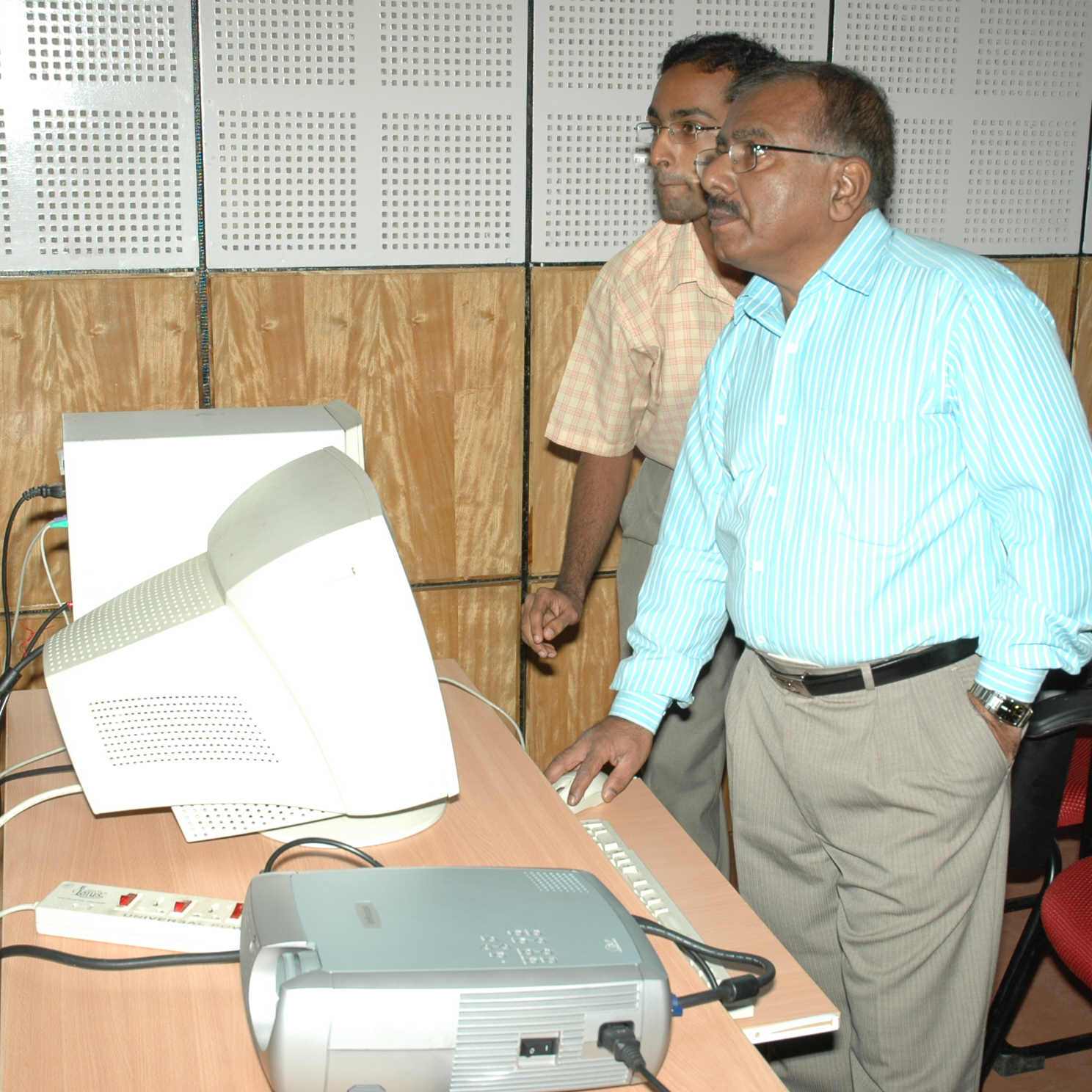
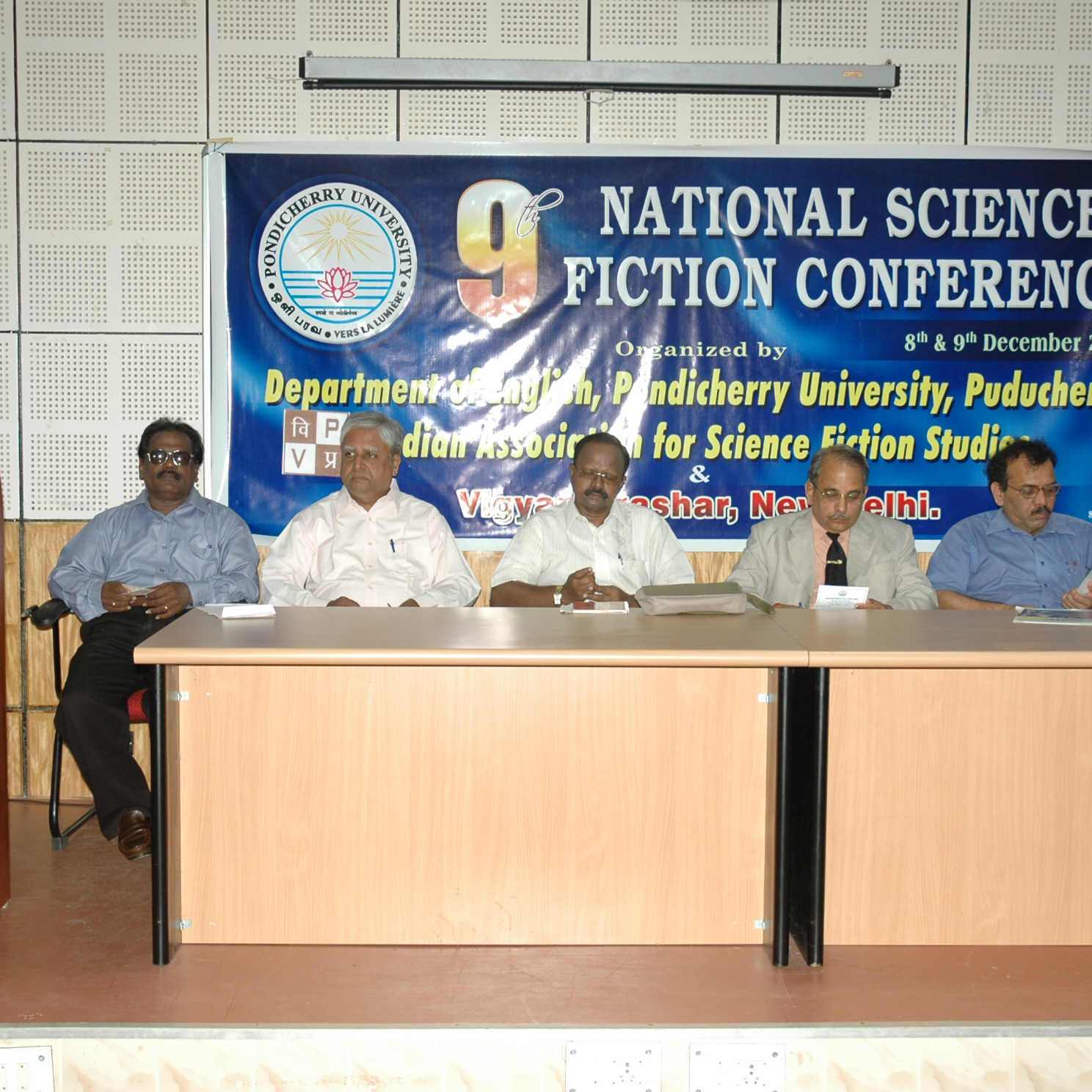
The 9th National Science Fiction Conference was held December 8-9, 2007 at Pondicherry University in Puducherry, India. Vignyan Prasar (an organization for the popularization and propagation of science & technology, and an autonomous body under the Department of Science & Technology in the Indian government) and the Department of English at Pondicherry University joined with the Indian Association for Science Fiction Studies (IASFS) in organizing the conference. More than 200 delegates from various parts of India, students of the University, and two Americans representing NakedLaw.org actively took part during the sessions. The inaugural function was followed by eight sessions of 28 paper presentations with themes including “Science in Science Fiction”, “Science Fiction Today”, “Science Fiction Theme: Time”, “Science Fiction: The Human Aspect”, a story reading session, a replay of a video conference featuring James Gunn, “Science Today”, “Science Fiction in Vernacular Languages”, and a concluding valedictory function.

After the traditional Indian invocation ceremony, Dr. Natarajan Professor (head of the Department of English) welcomed the distinguished guests and delegates. Dr. Clement S. Lourdes, coordinator of the program, explained the scope of the conference. While reading the Annual Report, Dr. Srinarahari (the General Secretary of IASFS) thanked the editors and publishers around the world for publishing reports on previous conference proceedings in Locus, Concatenation.org, Emerald City, SFS.org; for the full-length articles by Andrew Sawyer and James Gunn; and for the publication of articles in German and Spanish by Nova and Axxon respectively. In addition, he thanked the National Book Trust, various Indian Universities, and other public and private organizations for conducting SF sessions and special lectures, promoting research, and instituting awards for Indian SF authors.

In his address, IASFS President Dr. Purushothaman said SF is important because it can change the attitudes of people. Quoting Isaac Asimov’s observation about rational man in an irrational world, he spoke on the concept of the unification of minds. In his inaugural speech, Dr. Kannan (the Honorable Vice Chancellor of Thiruvalluvar University, Tamil Nadu) expressed his happiness in inaugurating the conference. As a scientist, he stated that SF provides authenticity and develops scientific spirit and temper. He said the conference was a turning point, and expressed his concern that though most of the people write, there is lack of readership. He called on the younger generation to read and write extensively. Showing immense concern about future science ventures, he said, “Though the sea is beautiful and bountiful, marine plants and animals are endangered. Little work has been done in the area of marine biology. Therefore, exploration of the possibilities of preserving and developing research in the unexplored vast regions of the undersea world is the need of the hour.”

In his keynote address, Dr. Balaswamy, a retired professor of English, recalled that in the previous conference the theme was “Grain”, and spoke on the relevance of the focus on Science in Science Fiction. He said students should learn about the second law of thermodynamics at the same time they’re learning about Shakespeare, and that there should be a culmination of science and fiction. SF is predictive genre, and a literature of change, and hence it explores “what if…” He concluded by saying humanity is software and science is hardware, and there should be a marriage between the two.

Dr. Subodh Mohanti spoke about the organization Vignyan Prasar and explained its goal of fostering the spirit of science and technology at various levels in the country. In popularizing science, the projects should reach the rural India. He expressed his wish that vernacular languages should produce qualitative and quantitative literary works — one of the aims of Vignyan Prasar is to encourage young writers. Since readers and writers are humans, SF must stress the human angle.

The IASFS publication division published Understanding Science Fiction by Drs. Srinarahari & Purushothaman. Concise and comprehensive, the book combines a brief account of the origin, history, concepts, forms, and themes of the genre with an exhaustive bibliography. Dr. Panneer Selvam explained the book is useful for students, teachers, research scholars, and to readers new to SF.

The Sessions held during the two-day conference:

“Science in Science Fiction”, chaired by Dr. Sujatha Vijayaraghavan, included the following programs: “Dreams Come True” by Dr. Srinarahari; “Hindi Science Fiction: An Overview” by Mr. Manish Mohan Gore; “Material vs Immaterial: Time Travel in Octavia Butler’s Kindred and Gibson’s ‘The Gernsback Continuum'” by Dr. Kalpana H; and “Fictionalizing Christ: A Study of Gore Vidal’s Live from Golgotha by Dr. Binu Zachariah.

“Science Fiction Today”, chaired by Professor Palanivel R, included: “Science Fiction Today: Introductory Note” by Dr. Mukherjee PK; “Ecological Nightmares in Science Fiction” by Ms. Zahirah Banu; and “Scientific Humanism: A Study of the SF Indian film Krrish” by Ms.Zuligah.

“Story Reading by SF Writers” was chaired by Dr. N Natarajan and featured Dr. Deshponde YH, Professor Bhoosanurmutt, Dr. Panneer Selvam, and Dr. Srinarahari.

The fourth session was a replay of a video conference. Before switching on the video, the Honorable Vice Chancellor of Pondicherry University Dr. JAK Tareen expressed the concern that, though man can reach the outer world, not much progress is seen in the area of Earth science. He expressed his happiness over the present conference and wished to provide support in the days to come. The video conference was recorded last year and was replayed for the benefit of the delegates in this part of the country. Professor James Gunn, director of the Center for Science Fiction Studies at the University of Kansas, was interviewed by Mr. Deshponde AP, Dr. Bal Phondke and Dr. Deshponde YH. Dr. Gunn spoke about the genre and his earlier interaction with Indian Scholars on the development of Indian Science Fiction.

“Science Today” was chaired by Dr. Deshponde YH and included: “The Contribution to Indian Science by Azim Premji Foundation” by Mr. Surendranath Banarjee; “The Highlights of Science in P. Tejaswi’s Karvalo” by Manoj CR; “Scientific Fantasy and Reality” by Ms. Prashanth Kumari, and “Science in Asimov’s Foundation Triology” by Dr. Panneer Selvam.

“Science Fiction Theme: Time”, chaired by Dr. Murali S, had: “H.G. Wells’s The Time Machine as a Science Fiction” by Ms. Muneera TR; “Scientific Romance in H.G. Wells’s ‘The Truth about Pyecraft'” by Mr. Arun C; “H.G. Wells’s Conscious, Artistic Envisionment of the Prospective Future of Humankind” by Ms. Lily Sharmila; and “The Time Machine: The Truncated Epic Novel in SF” by Mr. Umashankar S.

“Science Fiction: The Human Aspect” was chaired by Dr. Subodh Mohanti and featured these presentations: “Aliens as Humans” by Mr. Ram Kumar; “Science Fiction as Autobiography” by Mr. Mugundan; “The Thematic Study of Gibson’s ‘Burning Chrome'” by Mr. Shanmugavel P; and “Quest for a Genderless World in Le Guin’s The Dispossessed” by Ms. Parimala M.

“Science Fiction: The Human Aspect (Continued)” was chaired by Dr. Babu Abraham and included: “Man as Prey: The Disastrous Consequences of Namnotechnology — An Analysis of Michael Crichton’s Prey” by Dr. Rashmi; “Adventure as Escape: A study of Jules Verne’s 20000 Leagues Under the Sea and Michael Crichton’s Congo” by Mr. Raju Parghi; “Promise or Peril: Fear of Machine in Asimov’s The Caves of Steel and Jayanth Narlikar’s Waman Didn’t Return” by Mr. Vishnu Patil; “Science Fiction and Fantasy” by Dr. Michael Vishwamitr; and “Science Fiction in Vernacular Language — ‘Tamil Science Fiction'” by Dr. Arivunambi.

Dr. VC Thomas Dean, School of Humanities of the University, gave the valedictory address, the felicitation lecture was given by Dr. Bapu Abraham and Dr. Purushothaman presided over the function. Dr. Natarajan and Dr. Mohanti were on the dais. Professor R Bhosnurmutt proposed the vote of thanks, and the conference closed with a singing of The National Anthem. The Tenth National Science Fiction Conference is proposed to be held during October — November 2008 at Varanasi, Uttara Pradesh near New Delhi.

M.H. Srinarahari

((()))

7th Conference Report:

((()))

Updating Shortly:

The team is searching for the reports, proceedings, brochures, program list, photographs, videos, scholarly papers, and keynote address in each of the missing conferences in the above list. They might be in the form of A drive or B drive floppy discs,CD’s, video cassettes, and wordstar files. Attempts are being made to upload the missing conference reports shortly.

Dr.Srinarahari Secretary – General, for Team IASFS.

((()))