20th Annual National Virtual Science Fiction Conference

Indian Association for Science Fiction Studies (R), Bangalore, Karnataka, India had orgainzed the 20th Annual Conference in collaboration with ISFWA, Ayodhya, UP; Marathi Vidhyan Parishad, Mumbai; Malayalam SF Writers Association, Kerala, Kalpabiswa, Kolkata, and the host institution Deogiri College, Aurangabad, Maharashtra State. The following links connect to the details like the brochure, program link, proceedings, Guest lectures, plenary sessions and other activities of this mega event:

Video Links:-

https://www.youtube.com/channel/UCVZoHvVUK1Rnv9dZjrUiNww

https://www.adbhut.in/2021/09/events/damien-walter-20th-annual-national-virtual-science-fiction-conference-india/

https://www.adbhut.in/2021/09/magazine/issue-32/mugdha-sinha-20th-annual-national-virtual-science-fiction-conference-india/

https://www.adbhut.in/2021/09/magazine/issue-32/dr-bal-phondke-20th-annual-national-virtual-science-fiction-conference-india/  https://www.adbhut.in/2021/09/magazine/issue-32/dr-m-h-srinarahari-20th-annual-national-virtual-science-fiction-conference-india/ https://www.adbhut.in/2021/09/magazine/issue-32/dinker-charak-20th-annual-national-virtual-science-fiction-conference-india/

https://www.adbhut.in/2021/09/magazine/issue-32/dr-arvind-mishra-20th-annual-national-virtual-science-fiction-conference-india/

https://www.adbhut.in/2021/09/magazine/issue-32/t-gautham-shenoy-20th-annual-national-virtual-science-fiction-conference-indiahttps://www.adbhut.in/2021/09/magazine/issue-32/supriyo-das-20th-annual-national-virtual-science-fiction-conference-india/

https://www.adbhut.in/2021/09/magazine/issue-32/dip-ghosh-20th-annual-national-virtual-science-fiction-conference-india/

https://www.adbhut.in/2021/09/magazine/issue-32/sowmya-murukesh-releases-insight-20th-annual-national-virtual-science-fiction-conference-india/

https://www.adbhut.in/2021/09/magazine/issue-32/dr-shantala-on-her-book-3019-ad-20th-annual-national-virtual-science-fiction-conference-india/

https://www.adbhut.in/2021/09/magazine/issue-32/dr-kiran-kumar-singh-on-his-book-the-five-friends-battle-against-aliens-20th-annual-national-virtual-science-fiction-conference-india/

Authors are requested to contribute their unpublished Indian Science Fiction Short Stories in the Peer Reviewed ISBN Numbered Journal.

Life Membership is open now.

Indian Association for Science Fiction Studies (R), Bangalore is a non- profitable association and requires your support in becoming a life member. The life membership is open for all who are 18+ without any restrictions. Hence, we request you to become a member and spread a word to your contacts to support us. The subscribers may kindly mail me the contact details to iasfsindia@gmail.com; to enable the office to send them the original receipt after the payment of the prescribed fees of INR 2000/- made through any mode like Net Banking, Credit/ Debit card, wallet and others by clicking on the link:

https://docs.google.com/forms/d/e/1FAIpQLSeo8ZEYjyNytmMPM7JfcgLtJgjmy0rHGa3TZRsB99uLRvqKDw/viewform?usp=sf_link;

https://www.instamojo.com/@drsrinarahari/

Complimentary metallic Badge will be sent along with the receipt.

-Dr.Srinarahari Secretary – General, IASFS, Bangalore

Help for researchers and story writers in the area of SF;

IASFS team proposes to give guidance to those who are pursuing Ph.D. in the field of Science Fiction in consultation with their respective supervisors. However, those who wishes to pursue Ph.D. or wishes to write research papers could get the guidance from the team.

Further, the team will hold 5 days’ workshop for those who wishes to learn to write the Science Fiction short stories and publish them. Each batch will have one hour class for five days as a crash course. The course will impart about Science Fiction; art of writing; read classics/models/develop the stories from outlines/themes/subthemes/inter-disciplinary topics. Contact: iasfsindia@gmail.com; http://www.urbanpro.com/indian association for science fiction studies.

IASFS:

Indian Association for Science Fiction Studies (R), Bangalore, Karnataka State, India is a non- profitable registered association under Karnataka State Society Act. It was established on January 2, 1998. It aims in popularizing Science and Science Fiction; promoting Science Fiction Research; to provide a common platform for all sections of the society to partake in its activities like annual conferences, seminars, workshops, interactive sessions with other life members and the experts in the field. You are free to browse through various sections of the website to know the past activities before you make up your mind to become a life member.

IASFS has organized 14 National and 5 International Science Fiction conferences at different locations in India. The first conference was attended only by a dozen delegates. But from the second conference there was no turning back. The Association had begun to collaborate with many Colleges, Universities, Local Bodies and Institutions in organizing conferences. Hence, it could bring together hundreds of   academicians, scholars, scientists, writers, publishers, critics, movie makers, journalists, fans, webmasters, industrialists, technologists, farmers and readers.  So far the Annual Conferences were held at Chennai, Coimbatore, Gandhigram, Gudiattam and Vellore in Tamil Nadu, Bangalore, Yelahatti and Mysore in Karnataka, Varanasi in UP, Aurangabad and Pune in Maharashtra States, Pondicherry a Union Territory and Kochi/Ernakulum in Kerala State in India. During the annual conferences, participants have shown keen interest in discussing the following topics: the forms of science fiction, Artificial Intelligence, Cinema and SF,  “Science Fiction Film : Seventy Years of Synergy, 1926 to 2003”, Aliens, A Tribute to Kalpana Chowla,  Technology and Science Fiction, Fantasy, Genetic Engineering, Hindi SF, Indian Responses to World SF, Indian SF in Vernacular languages, Literary Criticism on Indian SF, Myth, Fantasy, Utopia, Feminism, Colonialism, Popular Science, Genetic Engineering, Robotics, Media and SF, Information Technology, Nanotechnology, Print versus Visual SF, Science and Science Fiction, Space travel, Time, Science Fiction Today, Science Today, SF and Mainstream Fiction, Interdisciplinary and Multidisciplinary prospective, SF Narration, SF the Human Aspect, Women in Science Fiction,  SF & Technology  and others. Each conference had plenary sessions and story reading sessions by respective authors in addition to paper presentation. IASFS had also arranged an SF Story Writing Workshop conducted by Eric Miller and story reading session by respective SF writers. The association had a video conference with Professor James E Gunn Director, Center for Science Fiction Studies, Kansas University, Kansas, USA.
The association has held the 19th Annual/5th International Science Fiction Virtual Conference in collaboration with Bangalore University, Bangalore on, December 7,8, 9, & 10, 2020. The unique feature of the conference is that all the 58 PG departments of the University, Sci-Fi fans, media and the general public had converged at “All Roads to Science Fiction” as ISFC -2020. There were themes varying from Myth to advanced technology and to the life in other worlds. The conference was inaugurated by Honorable Chief Minister of Karnataka State, The Honorable Deputy Chief Minister & The Minister for Higher Education, Honorable .Minister for Primary and Secondary Education, Honorable Vice Chancellor of Bangalore University, Nobel Laureate Professor Didier Patrick Queloz (Keynote- Physics 2019), had made their august presence. Plenary sessions, presentations, special lectures, interviews, panel discussions, narrating stories of tomorrow variety of programs from the PG department of Performing Arts and others were the highlights of this mega event.    

You are cordially invited to be a part of the association by becoming a Life Member. It is open for all provided the aspirant is 18+ in age and have maintained good mental record. There is no restrictions of qualification, experience, gender, class, race, nationality and others for the life member aspirants. The life member will have the option to leave the group at any time but cannot claim a refund of the life membership once paid in the beginning. The association will also have the right to remove such members who are reported to have a criminal background, carrying out criminal activities, authentically reported as a member of a terrorist group, or carrying out anti-social, anti-human activities for the destruction of the society or a section of the society without giving any notice or reason – which would not require any explanation to an individual, member or a group or to a registered body or to the court of law.

Please click the link below to become a Life Member of this association. The Life Membership fee is reduced to INR 2000/- only during the pandemic period and for an year more during the post-pandemic period: The link provided has a provision to pay in multiple ways like Debit ATM card, Credit Card, Wallet, Internet Banking and others. Automatically a receipt will be generated and you are requested to intimate over the email: doctorhari567@gmail.com; and iasfsindia@gmail.com; regarding the payment made, your name, address for posting the official receipt for the payment made and to preserve a life membership receipt: https://docs.google.com/forms/d/e/1FAIpQLSeo8ZEYjyNytmMPM7JfcgLtJgjmy0rHGa3TZRsB99uLRvqKDw/viewform?usp=sf_link

Thank you,

Dr.Srinarahari Secretary – General, For Team IASFS, Bangalore, India

19th Annual/5th International Virtual ScienceFiction Conference

IASFS had organized the conference in collaboration with Bangalore University, Bangalore, Karanataka, India during Deember 2020. The unqueness of the conference is that all the 52 PG Departments and affiliated Colleges had joined hands in organizing the mega event. There were 12 channels which beamed simultaneously the event. Science Fiction group events and Performing Arts group event programs were beamed from Channel One. This was led by Dr.Srinarahari Secretary – General, IASFS and Dr. Susheela SN HoD of Performing Arts.The credit goes to the Honorable Vice Chancellor Professor Venugopal KR.

Links for the mega event programs:

Collaborators: BU & IASFS

Brief Report: Channel 1:

Video links:

Valedictory Function:

 Speech of Nobel Laureate; Professor. Didier Patrick Queloz; 2019 for Physics;

Click the following links to access the 18 sessions of Channel I – IASFS Science Fiction group::

  1. https://youtu.be/7qZCSCrg1Xc
  2. https://youtu.be/ZTAy0Rk8Wqc
  3. https://youtu.be/BnNpAzTu94I
  4. https://youtu.be/pq0tDBp960Y
  5. https://youtu.be/7u2W8F9w3kA
  6. https://youtu.be/6hIZexn2Kkk
  7. https://youtu.be/B2DXniJrOHU
  8. https://youtu.be/aO9AISGxx9o
  9. https://youtu.be/figFLMzZpEg
  10. https://youtu.be/C0eBktiAztM
  11. https://youtu.be/AJASgoaimZA
  12. https://youtu.be/BNgTL-7CgRM
  13. https://youtu.be/5zboK4R3K7g
  14. https://youtu.be/xjZuCuL59tQ
  15. https://youtu.be/Z5DlCYuZYvI
  16. https://youtu.be/B2CkIyyWf50
  17. https://youtu.be/-s_jvDRUi28
  18. https://youtu.be/WHZC19ZKc-4

Channel 1 SF Group: Facebook link for all:

https://www.facebook.com/19th-Annual5th-International-Science-Fiction-Virtual-Conference-2020-107585411212794

Haridasa Sangeetha AP

Enhancing music through technology;

YouTube’s links for IASFS Conference – Day 3, Department of Performing Arts, Channel 6.

Session 1 :

Session2

Session 3

Session 4

session 5

YouTube links for IASFS conference: Dept of performing arts.

DAY 2:

Session 1:

Session 2:

Session 3:

PA

DAY 2:

Session 1:

Session 2

Session 3

Session 4

Session 5

Channel 11

PG department of Law:

[09:46, 08/12/2020] +91 99005 14367:

Live Stream on our YouTube channel – University Law College Bangalore:

https://bit.ly/3lOK8hR

Dept of Women Studies

A Report of the 18th National Science Fiction Conference

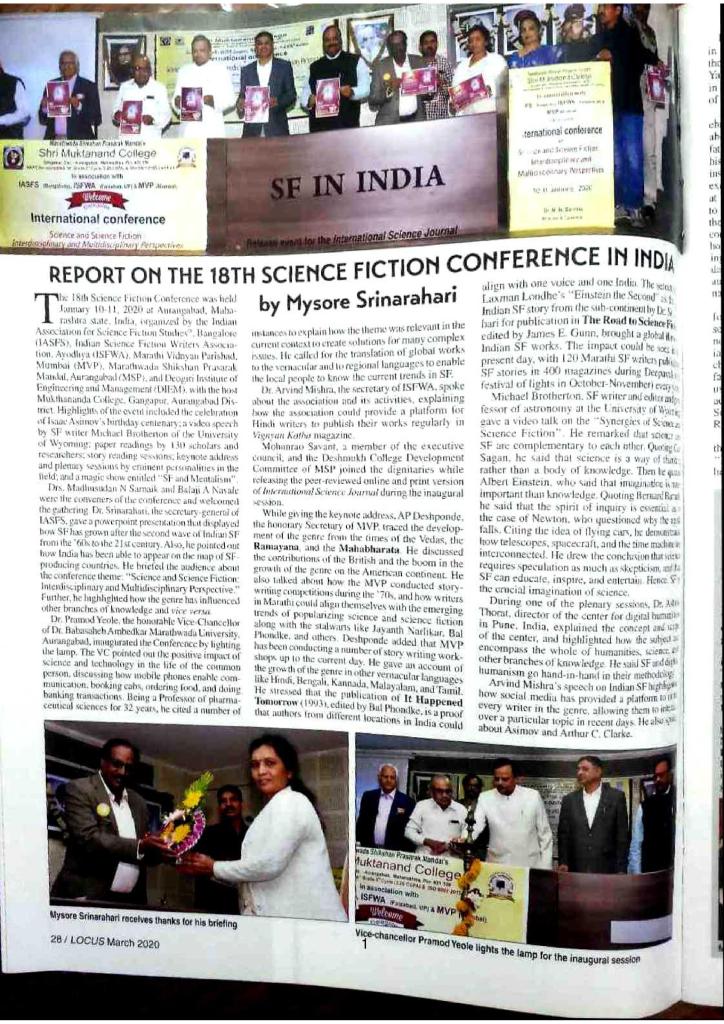
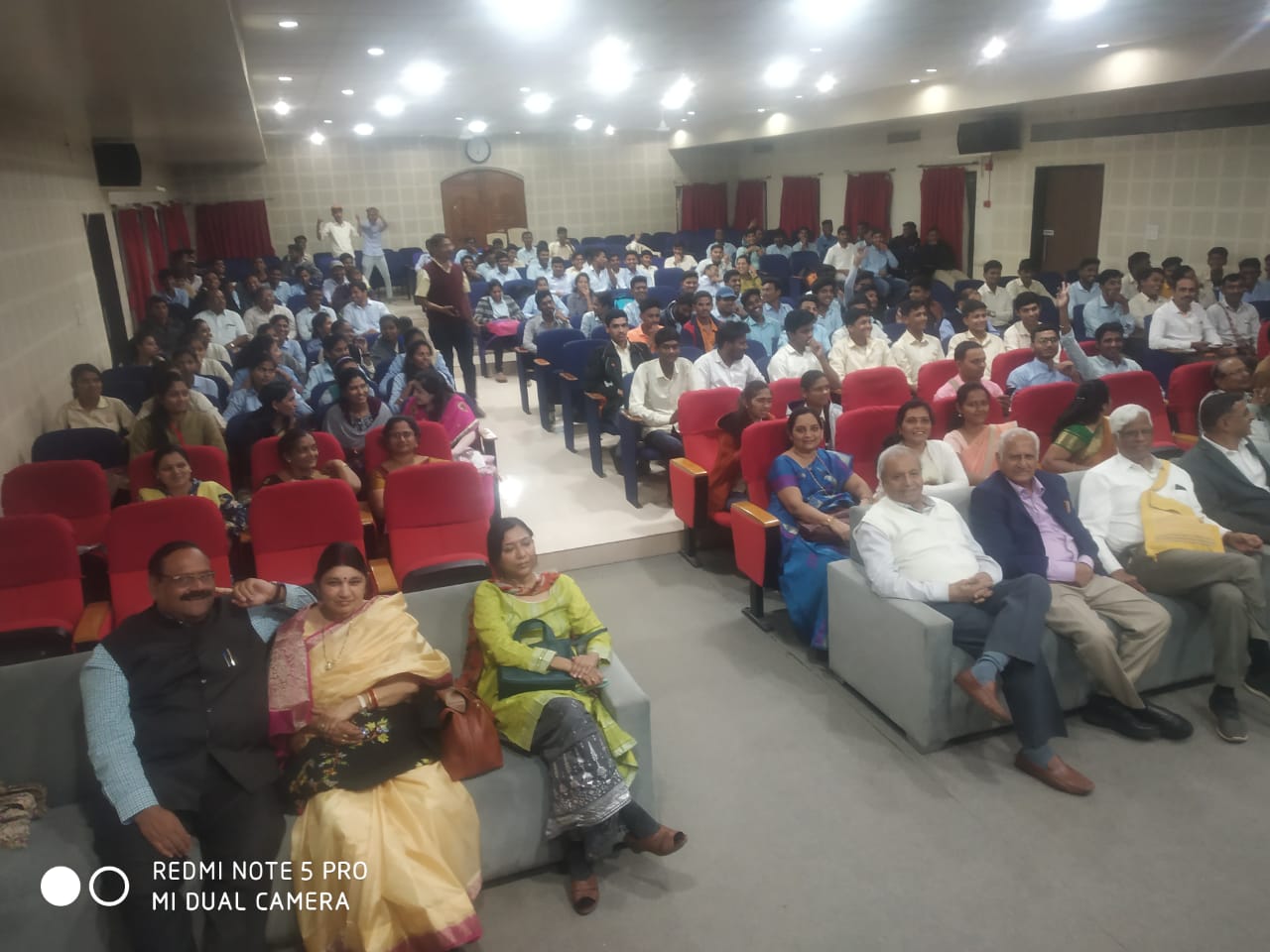
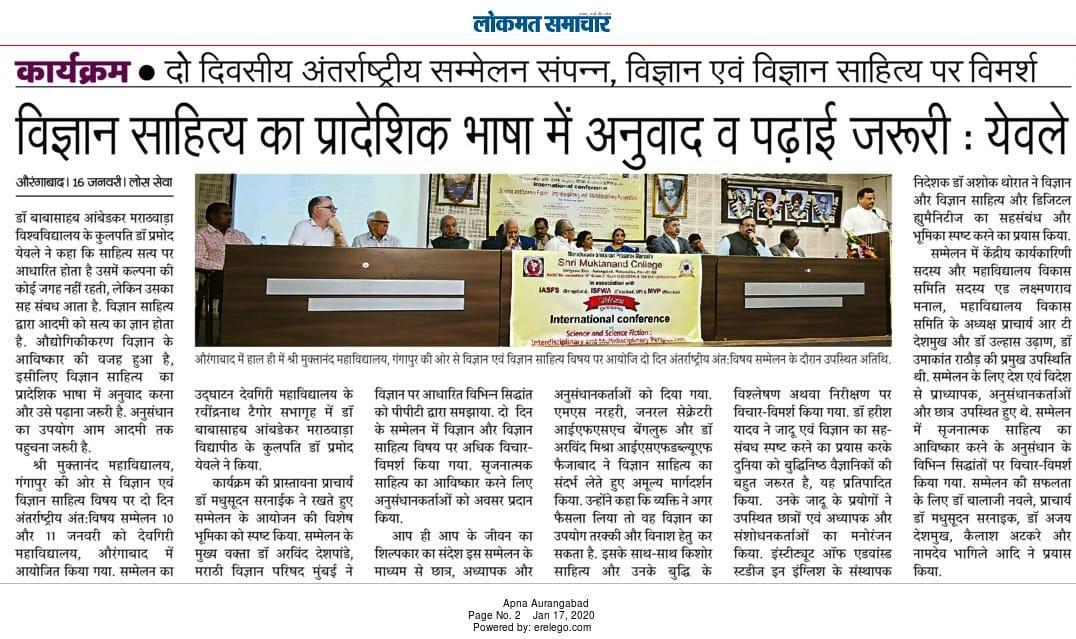
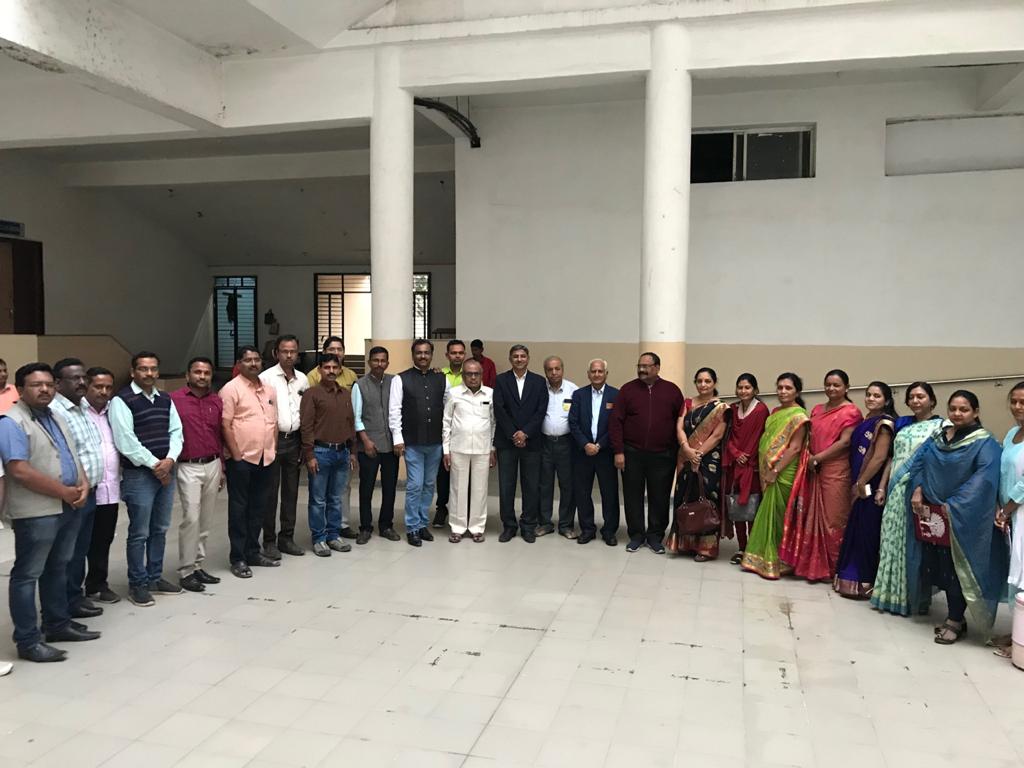
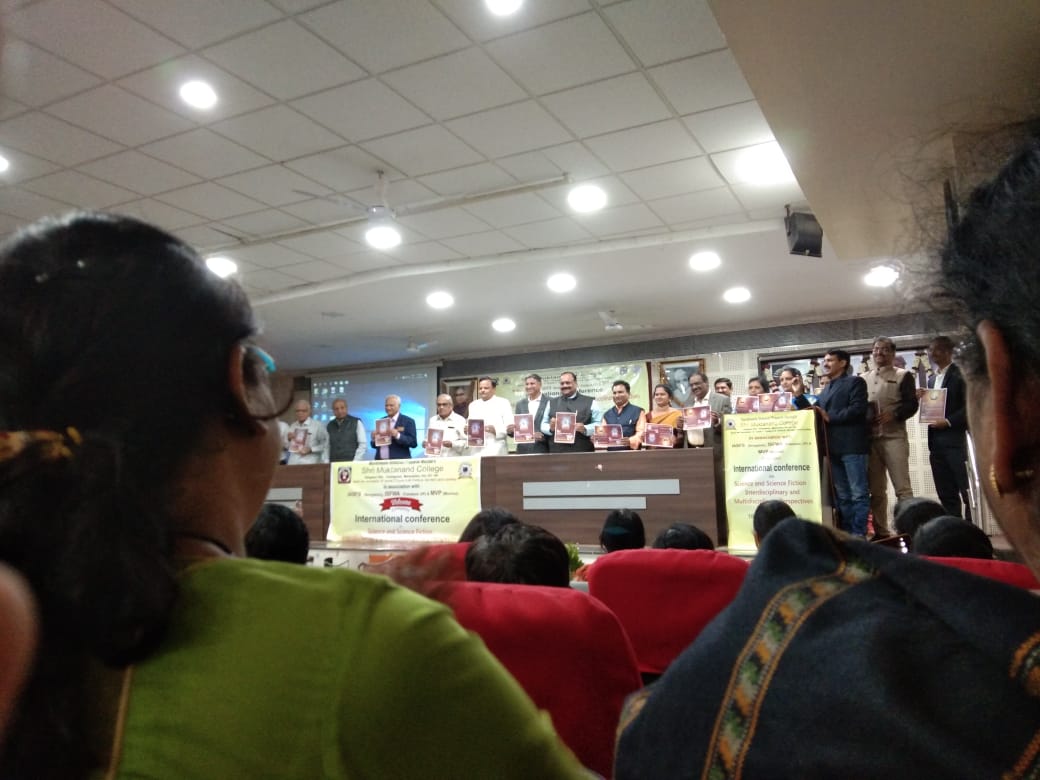
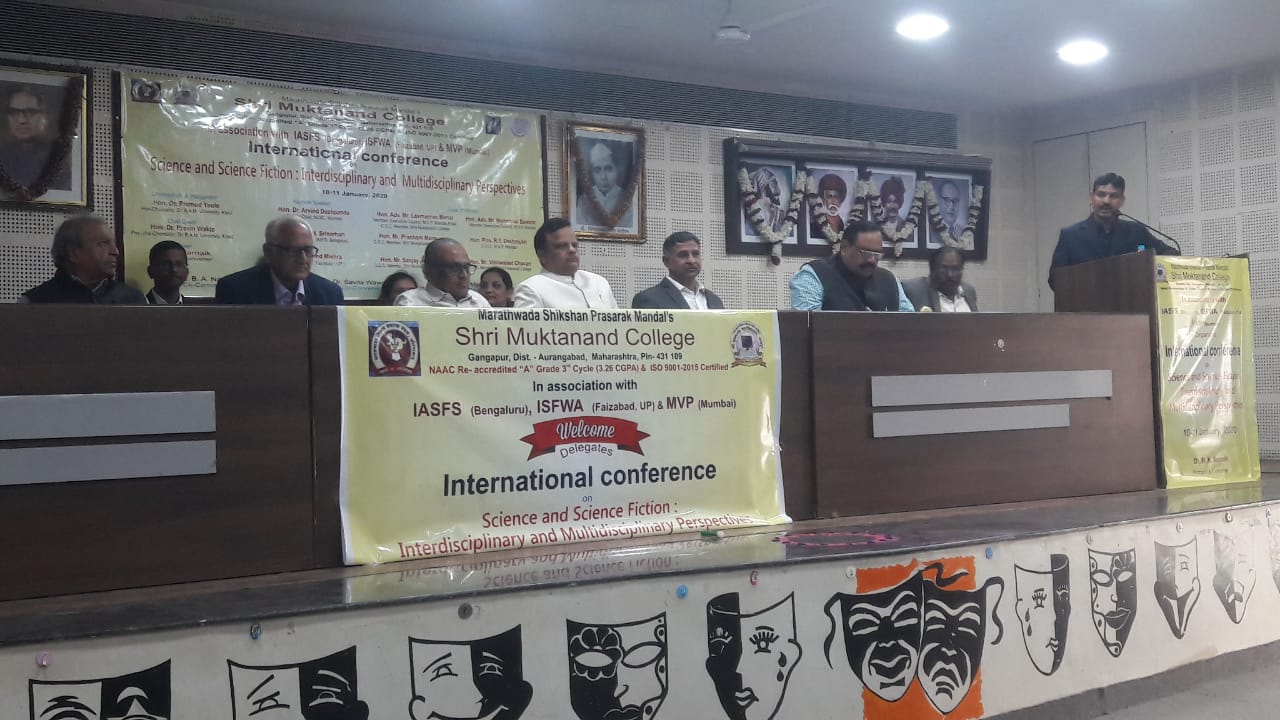
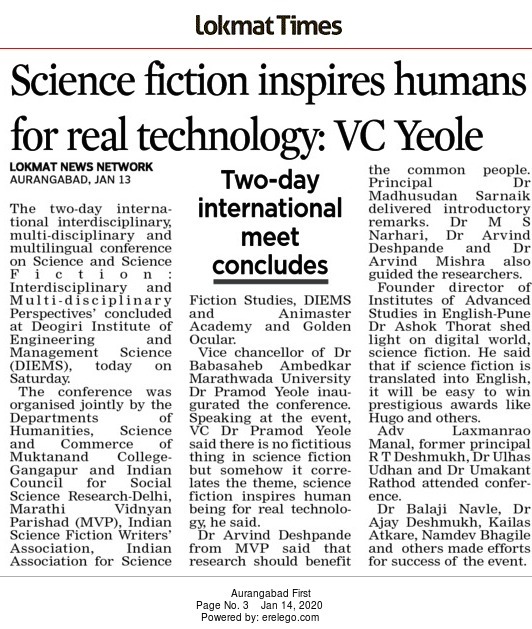
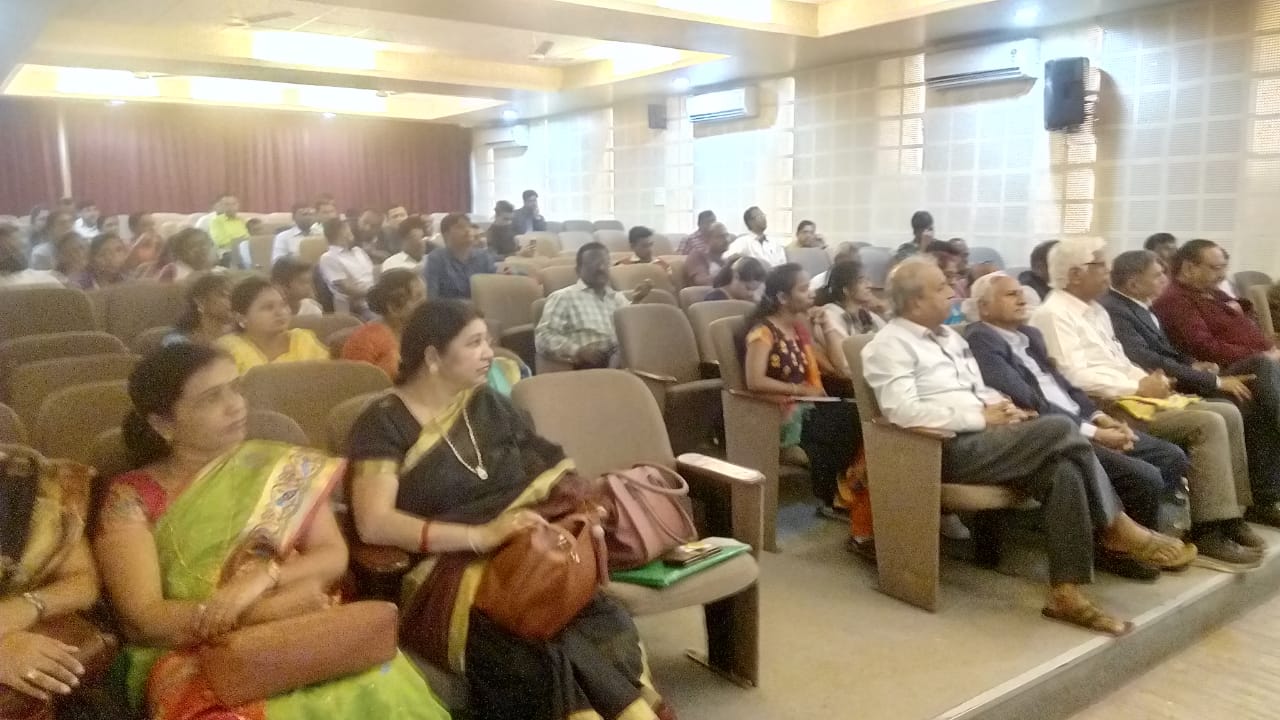
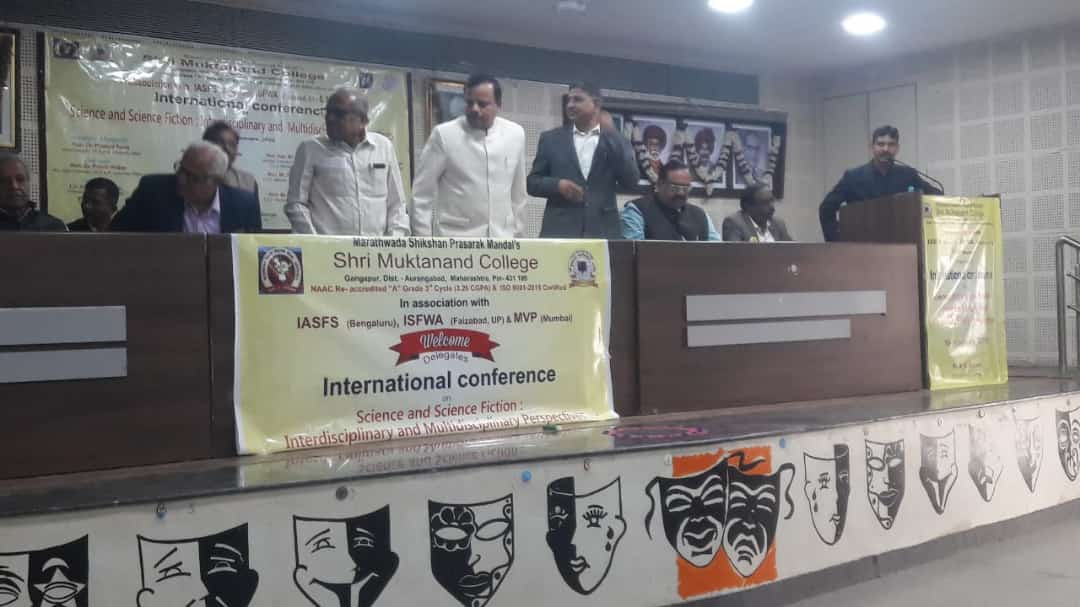
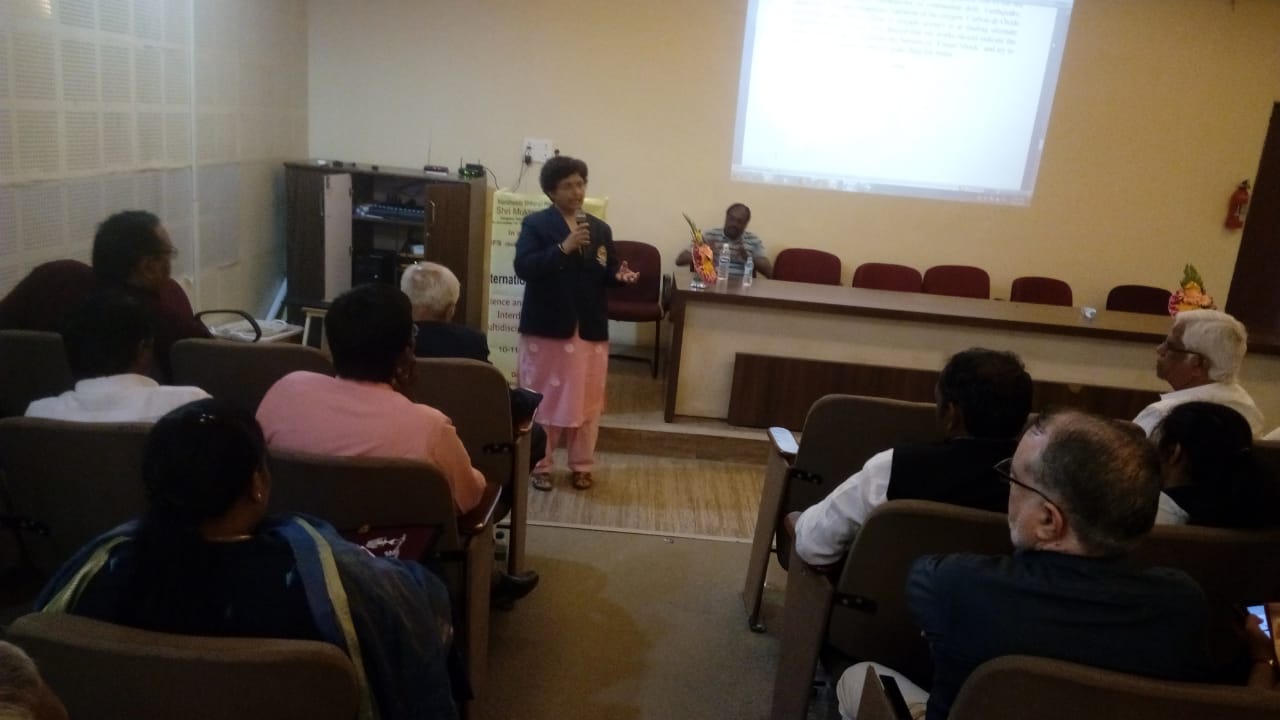
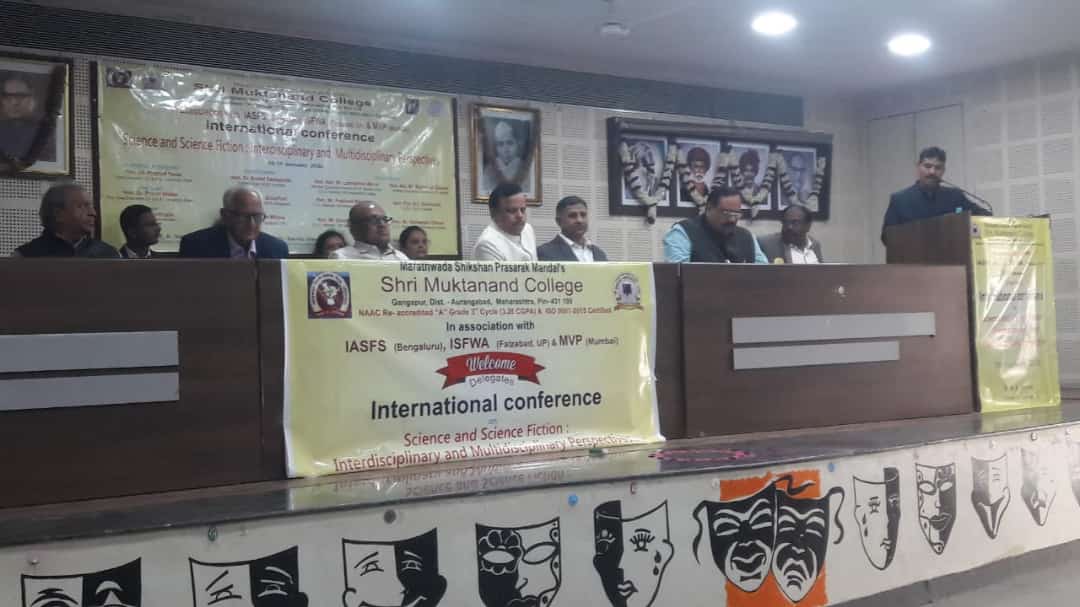
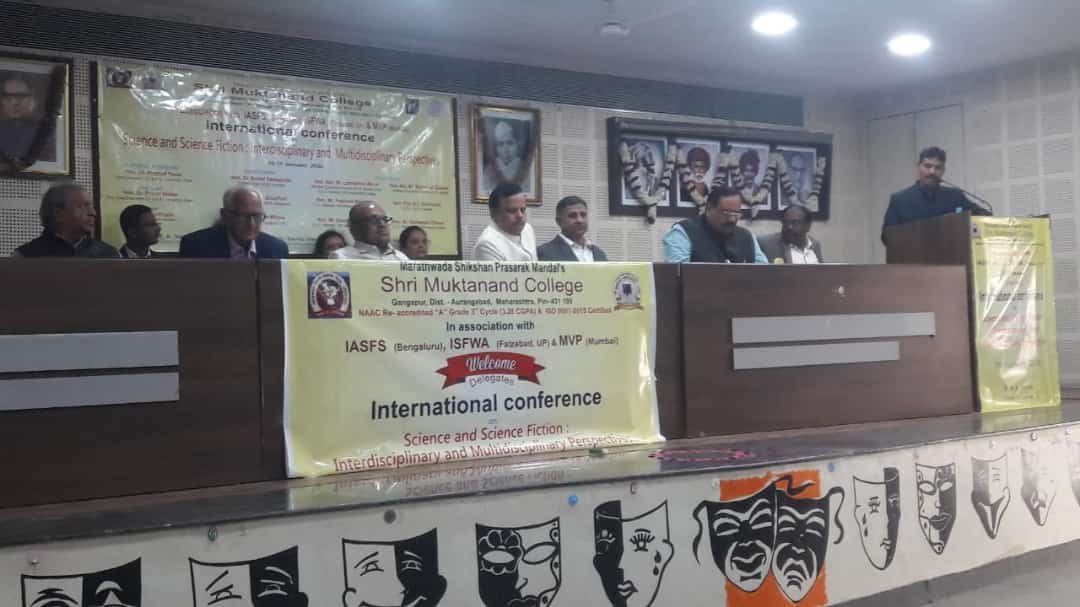
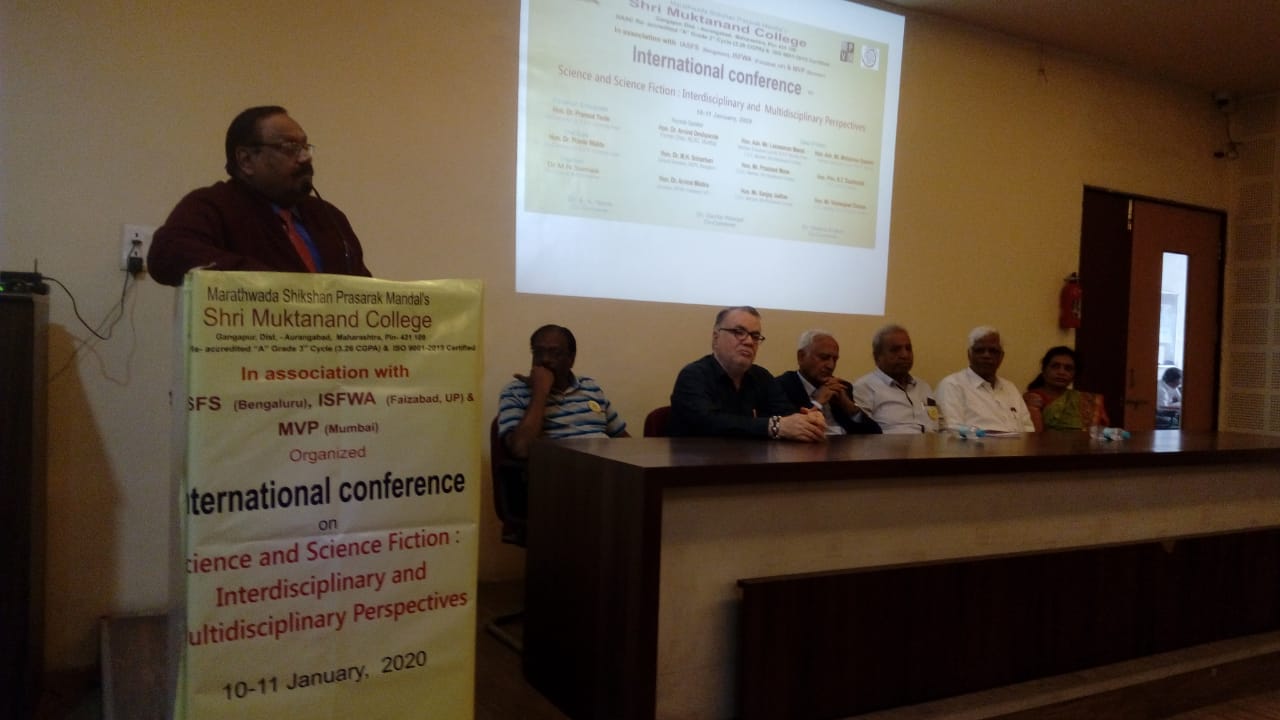
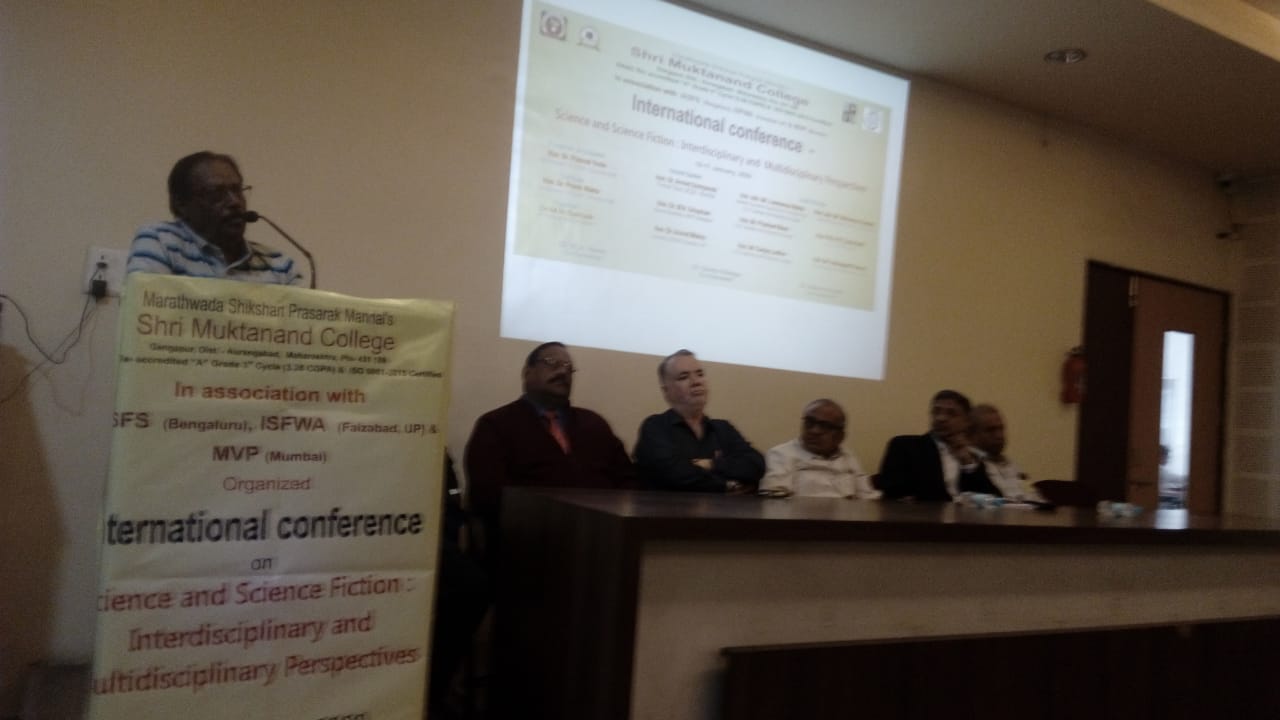
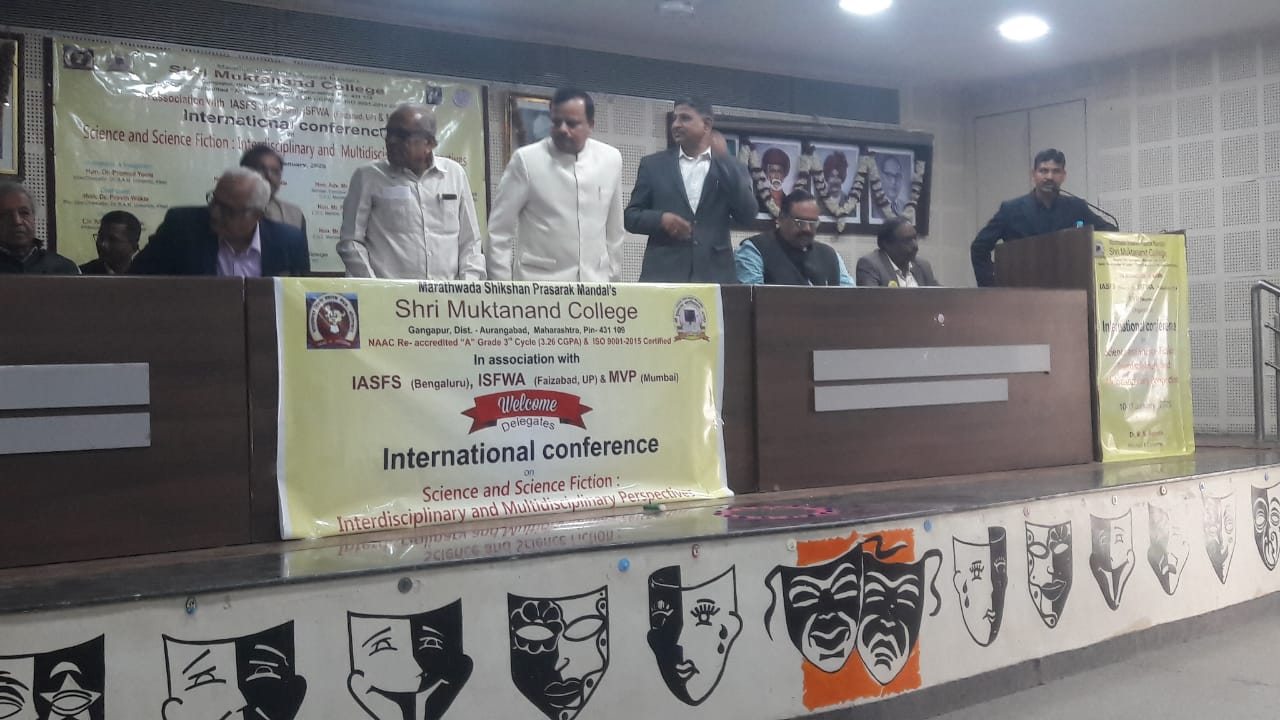
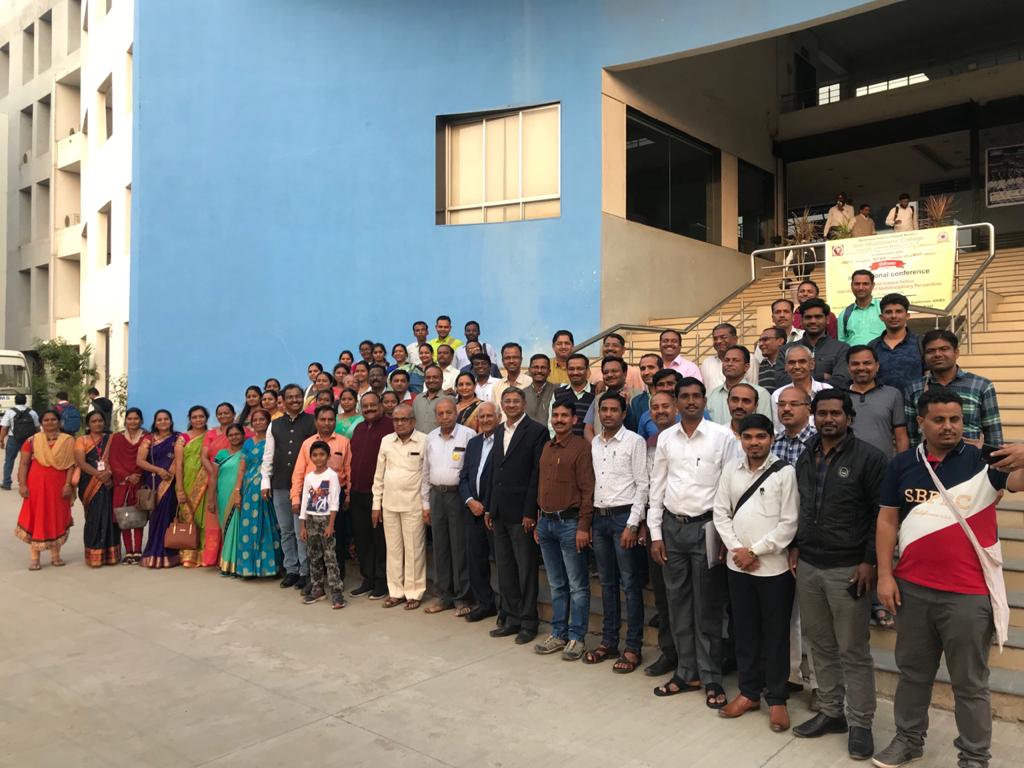
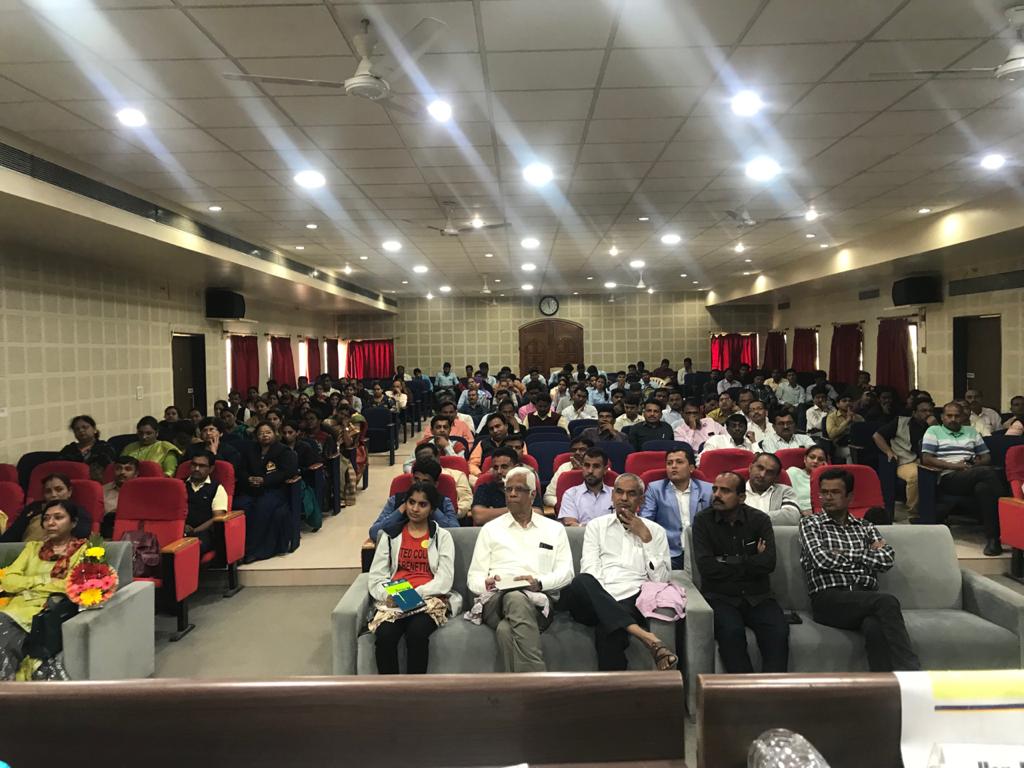
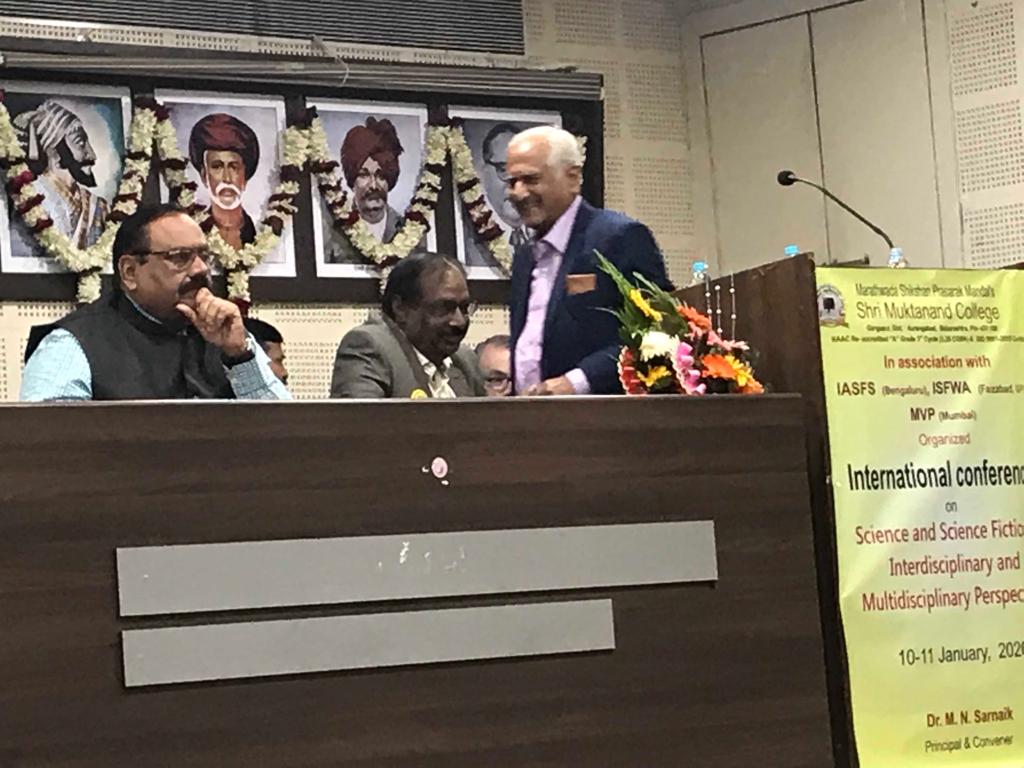
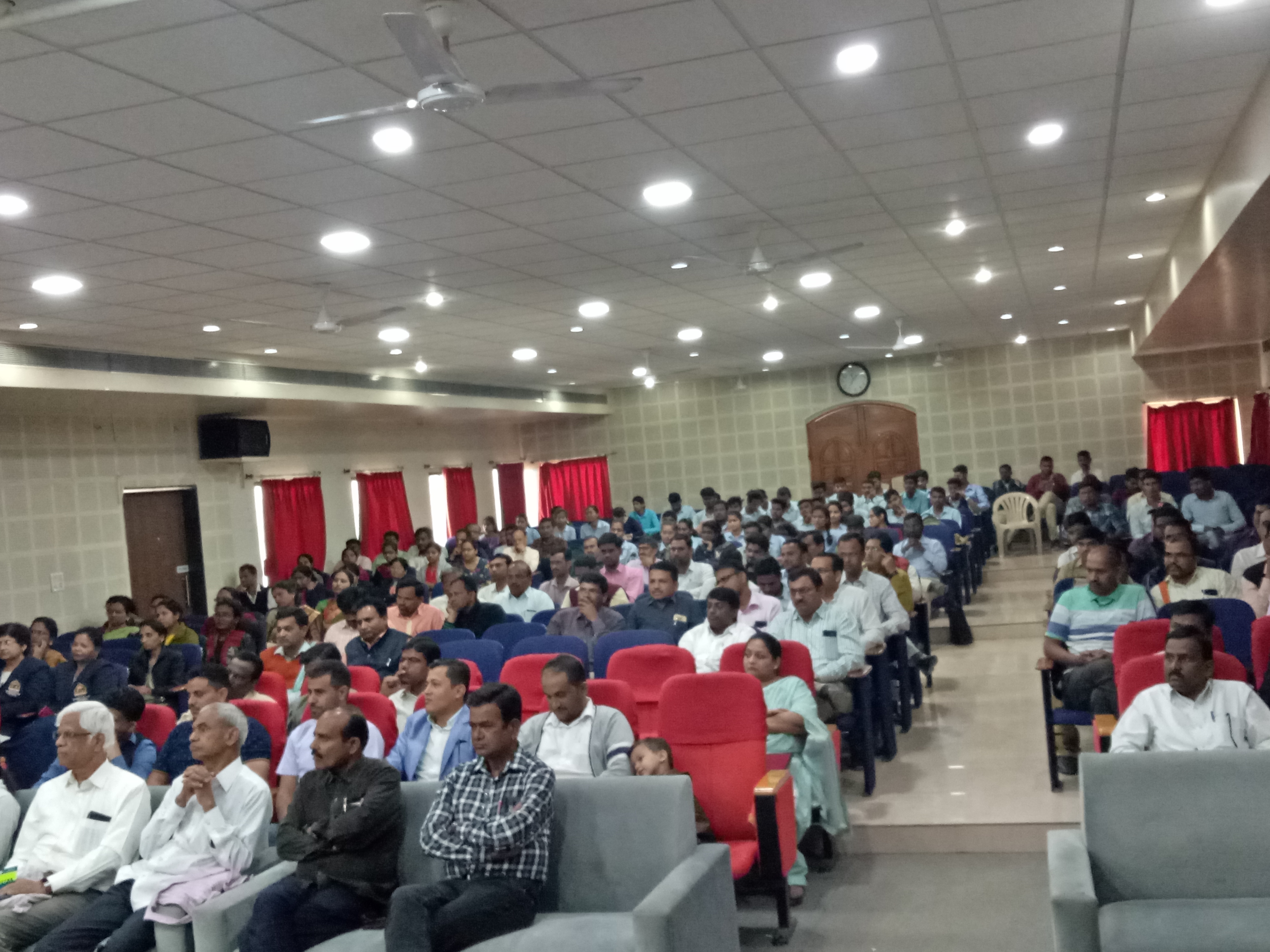
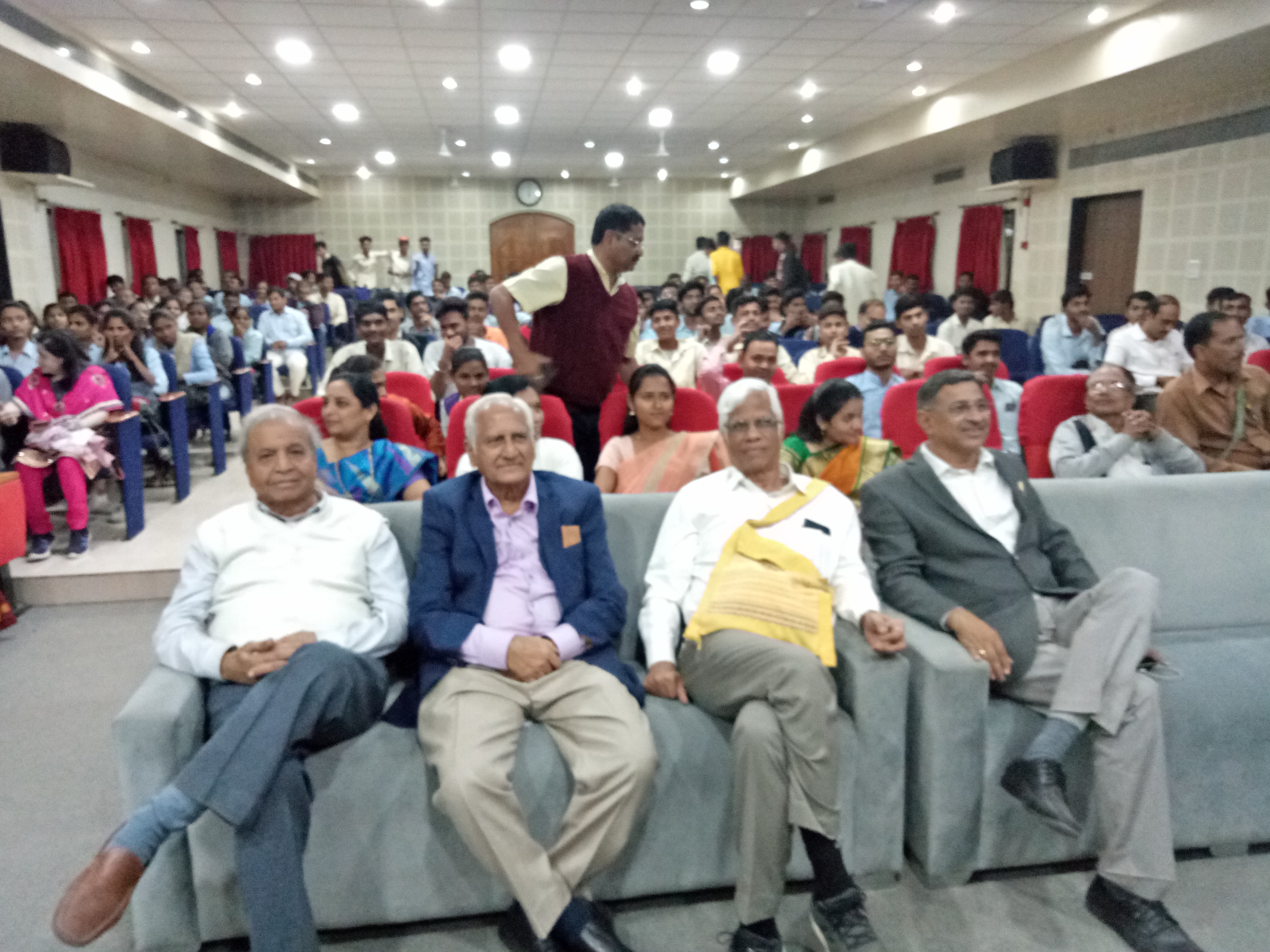
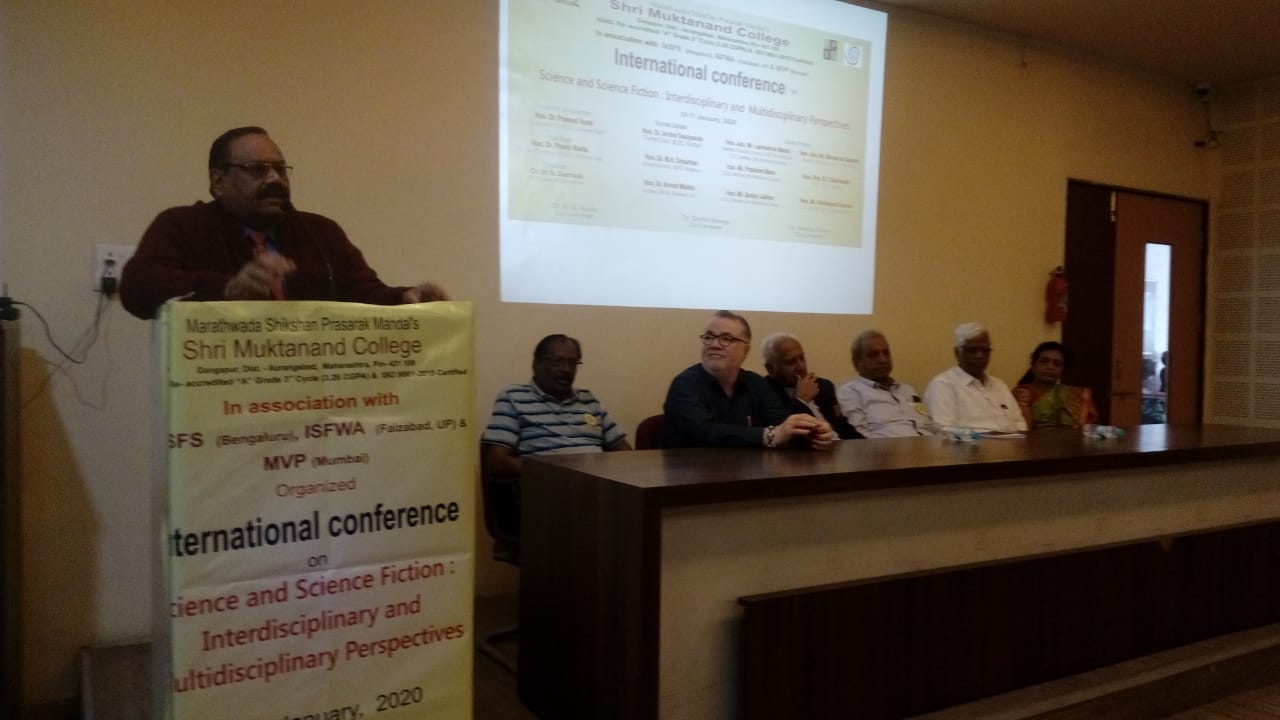
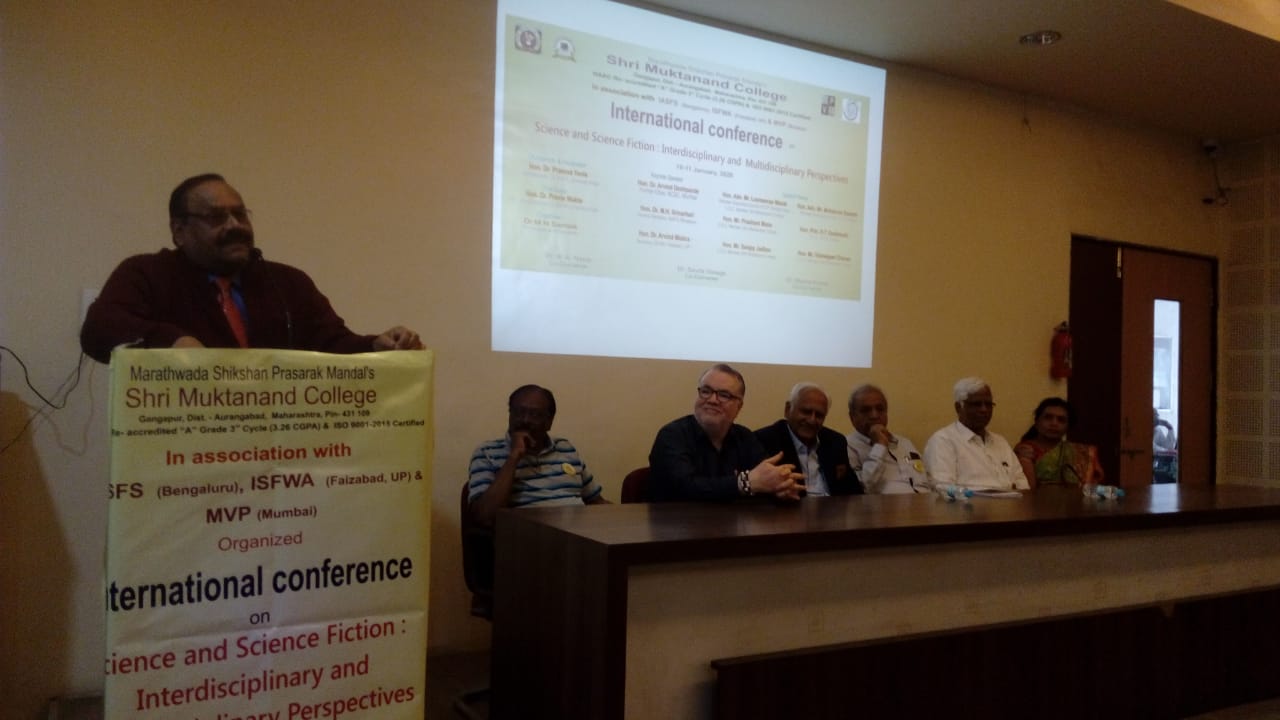
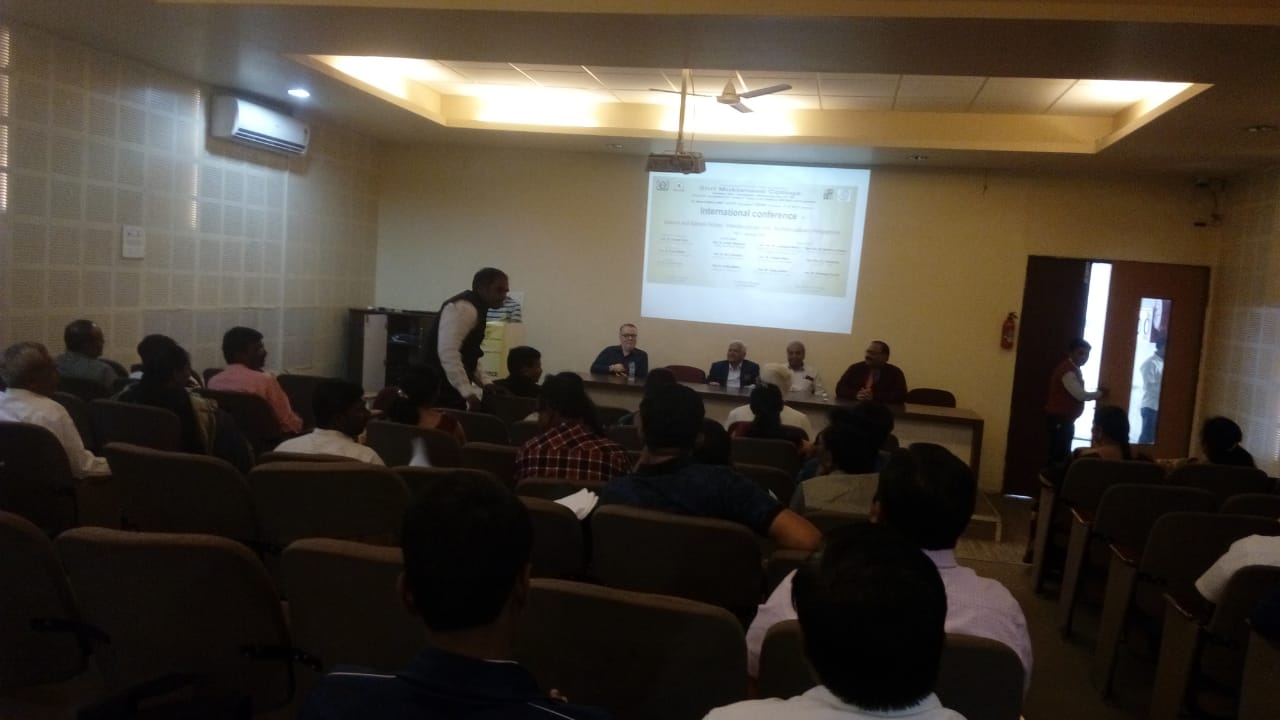
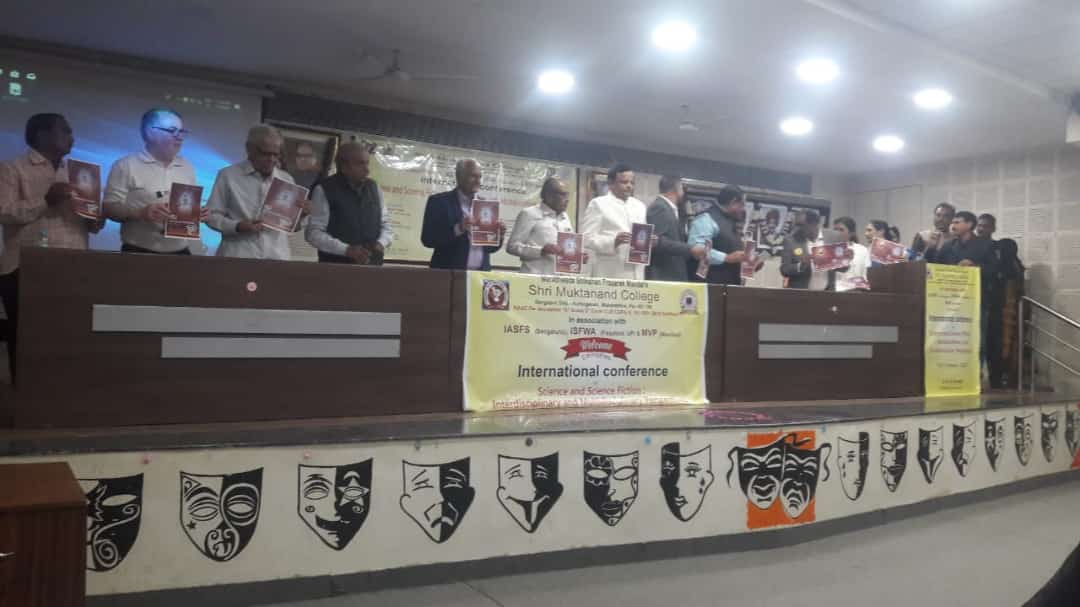
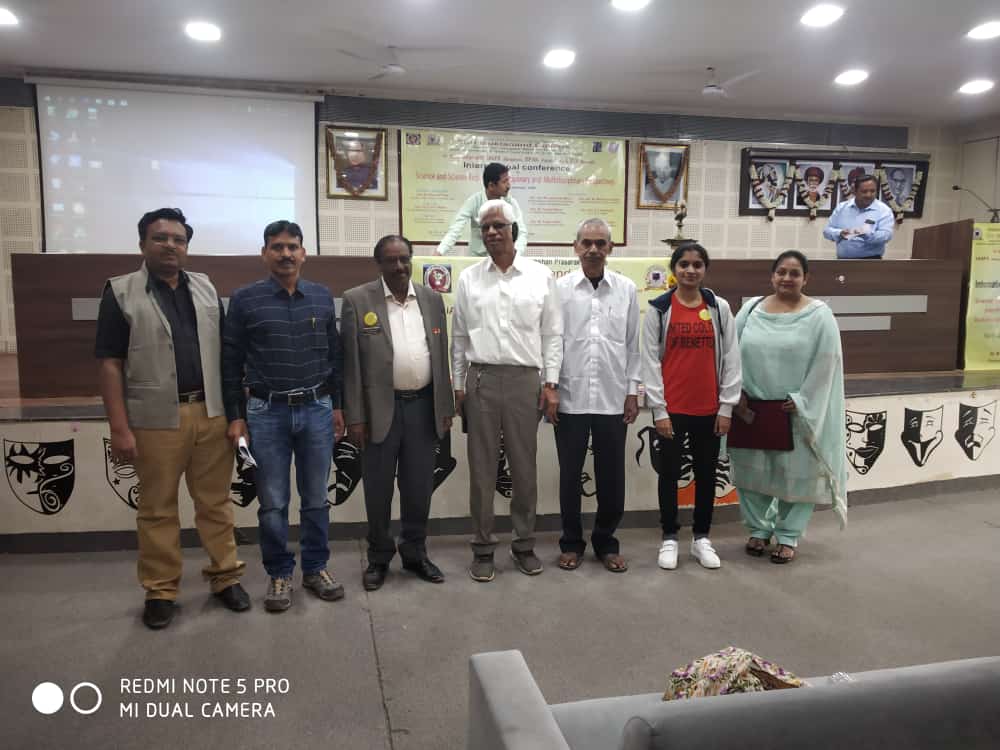
Indian Association for Science Fiction Studies®, Bangalore (IASFS), Indian Science Fiction Writers Association, Ayodhya (ISFWA), Marathi Vidnyan Parishad, Mumbai (MVP), Marathwada Shikshan Prasarak Mandal, Aurangabad (MSP) and Deogiri Institute of Engineering and Management (DIEM) had joined together with the host Mukthananda College, Gangapur, Aurangabad District, in organizing the 18th Science Fiction Conference at Aurangabad, Maharashtra state, India on January 10 & 11, 2020.

The celebration of Isaac Asimov’s Birthday Centenary; video speech by Michael Brotherton, U of Wyoming, the USA; Paper reading by 130 scholars and researchers; story reading sessions; keynote address and plenary sessions by eminent personalities in the field; a magic show entitled “SF and Mentalism” are the highlights of the event.

Drs. Madhusudan N Sarnaik and Balaji A Navale the conveners of the conference welcomed the gathering. Dr.Srinarahari the Secretary-General of IASFS with a power point presentation displayed how the growth of SF has taken place after the second wave of Indian SF from the sixties of the twentieth century. Also, he pointed out how India has been able to appear on the map of SF producing countries. He briefed about the conference theme: Science and Science Fiction: Interdisciplinary and Multidisciplinary Perspective. Further, he highlighted how the genre has influenced other branches of knowledge in their futuristic vision and vice versa.

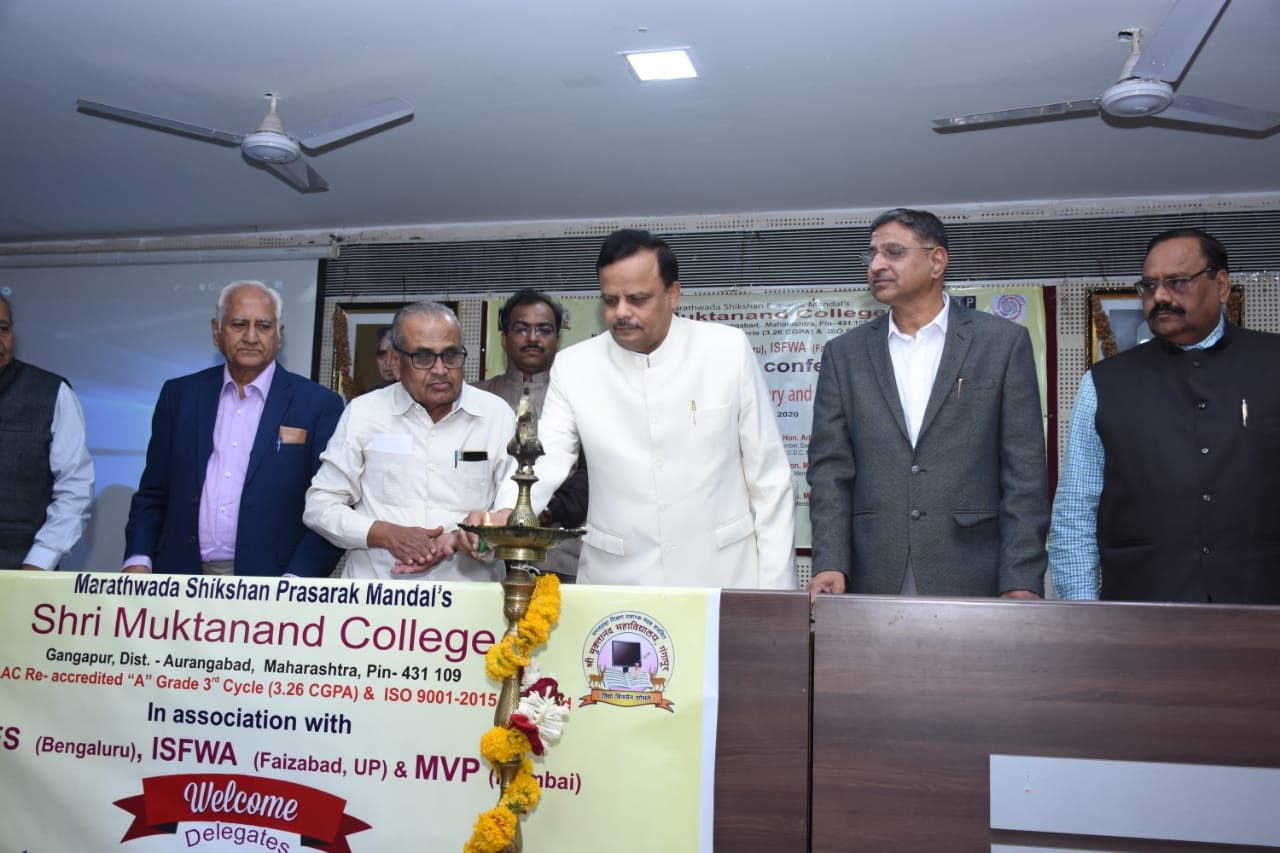
Dr. Pramod Yeole the honorable Vice-Chancellor of Dr. Babasaheb Ambedkar Marathwada University, Aurangabad inaugurated the Conference by lighting lamp. Speaking on the occasion the VC pointed out the positive impact of Science and Technology in the life of common man in the street. He highlighted how the mobile being a communication gadget has been providing multiple services for booking cabs, ordering food, and carrying on banking transaction. Being a Professor of Pharmaceutical Sciences for thirty-two years, he cited a number of instances to explain how the theme was relevant in the current context to churn out solutions for many complex issues. He called for the translation of global works to the vernacular and regional languages to enable the local people to know the current trends in this direction.

Dr. Arvind Mishra the secretary of ISFWA spoke about the association and its activities explaining how the association could provide a platform for the Hindi writers to publish their works regularly in Vignyan Katha magazine.

Mr. Mohanrao Savant Member of the Executive Council, and Mr. Deshmukh  College Development Committee  of MSP joined the dignitaries while releasing the peer-reviewed – online and print version of  International Science Journal during the inaugural session.

While giving the keynote address Mr.AP Deshponde the honorary Secretary of MVP traced the development of the genre from the times of the Vedas, the Ramayana and the Mahabharata. He traced the contributions of the British, and the boom in the growth of the genre in the American continent. He also pointed out how the MVP could conduct the short story writing competitions during the seventies and how the writers in Marathi could align themselves to the emerging trends of popularizing Science and Science Fiction along with the stalwarts like Jayanth Narlikar, Bal Phondke and others. Mr.Deshponde added that MVP has been conducting a number of short story writing workshop thereafter till date. He gave an account of the growth of the genre in other vernacular languages like Hindi, Bengali, Kannada, Malayalam, and Tamil. He stressed upon the point that the publication of It Happened Tomorrow (1993) edited by Bal Phondke is a proof to show how the authors of different locations in India could align with one voice and one India. The selection of Laxman Londhe’s “Einstein the Second” as the best Indian Science Fiction story from the sub-continent  by Dr.Srinarahari for its publication in The Road to Science Fiction edited by James E Gunn has brought a global flavor for the Indian SF works. The impact could be seen in the present day with 120 Marathi Science Fiction Writers publishing SF stories in 400 magazines during Deepavali (The festival of lights during October- November) every year.

Professor of astronomy at the University of Wyoming, the USA, Michael Brotherton who is a Science Fiction writer and editor of anthologies gave a video talk on the “Synergies of Science and Science Fiction”. He remarked that Science and SF are complementary to each other.  Quoting Carl Sagan he conveyed that Science is a way of thinking rather than a body of knowledge. Then he quoted Albert Einstein who said that imagination is more important than knowledge.  Quoting Bernard Baruch he said that the spirit of enquiry is essential as in the case of Newton alone who questioned why the apple falls. Citing the idea of flying cars, he demonstrated how telescope, spacecraft, and the time machine are interconnected. He drew conclusion that Science requires speculation as much as skepticism, Science Fiction can educate, inspire and entertain. Hence, he concluded that Science Fiction is the crucial imagination of Science.

During one of the plenary sessions Dr.Ashok Thorat the Director Center for Digital Humanities, Pune, India explained its concept, scope and highlighted how it can encompass the whole of humanities, Science and other branches of knowledge.  He brought out the point how Science Fiction and Digital Humanism go hand in hand in their methodology.

Arvind Mishra speaking on Indian SF scenario highlighted how the social media has provided a platform to unite every writer in the genre and interact over a particular topic in recent days. Also speaking about Asimov he recalled the “Park Avenue Pact” between Isaac Asimov and Arthur C Clarke.

Dr. YH Deshponde brought out facts how the Science Fiction has its roots in Indian mythology right from the days of Veda Vyas the pioneer writer of the Mahabharata. Mr. Harish Yadav presented a paper on “Magic and Mentalism in Science Fiction”. He dealt with the definition of SF, magic, mentalism, and magic in SF in print and movies.

Speaking on the occasion of the birth centenary celebration of Isaac Asimov, Dr. Srinarahari drew out a few anecdotes from the life of Asimov. His long hours of stay at the candy stores, the expression of surprise of his father over his production of a few books, his acknowledgement of gratitude to his father for he who inspired for his writing as he “valued learning”; how excited they were when they could get a telephone connection to their home and an extension to the kitchen; returning to full time authorship like Jules Verne; described  space travel vividly being an acrophobic; considering reading news paper as a change of work in the hospital when he had heart surgery; creative writing and personal habits and aspirations. The speaker described Asimov’s writing his own biographies; authenticity of matter, appealing language, narration techniques, lucidity, and others.

The speaker on the occasion categorized Asimov’s four hundred works and focused on his Science Fiction works: He spoke about the foundation series and robot novels and their culmination in the novel Robots and Empire (1995). Dr.Srinarahari being an Asimovian scholar dealt with his structure, plot, characterization point of view, themes and others. He highlighted that Asimov is alive here with us because of his extra-ordinary ability to sketch the character of Susan Calvin, Kelden Amadiro, Gladia Solaria, Harry Seldon, Elijah Bailey, Robot Giskard, R. Daneel Olivaw and others.

In addition to the speaker’s address in the past dealing with the impact of Asimovian works on Indian SF and the “Indian Response to American Science Fiction”, he enlisted the following Indian scholars who have done research on Asimovian works for which the doctoral degrees were awarded by various Indian Universities. The theses and dissertation works which have focused on Asimov’s works are Prakash S. Rao’s “Isaac Asimov’s Works of 60’s and 70’s: A Study in Scientific Humanism”; Veena’s “Paradoxes of Order in the Fiction of Isaac Asimov”; S.Guruswamy’s “Asimov’s Vision of Utopia in Foundation’s Edge and Foundation and Earth.”Fiat Homo- Let There be Man – Apocalyptic Renewal in Asimov’s Foundation Series” by K.S.Purushothaman; Panneer Selvam’s “Credibility Criterion in Asimov’s Foundation Trilogy”; The Robotistic Works of Isaac Asimov: A Study” by the speaker and the recent contribution of Anand Arul Das who has applied the theory of Post humanism in the works of Isaac Asimov.

Concluding his talk the he explained that Indian Association for Science Fiction Studies®, Bangalore, India was established on the birth day of Isaac Asimov on January 2nd, 1998. Now, the institution is celebrating its 22nd year of its establishment. Asimovian topics were chosen by many scholars in presenting their papers during the last 18 Science Fiction Conferences held in India. Thus, it acknowledges a tribute to the great giant of Science Fiction.
Dr. Yeshwant Deshponde is often referred to as Indian Asimov. Coincidentally, his birth day was on the second day of the conference. Hence, it was celebrated with all pomp. The celebrity was honored by the organizers and participants.

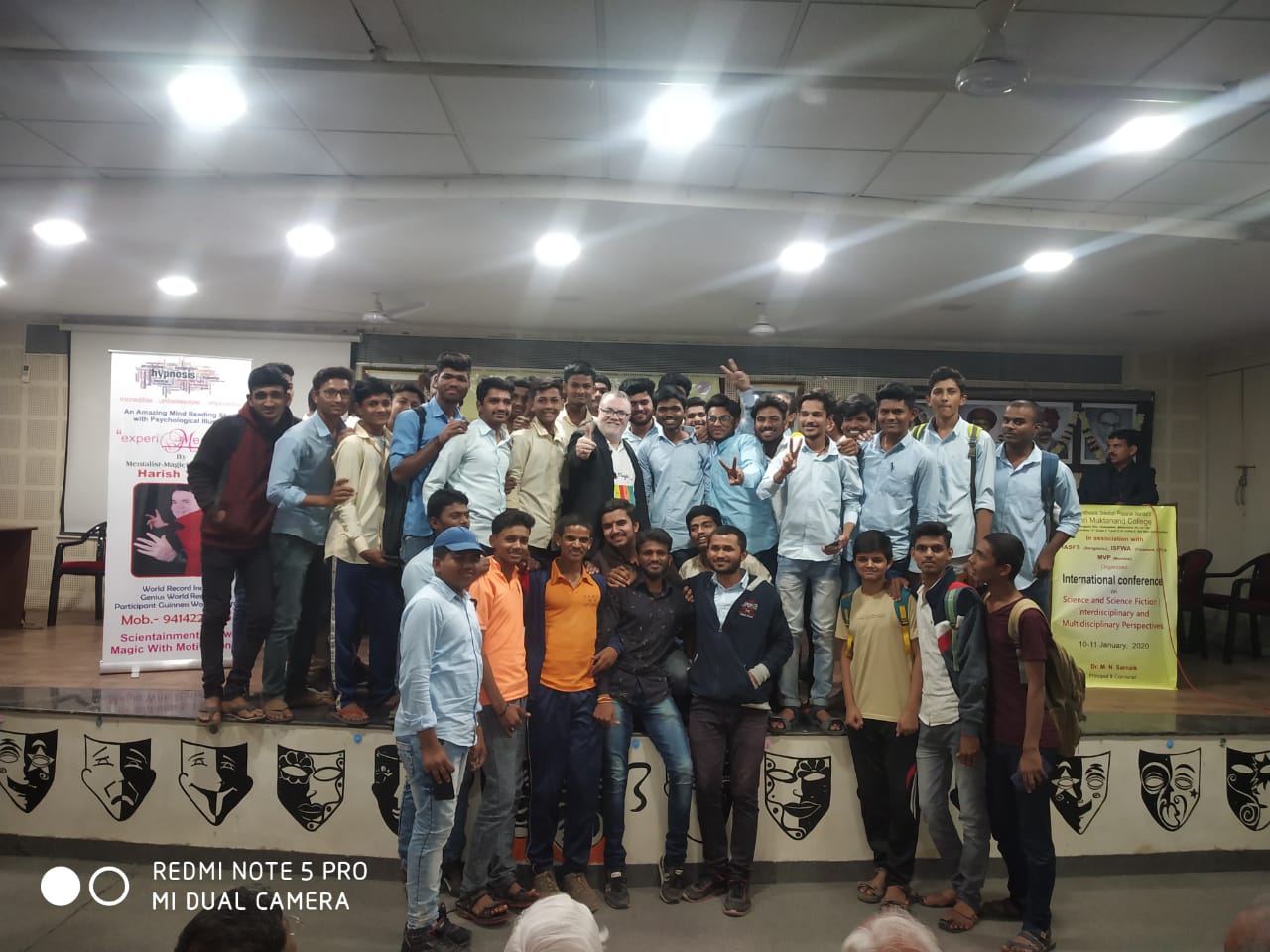
Apart from the presentation of one hundred and thirty papers by the participants, there was a magic show entitled “SF & Mentalism” by Harish Yadav. There was a festive mood, a sense of thrill, a sense of achievement, contentment and gratification among the delegates, participants and the host. This conference has paved way for the scheduled 19th Science Fiction Conference in India which will be organized by Bangalore University in collaboration with IASFS, ISFWA and others on 5, 6 and 7th of October 2020 at Bangalore, Karnataka, India.
A report of the 17th Science Fiction Conference

Host: Indian Instititute of Technology, Benaras, UP

17th Indian Science Fiction Conference was organized by Indian Association for Science Fiction Studies, Bangalore, India in collaboration with Indian Science Writers Association, Ayodhya, India and MCIIE, IIT, Benaras, India at Indian Institute of Technology, Benaras Hindu University, Varanasi, Uttar Pradesh, India on 15th and 16th of December 2018.

The theme of the conference was “Technology and Science Fiction”. Twenty-five papers were presented, two Science Fiction books were released; a session on the Introduction to Science fiction; a session on how to write science fiction script for broadcasting over the radio; an interactive session of Indian SF writers with Korean SF writers; celebration of the Bicentennial year of the publication of the first SF work Frankenstein by Mary Wollstonecraft; a show on mentalism and science fiction; beaming of a Tamil Science Fiction short movie and others.

The inauguration of the function took place with a prayer praising the goddess of knowledge Saraswati and lighting the lamp in Indian traditional style. Dr.Manoj Patairia the Director for Council of Scientific and Industrial Research – National Institute of Science Communication And Information Resources, New Delhi in his inaugural address highlighted how the present conference is coinciding with the 200th year of first science fiction novel Frankenstein (1818); the 500th Death anniversary of Saint poet Kabir who was in this city had worked against myth and always worked for scientific explanations. Speaking about the history of Indian SF, the eminent Scientist cited the contribution of physicist Dr J.C. Bose and the Vishwa Parichay by the Nobel laureate for literature Rabindra Nath Tagore in the past for the growth of Indian Science Fiction particularly in the field of astronomy. He concluded how the genre science fiction could foresee Future Shock.

In his Keynote address, the Secretary – General of Indian Association for Science Fiction Studies Dr. Srinarahari described two ways of approach to the philosophy of life. Formerly, the sages (Rishis) achieved the supreme power by means of penance. The modern Indian citizens have been practicing yoga by which the mind could reach status of blank. The Science Fiction of today is the science of tomorrow and in turn applies the principles of science to make technological gadgets, apps in the service of humanity. To elaborate the idea he gave an analogy of representation of a god or an eminent person’s sculpture. The Sculpture is made by chiseling the unwanted parts of a wood or stone ultimately to make a sculpture. Whereas in the case of technology one fills up color in making a portrait. Thus, he concluded how there is culmination of Indian philosophy, culture, tradition, way of life, myth and history on the one hand and the adoption of technology on the other go hand in hand in the development of what he christened as “Techno-Fiction”. 

Dr. Rajiv Ranjan Upadhyaya the president of ISFWA in his address quoted how the Vedas and Upanishads of the ancient times have had dealt the science and technology.

Suhyeon Lee and Boyoung Kim the writers from Korea were on the dais and they were introduced to the audience. The former is a prolific writer of Korean SF and has bagged many honors at a young age. She has written about minority groups, terra-farming in outer space and under water cities. The latter has a base in game development, graphic designer and scenario writing. Further she has earned a name for extrapolation and for a vivid description of the protagonist’s psyche in her SF works.

The SF books Trends in Science Fiction in Tamil by Nellai S Muthu (former scientist at Indian Space Research Organization) and Dr. Archana Mirajkar’s Home were released. The youngest 21 year old Indian Science fiction writer Rishabh Dubey also introduced his Krikos during the conference.

Dr. Pramod Jain Director of Indian Institute of Technology, Benaras Hindu University in his presidential address, pointed out that the conference theme “Technology and SF” was the first of its kind in the history of the institute and hoped how the two communities would exchange ideas in their future positive ventures.

Dr. Arvind Mishra the convener of the event welcomed the dignitaries and participants. The vote of thanks was given by Dr.PK Mishra the Chairperson of the Malviya Center of Innovation Incubation and Entrepreneurship, IIT, Varanasi.

Immediately followed by the inaugural function, Dr.Srinarahari presented an  “Introduction to Science Fiction with Special Reference to Indian Ambience”. Though, the target audience were the participants namely, a class of students who had represented local Varuna College, and to those who were new to genre SF, the session was attended by all the dignitaries and all the participants. During his presentation, he briefed about the origin, history, concept, definitions, themes, movements, representative world class writers, and kinds of SF in general. However, the focus was on Indian Science Fiction beginning with Indian states which have promoted SF studies; Universities, Colleges and organizations which have taken up research works at the higher education level by providing facilities to the scholars for pursuing their Master and doctoral degrees in SF; the SF writers in English, Hindi and vernacular languages; Indian SF visual media and others were also highlighted in his lecture.

 The same pre-lunch session was made further interesting by beaming an Indian Tamil vernacular language Science Fiction short movie of thirty minutes duration which had the subtitles in English. It is based on SF novel Munusami 1.2.1 by Sujatha one of the stalwarts of Indian Science Fiction writer. The movie is entitled Mathi Mayanginen which is directed by Ramanan Purushothama.

The post – lunch session focused on the paper presentations. To begin with Mr.Abhishek Kumar Mishra presented a paper on “Hindi Cinema aur Vignyan Kathaye”. It was followed a paper “Deconstructing Myths: Narrating the Story of Sita” by Indrani Das Gupta. Sita is the wife of Lord Rama in the Epic the Ramayana. The paper was based on several modern Indian SF works which have overcome gender bias in characterizing Sita. Dr. Shiva Kumar Sonalkar’s “Jayant Narlikar’s Science Literature: A Study” served as a base for Meenal Kale’s paper on “Time and Space in Return of Vaman”. Both of them dealt with Astro-Physicist and the top SF writer Jayant Narlikar’s works.  “The Concept of Avatar in Science Fiction” by Dr. Reema Sarwal and Arvind Mishra generated a long-term interaction among the group.

 Ashish Kumar Yadav’s “Hindi Vignyan Katha Sahithya” further supplemented the ideas presented by Zeashan Zaidi’s paper which reflected on the application of futuristic technology by the impact of Science Fiction in Hindi SF in general and Zeashan’s stories and novels in particular.

The youngest SF writer Rishabh Dubey marveled by taking the audience a step ahead in introducing the latest ideas in the field which could bring about a drastic change in the technology of the near future.

In addition, young scholars who are   carrying out doctoral research in the field of SF exhibited their ability to open up new horizons in terms of innovative ideas. The exemplary attempt in making novel interpretations were noticed in the papers presented by  Indrajit Patra on “Impact of Science and Technology on Future Science Fiction”; Rishabh Dubey: “A Route to a Better Tomorrow: The Power of Science Fiction”;  Kailash Atkare: “Post – Colonial Literature: A Critical Perspective”; Debraj Moulik: “Philip K Dick’s The Man in the High Castle: A post Colonial Study” and above all they were by Dr. Alpana Gupta’s  “Science Fiction in the Post Truth Era” and Dr.Kalpana Kulashreshtra’s views on contemporary SF trends.

The sessions with Chairpersons Dr.Archana Mirajkar, Dr. YH Deshponde, Mr. Harish Yadav, Dr. Harish Goyal, Dr. Rajiv Ranjan Upadhyaya, Nellai S Muthu, Dr.PK Mishra, Arvind Mishra and the anchor persons Dr. Bhise Ram, Dr.Balaji A Navle, Kalpna Kulshreshtha have created an ever lasting impression upon the general public and media persons due to their spontaneous direction, monitoring,  and spell bound remarks about the papers as well as for being democratic in providing equal opportunity for the open house audience to interact with the scholars who presented the papers.

Most popular All India Radio program makers Ms. Meenu Khare and Ms. Rajashree Banerjee addressed the SF writers about making a science fiction script for a radio show. The topic was “Science Fiction on Radio: How to see through ear?” Speaking about the Indian ambience, they pointed out that in spite of the advent of TV, the radio media continues to be accessible throughout the country and pointed out how FM radio has been preferred to Television media in recent days. They also gave hints for the SF writers how cautious they should be in writing the script that the listeners should be made to visualize the situation by mere audio effect. Also they stressed how catchy the title, loudness, pitch, pause, dialogues, background music, expression of the mental status {The Indians call them as Navaras – the nine types of emotions namely, Shringara (love), Hasya (laughter), Karuna (kind-heartedness or compassion), Raudra (anger), Veera ( courage), Bhayanaka (terror), Bheebhatsya (disgust), Adbutha (surprise), and Shantha (peace or tranquility)}. These are the emotions which are contextualized may aid the listeners to visualize the situations. In addition, they pointed out how editing and rehearsals help to improve the recording and enhancing the quality of the production.

Harish Yadav is a Guinness World Record participant under the Magic category. He gave a show on magic – mentalism. He could read the minds of the audience and made them public. In turn, the subjects acknowledged them as the rightful thought that they had which he could read. He also connected the matter to SF telepathy and suggested that an intensive study and practice could make perfect in their performance.

The year marks the completion of 200 years of the publication of Frankenstein or the Prometheus unbound by Mary Wollstonecraft. The celebration took place in dedicating  an entire session during the conference. Dr. Balaji A Navle in his paper “The Origin of the Species” traces the storyline and also the criticism, reviews and the continuous flow of publication of works on the theme for the past 200 years. As Navle puts it, “…it is time tested and deals with the problems of artificial creation as well as deals with the revolt against the machine culture which have all immortalized Mary’s work”,

Reacting to the paper, Dr.Srinarahari, explained how intense was the industrial Revolution. He also dealt with the terms “Frankenstein complex” and tracked the works from Rossums’ Universal Robots till the 2018 December release Indian movie 2.0.

In addition, to mark its celebration, the organizers had conducted a writing competition for the students on Frankenstein theme. Winner of the prize was Smriti Raghuvanshi. She was given a cash prize with a certificate on the spot.

There was an interactive session with Indian Science Fiction writers and the Korean science Fiction writers. The writers on the Indian side were Dr.Arvind Mishra, Zeashan Zaidi, Nellai S Muthu, Dr. Y.H.Deshponde, Dr.Archana Mirajkar, Dr.Harish Goyal and Rishab Dubey, the Korean counter parts were Ms.  Suhyeon Lee & Ms. Kim Bo Young. The former is a Korean writer and translator, her area of specialization is fantasy particularly extrapolation. Her protagonists are all perfect characters. She has introduced more than 100 SF/Fantasy works to Korean readers. The latter is excelled in the field of mythology and science. Evolutionary Myths which is published by Clarks World magazine – deals with the reinterpretation of Korean mythology and evolution.

In his introductory remarks, Dr.Srinarahari said, “we are one. Hence, we term all the countrymen belonging to Science Fiction producing Asian Countries as WE and US. The initiative taken up by the organizers of Chinese in holding the First SF con at Beijing in this year has made us to work together. The Asian countries have both myth and technologically advanced modernity. We are having ancient cultures which might be due to the impact of the ancient civilizations on the banks of prominent rivers of the respective countries.

We want to preserve our past and to adapt to the contemporary progress of the technologies and to foretell accurately the future through ‘Gedenken experiment’ that is, Science Fiction. We have a common understanding that today’s science fiction is tomorrow’s Science and Technology.”

 The interaction covered the exchange of information, methods of writing, major themes dealt, the response of the media, publication, criticism, forums, organizations, research work carried out, upcoming events and accessible websites.

The 17th Indian Science Fiction Conference is not the end but it has paved way to the proposed 4th World SF Conference. In other words the 18th ISFC is proposed to be held at Aurangabad, Maharashtra state in India during 2019.

A Concise Review of Indian SF

Background:

As per the Constitution of India there are twenty – two recognized official languages. There are thousands of dialects which are in use. There were several magazines which had published Science Fiction stories and articles in the past. They have shuttered down long back. There were several authors who had experimented weaving stories. But they have not preserved a copy. There is no library which could provide all the published works at one place.  Hence, collection of data is a ‘Herculean task’. One cannot master all the languages at a time to write a review. Hence, we are not claiming this report to be a comprehensive one.

Myth:

The great Indian epic the Ramayana, introduces a flying vehicle named Puspak Vimana. In addition, the glassy floors, wax palaces, hints to present day test tube babies, live telecast, are described in the epic the Mahabharata. The Vedas, Upanishads, Katha Harithsagar and many incantations refer to the science and its thought experiments. Since, no proof is available these mythological gadgets and their descriptions are categorized as ‘proto science fiction’.

History:

Indian Science Fiction made its beginning with the publication of “Aashcharya Vrithant” (A Strange Tale) by Ambika Dutta Vyas, in a Hindi magazine Piyush Pravah in 1884. Niruddesher Kahini/Agosh (Story of the Untraceable) by a scientist Jagadish Chandra Bose was published in Bengali in 1896. The story is about using a drop of hair oil Kuntalini to pacify the Oceanic storms. Around the same date the publication of the Marathi science fiction stories, “Tareche Hasya” (The Laughter of a Cable) of SB Ranade, and “Srinivasa Rao” Madhav Nath came to light.

Translations:

Jules Verne’s novel Journey to the Moon was published in the Malayalam language in Kerala Kokila. In Hindi language “Chandra Lok Ki Yatra” (Journey to the Moon) by Babu Keshav Prasad Singh appeared in mainstream literary magazine of the repute, Saraswathi in 1900. Right from the beginning of the second half of the twentieth century the SF translations have gained popularity in Assamese language. To name a few Adrisya Manav (1956) by Hemabala Das is a translation of The Invisible Man by HG Wells. Another translation of the work “Adrishya Manuhjon” (2001) by Abhijit Sarma Baruah. Sada’s translated version Aielita, Kshiren Roy’s translated work Sagaror Taliyedi Kurihazar from Jules Verne’s Twenty Thousand Leagues under the Sea, Dinesh Chandra Goswami’s 2001: A Space Odyssey areall the milestones of progress of Assamese SF.

First Wave:

 “Ashcharyajanak Ghanti” (A wonderful bell – based on the principle of resonance) by Sathya Dev Parivarjak was published in 1908. It has been reported that during those years Lala Srinivas Das, Gopal Das Gahmari, and others wrote works of science combined with fairy tale themes. Followed by it the significant works are Devaki Nandan Khatri’s Chandrakanth (1918) and the sequel Chandrakanth Santati. At the same time, a prolific writer of novels Chatursen Shastry has contributed three SF works namely, Khagras (The Eclipsed Moon), Neelmani (The Sapphire), and Adbhut Manav (The Amazing Man). Devakinandan Khatri’s son  Durga Prasad Khatri in the footsteps of his father, published Bhooth Nath (1913), Pratishodh (1925) and  Lal Panja (1925), followed by Rakt Mandal, Swarg Puri, Safed Shaitaan and other novels. 

Impact of Science in the Sixties:

Probably because of the negative impact of the Second World War, the development of Science Fiction in India suffered a hitch.  Due to the success of Man landing on the Moon, the discovery of quarks, the advent of TV, computers and the internet, deciphering the human genome and cloning, the movement gained momentum by the progress in the techno-scientific arena in the sixties. With these elements in the background, people in the scientific world began writing science fiction in journals with the aim of popularizing science.

The flow of publication and translation went on uninterruptedly in Hindi. The noted authors were Aacharya Chatursen Shastri, Gurudutt, Yamuna Datt Vaisnava Ashoka Naval Bihari Mishra, Kailash Shah, Maya Prasad Tripathi, Shukdev Prasad and Devendra Mewari.

Second Wave:

Writers in their majority of works overcame the ‘Frankenstein Complex’ during the second wave of Indian Science Fiction which began in the seventies. Marathi Vignyan Parishad, Mumbai (MVP) conducted SF story writing competitions. Drs. Bal Phondke and Jayanth Narlikar emerged as the pioneers in the field of Indian Science Fiction in general and Marathi Science Fiction in particular.

Marathi SF:

In Marathi, Dr. Jayanth Narlikar, Dr. Bal Phondke, Laxman Londhe, Niranjan Ghate Dr. Yeshwant Deshpande, Meghashri Dalavi, and others have contributed for the growth of SF. The man behind success of Marathi SF is A.P.Deshpande.

Connecting With Other Countries:

India was connected with the western world by the pioneer attempt made by the magazine 2001 from New Delhi in 1988. The team had an interview with Isaac Asimov over satellite. The event was carried out by Chandan Mitra (Coordinator) Mukul Sharma (Editor 2001), and Jug Suraiya (Times of India).   The notable another event was the publication of It Happened Tomorrow (1993) edited by Bal Phondke. It contained a dozen and a half short stories which were in various vernacular languages in turn were translated in to English. MVP made a pioneer attempt in holding an exclusive session on Indian Science Fiction in a conference in 1996. Indian SF Criticism took off with the publication of Dr.Srinarahari and Upinder Mehan’s articles in Global journals and magazines in 1996 and 1998 respectively.

Tamil, Telugu & Oriya SF:

The first work of Tamil Science fiction is Bharathi Noolgal (1959) by Subramanya Bharathi. The first Tamil SF movie is Nella Thambi (1949). The representative writers in Tamil are Sujatha Rangarajan and Nellai S Muthu. The only pointer in Telugu language is KRK Mohan. Oriya language is represented by Gokulananda Mahapatra.

Assamese SF:

Hariprasad Baruan has published the first Assamese SF in Awahan in 1937. A story in the anthology entitled “Biracharitiyar Desh” describes the adventures of an inhabitant of the planet Jupiter. In 1938, Nagendra Narayan Choudhury published “Rasayan” in Awahan

Dinesh Chandra Goswami has published short story “Kankal” (1970), anthologies Bhadrata Mapak Yantra (1985), Odor Absorbing Notebook (1985), SF drama Tritonor Abhijan (1985). Ek Tarangar Dare (1993) and Abhinna Hriday (2003). His SF novels include Ejak Jonakir Jilikani (1992), Sabda, Nirantara Sabda (1992) and Usma Prabha (1993). Goswami has published forty short fictions for the monthly magazine Bikol. His novels Ati Bisista Samaj (1999) and Mananiya Sampraday (2000) were adapted for television serials.

Malayalam:

The origin of Malayalam Science Fiction began with the efforts of P T Bhaskara Panikker and N.V.Krishna varier who made pioneer contributions in the magazines published by Kerala Sastra Sahithya Parishad in the year 1952. G.S.Unnikrishnan Nair and C. Radhakrishnan are the prominent writers. Balabhumi, – a children magazine also brought out SF works.

Bengali:

Bengali SF began a century back with JC Bose’s work and it was well perceived by Rabindranath Tagore the first Nobel laureate of India. Sathyajith Ray a prolific writer and movie director is a synonym for Bengali SF. In 1962 Ray wrote a story Bonkubabu’s Friend which deals with extraterrestrial life. When Arthur C Clarke asked Sathyajith Ray to write a science fiction script for Hollywood production, he took up the story Banku Babu’ Friend  and turned it into a script titled The Alien. The Diary of Professor Shanku (1965) gained popularity. Unlike Frankenstein monster, Ray’s creation of artificial intelligence does not pose a threat to the creator.
As Subha Das Mollick who analyses Bengali SF notices, “Both the real scientist Bose and the fictional character Shanku had turned their scientific enquiry to understand the ebb and flow of life’s energy trampled over by mankind.”  Further, as Isaac Asimov experiments with the variations in the “Three Laws of Robotics” so does Ray with Artificial Intelligence in his stories. Ankul is one such classic work of Ray that with the same name Sujay Ghosh has produced a movie in 2016. In 2017, a six minutes long film titled The Bounty premiered at the 23rd Kolkata International Film Festival. Sudipto Shankar Roy is now making a sequel to The Bounty. In addition, Bengali SF is enriched by Adrish Bardban, Anish Deb, Meenakshi Chattopadhyay, Narayan Sanyai, Niranjan Sinha, Sirshendu Mukhyopadhyay and others. Bengali Science Fiction has grown enormously in recent years. One can browse an online magazine Kalpabishwas Kalpabignyan run by Dip Ghosh to catch the current trend.

Kannada:

The Origin of Kannada Science Fiction is traced with the publication of Nagavarma’s work Karnataka Kadambari (10th century) which describes an elaborate process of preserving the dead body of the protagonist Pundarika in ice. In the same century, Shivakotyacharya’s novel Vaddaradhane was published. Rajashekhara Bhoosanoor Mutt made an entry with “Holiday Planet” in 1965 and has remained as a prominent writer for five decades.

Yanthra Manava edited by Srinarahari and Kannada Vyjnanika Kathegalu edited by Subhashini were published at the turn of the century. They have dealt with machine phobia, ecology, Feminism, and hardcore elements of Physics, and Botany. A special mention has to be made of Bairnatti and Santhosh Kumar Mehandale for their continuous contribution for enriching Kannada ‘SF world’.

 A pioneer work of SF story writing workshops were conducted for the children of the age group 13-15 in the entire state. It is published with a title 101 Science Fiction Short Stories written by children (2004). Similarly, a workshop was conducted for the Science writers and Scientists and the workshop product was brought out as Mundanondu Kaalada Kathegalu (2006) by National Book Trust, India.  In the same way a Women Science Writers workshop was held (2012). All these workshops were conducted and the workshop products were edited by Srinarahari and Bhoosnurmutt. In addition, Mayura, Sudha Taranga, Tushara, and other popular Magazines and news papers Prajavani and others are also bringing out special editions of SF short stories.

SF in English:

The prominent SF writer in English are Archana Mirajkar, Ashok Banker, Rishab Dubey, Sami Ahmed Khan, Kalpana Kulashrestra, Nellai S Muthu, Anil Menon, Anupam Bhattacharya, Arvind Risbud, Arya Madan Mohan, Ashok Banker, Bharathi Ramachandran, Bhushan Kapoor, Dilip M.Salwe, G.P.Phondke, Harshita Verma, Jayanth V. Narlikar, Kenneth Doyle, KRK Mohan, Laxman Londhe, Meyhna Sujata Mitra, Mukul Sharma, Niranjan Gagte, R.N.Sharma, Radha Ganguli, Rajashekhara Bhoosanoor Mutt, Ramesh Deshponde, Salil Chowdhary, Sanjay Havanoor, Sathyajit Ray, Shalini Tuli, Sourabh Bhattacharya, Srinarahari, Subodh Jawadekar, Surekha Nagar, Surekha, Harish Goyal, RR Upadhyaya, HS Bairnatti, Dip Ghosh, Salik Shah, Arvind Mishra, Balaji Navale, Varun Sayal and others. Vandana Singh, Hari Kumar Nair, Ashish Mahabal, Divyaraj Amiya, Reema Sarwal, Superno Banerjee & others are contributing to Indian Science fiction from outside the country.

Themes:

Most of the Indian SF works could be classified under the head “robot stories” or “alien encounters”. But in these stories homosepians triumph over the Extra Terrestrials. The Gadenken experiment is carried out in the areas of Ecology, Biotechnology and Physics. Certain stories are about ​​humanoid and supercomputers. However, the stories moralistically tend to highlight the qualities of a perfect human being.

Bollywood movies:

The SF movies right from Kaadu (1956) through Mr. India (1972), and Endhiran (2011), Indian movies had a thin science element intermingled with romance. But, Ra One (2011) and 2.0 (2018) are the good movies. The movie 2.0 is released in multiple languages. It has hit the box office an all-time record.

Associations:

There are two Science Fiction associations in the country namely, Indian Association for Science Fiction Studies, Bangalore and Indian Science Fiction Writers’ Association, Faizabad. There are online forums like Sci-fi Katta, Mithila Journal, Kalpabishwas Kalpabignyan, Vignyan Katha and Indian Science Fiction which are connecting the Science fiction people. The aim of the associations and forums in India is to popularize Science, to promote inter-disciplinary studies, to provide platform for creating master piece in literature by facilitating scientific temperament and also to provide a common platform for all the scientists, researchers, scholars, technocrats, academicians, students and writers to express and to present papers during the annual conferences, seminars, and workshops.

ISFWA:

The establishment of Indian SF Writers Association, Faizabad in 1995 has brought together all the veteran and amateur writers to contribute to their quarterly magazine Vignyan Katha. With the leadership of Dr. R.R Upadhyaya, Dr.Harish Goyal and Dr.Arvind Mishra there was no turning back in their writing and publication till date. Including the classic work of Ek Aur Kraunch Vadh by Arvind Mishra, the contemporary writers like Rajiv Ranjan Upadhyaya, Harish Goyal, Kalpana Kulshrestha, Zeeshan Haider Zaidi, Abhishek Mishra, and others.

IASFS:

Indian Association for Science Fiction Studies (IASFS), Bangalore was launched on January 2, 1998 – the day coincided with the birth day of Isaac Asimov and the completion of a century of the publication of JC Bose’s story “Agosh” which is a mile stone in the path of Indian Science Fiction. The main aim of IASFS is to provide help for Science Fiction research. The association also brings out a quarterly journal namely Indian Journal of Science Fiction. The Association has organized Fourteen National and three World SF conferences in India. The themes comprised of artificial intelligence, nano-technology, robotics, space exploration, time machine, fantasy, myth, utopia, history, criticism, Indian Science fiction in vernacular languages, Impact of Western SF on Indian SF writing, Responses of Indian SF on World science fiction, Science Fiction Visual media, SF and Technology. It has conducted SF writing workshops for all ages and for all levels. The association had organized an interactive session with Professor James Gunn of Kansas University, USA.

IASFS has collaborated with Mukthananda College, Gangapur and MSP Mandal, Aurangabad in organizing the 18th ISF/4th International Science Fiction Conference on 16,17 & 18th of October 2019 at Deogiri Engineering College, Aurangabad, Maharashtra, India. The highlights of the event are the SF poster design completion; A five minute SF movie making completion; exclusive women session; an introduction to SF session for the new members; a SF short story writing competition for the students and others.

IASFS is a world community. The membership is open for all. There is no bar of class, race, gender, qualification, regionalism, nationality, languages and others. But restrictions of age limit between 18 and 90 years as well as they should not be having any criminal background; drug addicts and involved in drug trafficking. One can contact: doctorhari567@gmail.com; sciencefiction_india@yahoo.com for membership procedure.

Working Together:

There is a congenial harmony among the associations, institutions, organizations, University departments, Indian Institute of Technology which work together for the promotion and development of the genre. They will all work together in organizing national and International Conferences, seminars, workshops at various locations of the country. 

A classic example could be cited where in the event of the 17th Indian Science Fiction Conference held at Varanasi, Uttar Pradesh district in India where the IIT, ISFWA, collaborated with IASFS  was a tremendous success. It is because of the joint effort of all the organizational people who could produce a variety of programs during the event.

Hitch:

There are a few hurdles in the progress of Indian Science Fiction.Many Indians believe in the unbelievable. They are mostly on the threshold of skepticism and rationality. However, lack of acceptance by publishers, fewer Science fiction writers and lack of support and encouragement for Science fiction writers are some of the reasons why there are not many works in each language. There are no proper training centers or courses to educate the writers. Money flows for organizing religious mela, but not for Science Fiction programs. In addition, generating funds for organizing events is a Herculean task in India.
Positive Trend:

The boom in Indian Science Fiction is seen in Metro cities, and in many states. In scholarly circle, doctoral degree in Science Fiction is given to several researchers. The efforts of the media in highlighting the SF events are to be appreciated in India.  In this regard, it shows a positive signal in the response of youth to the genre. Jnanavahini, an educational channel radio on the FM band has broadcast the speech of Dr. Srinarahari several times. The Delhi based FM band radio has interviewed Dr.Arvind Mishra and Dr.Srinarahari. All India Radio stations Lucknow and Agra are airing many SF programs. SF dramas were also aired by AIR, Dibrugarh town. The nation’s leading newspaper The Hindu, Times of India, The Deccan Herald, Amrith Bazaar Patrika, the Bangalore Mirror, Tehelka, and others, have highlighted the SF events so far. Young people with innovative ideas are currently working in this region. In addition, SF progress has been remarkable over the past four decades as special editions for Bihu and Durga and Diwali Pujas have given way to the publication of science fiction short stories in some of the magazines.  We are also grateful for the seminar, workshop, conference organizers, publishers, advertisers, and other institutions which are sponsoring programs of science fiction.

Popularizing SF:

It is planned to involve everyone in the SF movement from the year 2019.  In this regard, the ensuing scheduled IASFS 18th ISF/4th ISF con to have a theme, “Interdisciplinary Approaches to SF”.

In connection with the same, it is planned to have a poster design competition on the theme “SF and Animation”. And also to hold a competition in short movie making on Science Fiction and its allied themes. To involve the international community, it is proposed that most of them would be digital in form.

APSF:

The First Asia – Pacific Science Fiction (APSF) Convention was held at China Science and Technology Museum, Beijing, China on May 19 & 20, 2018. The event was jointly organized by Future Affairs Administration, Global Innovators Conference and APEC China Business Council. The event has opened the window to the world in providing an opportunity to view from an Asian Science Fiction perspective. Further the Asian Science Fiction Association has taken an initiative to bring together all the SF produced in Asian Countries to one single mainstream to proceed further. The continuous effort of the office bearers in this direction is laudable.

A Desire: We have no desire to segregate ourselves from the rest of the world. We aspire to have one International SF community which can take us all together. With mutual understanding and inter-dependency let us all partake in the community movement.

About the Authors

Dr. Srinarahari is the Secretary – General of Indian Association for Science Fiction Studies located at Bangalore, Karnataka India. This registered association was established in 1998 and it has organized 14 National and 3 International conferences.

The author has conducted Science Fiction short writing workshops for all ages and levels. He is a writer, critic and a reporter for Locus from India. He has a doctoral degree in Science Fiction.  After a 47 years of lengthy service in Government and private Colleges as Principal, he is presently working as Principal at Animaster College, Bangalore, in India.