
IASFS has been contributing for the promotion and development of Science Fiction in multiple ways. The association is providing guidance, support, and material to the Science Fiction research scholars, organizing conferences, conducting short story writing workshops, and arranging the publication of self-authored sf stories and scholarly papers present during the conferences in peer-reviewed, ISSN numbered journals and a Prelude to Translation Workshops and others. Tributaries will try to include the reports, details and videos of these programs which are hoped to faciltate the viewers/observers/ researchers/media persons to have a holistic picture of Indian Science Fiction.
It also compraises of reports about the events held recently, New arrivals and special commentaries which may bear directly or indirectly to the main stream. In additon to the activites like organizing the celebration of the birthday of Professor Jayant V Narlikar & A Tribute to Dr.Mangala Narlikar), IASFS has been providing information which are not in the mainstream but will be indirectly connected to the genre SF. This includes facilitating the visitor to know about the similar/ parallel events taking place by other organizers and at other places in the world. Opportunities are provided for the “Viewers to Rate Visuals”; partaking in the process of preparation for the upcoming Conferences including an open discussion, welcoming suggestions and lively interactions of the organizers with volunteers; Resource persons, collaborators; sponsors; institutional representatives; technical team members, willing proposed participants, and others. In addition, IASFS is also carrying out activities which are complementary to the above listed tasks.
Indo-Japan SF Interactive meeting.
This historical event was held on March 14, 2026 on Zoom Cloud Meeting Platform. Indian SF writers Dr. Sami Ahmad Khan, Mr. Samit Basu, Ms. Lavanya Laxminarayan interacted with Japanese SF writer Mr. Taiyo Fujii, Professor Miwako Namba and Dr. Hirotaka Osawa, Director, SF & Fantasy Writers of Japan; Professor Miwako Namba spoke on Indian and Japanese SF.
((()))
Mr. Rishabh Dubey’s Kindle edition of Dev: Battle of the Ten Kings (2026) is s released for a preview and open for feedback.
Book Launch: Dr. Shantala’s Playing God (2026) was released by Dr.Srinarahari on 14.03.2026 at the Harivu Book Stores, Bangalore; Dr. Sujatha Rathod the Director of Medical Education had graced the occasion.
Cosmic Roulette (2026) by Dev Ganesh is released and its trailers are available over YouTube; more details on his website: https://devganesh.in;
((()))
Seeding for the Growth of Indian Science Fiction.
An online meeting was held on Sunday June 29, 2025 at 19:15 hours in which Dr.Srinarahari made a power point present (which is attached herewith). Dr. DP Singh from Canada, Mr. George Dimitirio from Romania, Ph.D scholars, authors, sci-fans and and other diginitaries interacted during the meeting.
Report: Workshop on “How to Become Competent with AI?”
Vemana Institute of Technology, Koramangala, Bangalore in association with R & D of GRID had organized a workshop for Engineering students on the above theme on 14.06.2025 at the host College. A brief report is appended here with for the benefit of the researchers.
Indian Science Fiction Magazines: An Article.
We are highly thankful for the Locus team for having publshed this article in March 2024 issue. It has added beauty by inserting images also.
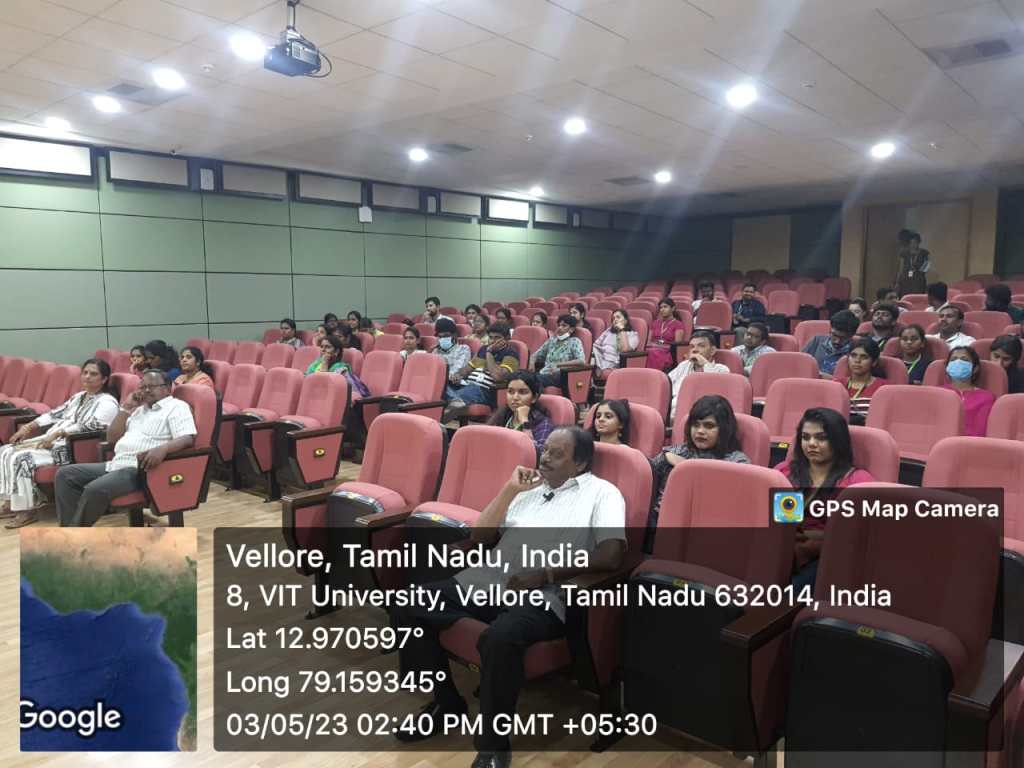
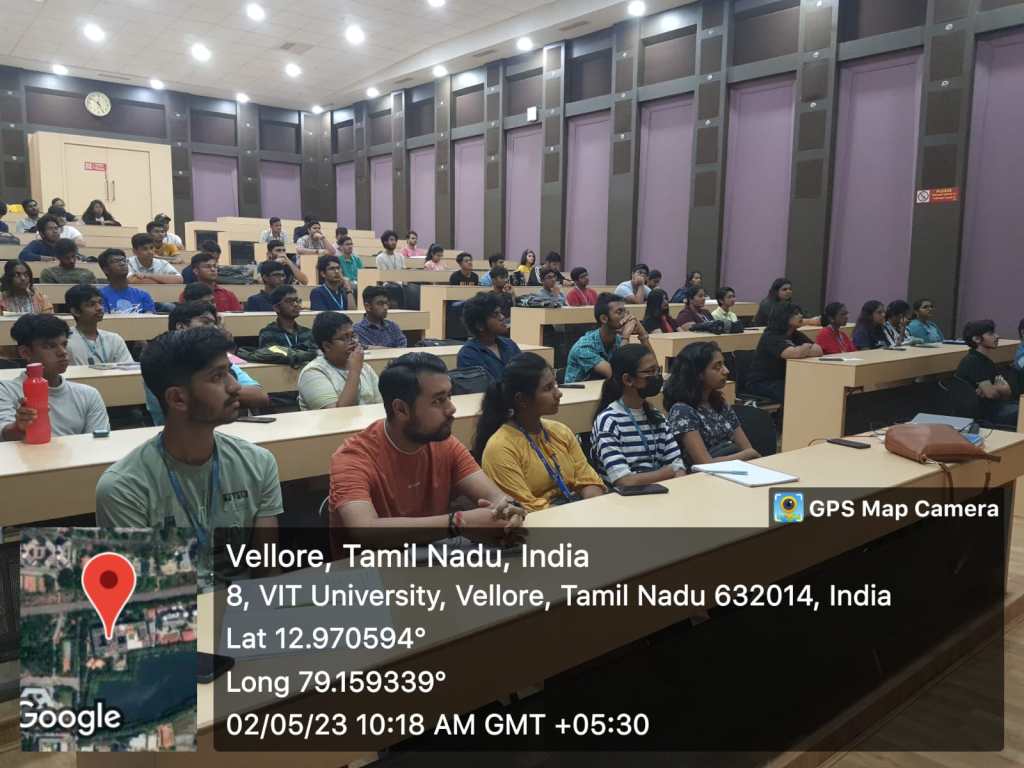
Two Special Guest Lectures were delivered by Dr.Srinarahari.
Venue: Vellore Institute of Technology (Deemed University), Vellore, Tamil Nadu, India
Dates: 2nd and 3rd of May 2023.
- For B.Tech students: Topic: The Road Not Taken: Science Fiction.
- For Ph.D scholars of various departments: Topic: Science Fiction’s Insight: Researchers’ Delight.
- IASFS is extremely happy to share a report of a day’s session which was written overnight and submitted by a student Mr. Yash Agrawal. IASFS encourages such activities carried out by students.


ISFWA Activity:

The Mishras’ invited Professor Saibaba, Mr. Dinker Charak, Mr. Kollegala Sharma, Dr. Shantala, Ms. Savitha IPS, and Dr.Srinarahari.
Indian Science Fiction Writers’ Association General Secretary Dr. Arvind Mishra who hails from Teletara, Jaunpur, Varanasi, Uttara Pradesh was pleased to invite a few of the luminaries in the field of Science, Science Communicator, woman Medical Doctor and woman Law Enforcement Officer who are also Science Fiction writers, webmasters, entrepreneur, academician, software engineer, house maker, women financial officer on a single platform for a dinner in a private hotel Sattvam at Bangalore, Karnataka, India on September 23, 2024.
The invited distinguished guests were Professor Sai Baba, the renowned scientist at Indian Institute of Science, presently holding the post of Director at M.S Ramaiah University, Bangalore; Dr. Shantala Anil a medical Gynecologist & Obstrician and a renowned contemporary Science Fiction writer, Bangalore; Ms. Savitha S IPS serving as Superintendent of Police, Bangalore and a prolific Science Fiction author, critic, anthologist and editor; Mr. Kollegala Sharma from Mysore City who is a former senior scientist at CFTRI –Central Food Technological Research Institute, science communicator, publisher, editor podcaster of jaana Suddhi, the man behind the publication of science journal Kutuhali; Mr. Dinkar Charak a product designer, entrepreneur, pioneer of Indian science fiction website namely, adbhut.in, a science fiction writer, orator, editor, publisher, and webmaster; Dr.Srinarahari an academician for the last five decades till this day and an activist of Indian Science Fiction; Mrs. Varsha Kaustubh and Mr. Kaustubh Mishra from the fiscal departments and Science Fiction story writers; and Mrs. Arvind Mishra the house maker and a voracious reader of Science Fiction genre hailing from Teletara, Jaunpur, UP.
1. Viewers to Rate Visuals.
IASFS organized the the following programs online.
Dates: Monday and Tuesday: August 7, 2023 & August 8, 2023 At 19.15 hours (IST)
Viewers watched on August 7, 2023 an Indian SF movie of 30 minutes on an identical contemporary issue on the theme: AI is Snatching Human Jobs!
&
On Wednesday: August 9, 2023: 19.15 hours (IST): viewers watched 30 minutes Long short SF Movie on the theme: Indian Sci-fi: Climate Change.
Viewers were the evaluators for the event/s during the 23rd conference.
2. Birthday
On 19.07.2022 the association had celebrated Doyen of ISF Professor Jayant V Narlikar’s birthday. On the same day this year we are giving: A Tribute to Mangala Narlikar by IASFS
We regret to inform you all about the sad demise of Mrs. Mangala Narlikar (Wife of Professor Jayant V Narlikar)on 17th July 2023. She has a great name for her enormous work in the field of Mathematics and to ISF.
As a Tribute to her, IASFS had scheduled a Zoom Cloud Recurring Meeting on Wednesday 19.07.2023 at 19.00 hours and 20.07.2023 at 19.00 hours.
We have offered her the petals of Indian Science fiction works in the form of reading self-authored SF stories and presenting a few scholarly articles by registered participants.

Press Note:
Report of the Event by Mr. Raghavendra Vanjari (Program Director), Ms. Aarthi Priya (Program Assistant) and Mr. Bikramjit Ghosh (Joint Director, Technical Team) will be uploaded shortly.
YouTube link of the 2-days’ program.
The association is highly indebted to the contribution of Mr. Showik Chatterji (Technical team Head) who has added beauty to naturality. Please click on the following link:
3. Translation: Issues and Plausible Solutions
A program on Translation was initiated by organizing successfully on 13.06.2023 an offline/online meeting of the authors, publishers, editors, media persons, resource persons, experts in the field of literature, visual arts, and performing arts.
Online and Offline meeting on Tuesday 13.06.2023
“Science Fiction Translation: Issues and Plausible Solutions”
IASFS had scheduled an offline meeting on the above mentioned date at Bangalore, Karnataka State, India at 10.15 hours IST to discuss the “Science Fiction Translation: Issues and Plausible Solutions”. The scheduled offline meeting was arranged at an Airbnb independent apartment in Thanisandra, Bangalore city, Karnataka, India. An online meeting was also scheduled simultaneously at the same time. It was pertaining to the translation of works (both critical and creative writings) from Indian Languages to Global Languages and Vice Versa. This event was not restricted to translation of works from one language text to another language text. It is broadly viewed as to transform the text into performance, production of visual media material and Vice Versa.
A few of the authors, translators, publishers, editors, bilingual experts,critics, printers, organizers, musicians, choreographers, directors, script writers, producers, artists, visual media experts, sponsors, agencies, and others had attended. There were no restrictions of age, qualification, position, class, religion, nationality, geographical location, race, gender and others.
IASFS had organized the meeting to bring together variety of like minded people and remained as a facilitator (Catalyst) for a noble cause.

Recalling the Beijing session on Translation, Dr. Srinarahari briefed about the past international event during the beginning of the meeting:
Recalling an International SF Event:
The First Asia – Pacific Science Fiction (APSF) Convention was held at China Science and Technology Museum, Beijing, China on May 19 & 20, 2018. The event was jointly organized by Future Affairs Administration, Global Innovators Conference and APEC China Business Council.
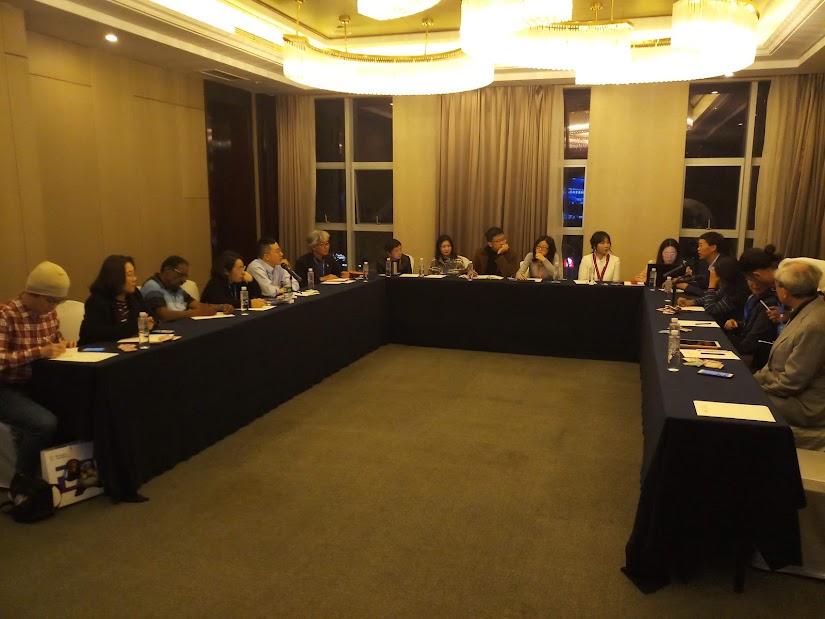
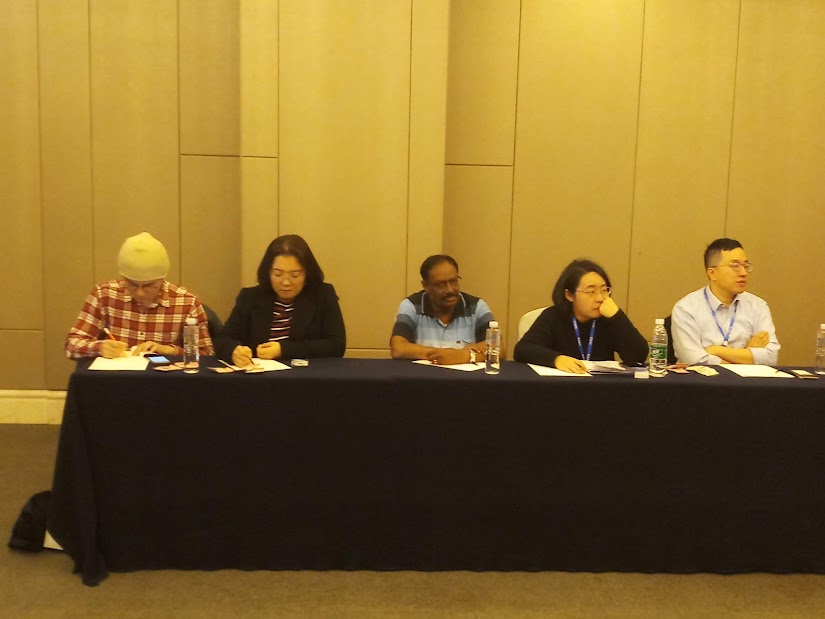
In a parallel session, the panelists Chiara Cigareni, Dr. Srinarahari, Eero Suoranta, He Xiang, Nikolai Karayev, Park San Joon, Sun Wei, and Wang Meizi, discussed on the issues concerned about translating SF in conducting workshop. Dr.Srinarahari initially dealt on the topic covering the concept, forms, methods, L1 to L2 and vice versa, the scenario in India, the difficulties faced in different levels in carrying out the workshops and in the production of the workshop products, the difficulty in bringing together the works in twenty two Indian vernacular SF works into English, and the efforts of the translators in translating English language SF to their respective vernacular and regional language formats and the abundant scope of publication of such works in Indian languages. The major hurdle in translating SF works, as he pointed out, is in localizing the cultural contexts.
Vera Sun the anchor person, excelled in initiating and in conducting the discussion from various angles and items. While discussing the difficulty in translating Terry Bison’s story “Meat”, it was a surprise for every one when the writer himself involved in the discussion and shared his original ideas. As experienced translators and editors, the panelist could also throw light upon how the difficulty level could be nullified in the process of translating SF works.

Further, Dr.Srinarahari dealt with the various aspects of translation issues. A PPT is appended for information:
In continuation of the meeting…
Science Fiction authors, tranaslators, editors, Dr. Madhu Chittaravu, (Cardiologist and Diabetalogist, Hyderabad, Telangana), Ms. Savitha S. IPS (Superintendent of Police, Bangalore), Ms. Shubrali Kulashresta (Research Scholar, New Delhi) had partaken in the lively interaction. Each one of them dealt with the Translation issues and plausbile solutions. It is also suggested that a separate organization should takeover for selection, conduction translation workshops, establish editorial board and publish them. Simultaneously, the performing arts division, film division, visual arts division should take up the work of translating the text into art form. It was suggested that the organization may apply for grants or generate funds from the private sectors for making the dream come true. However, the thought process has begun as the saying goes “Today’s Science Fiction (Gedenken Experiment) is tomorrow’s Science and Technology.
((()))
Webinar on Science Fiction in India
-Dr.Srinarahari
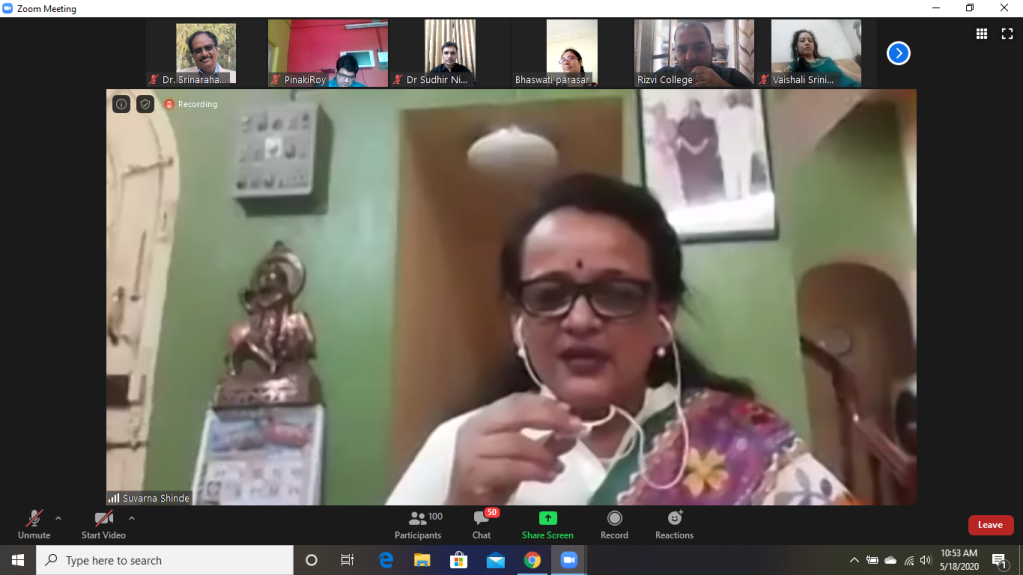
Guest Lecture during the webinar on Science Fiction in India
((()))
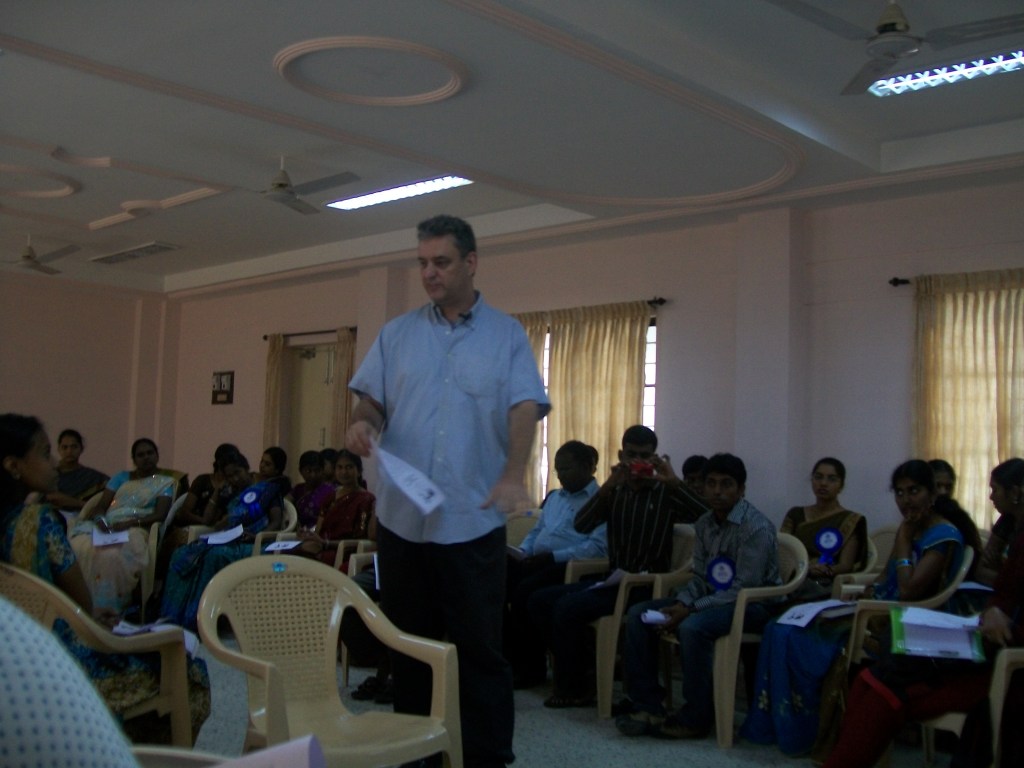
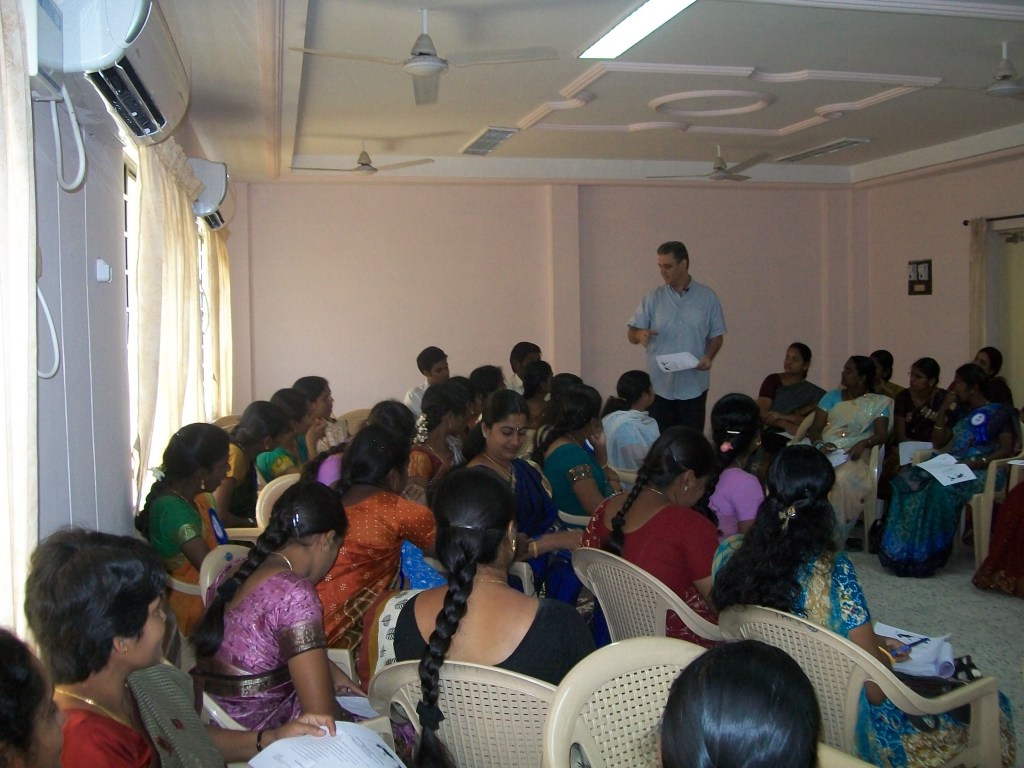
Mr. Eric Miller conducted a workshop on Science Fiction Short StoryWriting during the Coimbatore International Conference:
(((())))
Indian Exclusive Spices:
A few Images of a few attractions and events:
1. Within India:
At Sri Shankaracharya University of Sanskrit, Kaaladi, Ernakulam District, Kerala:

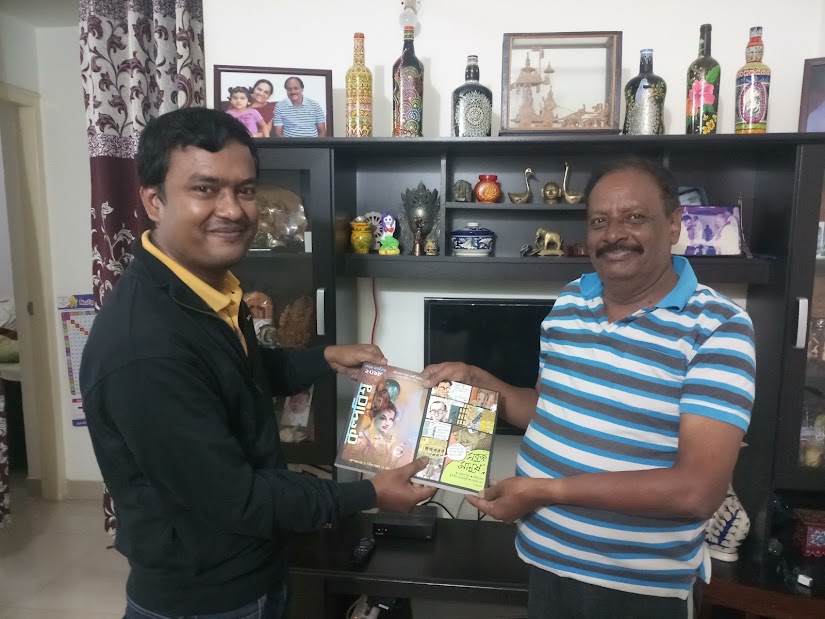
Bengali SF Books:
Mr.Santu Bag has handed over recently published Bengali SF books by Kalpabiswa to be exhibited at International SF Conference Book Exhibition at Chengdu.
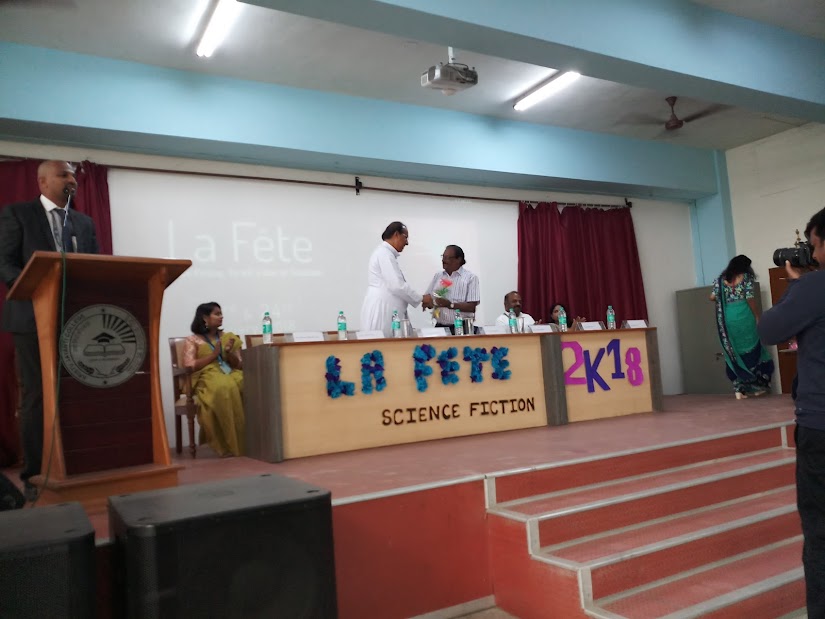
Kristu College (Christ University, Bangalore) had organized a mega science fiction event:
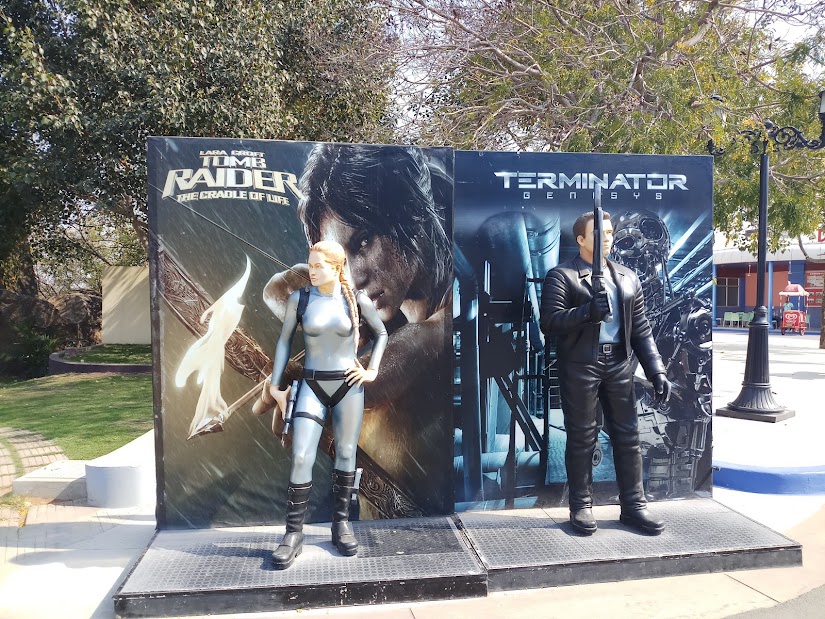
Science fiction as an attraction at Ramoji Film City, Hyderabad, Telangana;


2. Outside India:
An Exclusive panel discussion session was held on “How to Organize the Best Science Fiction Conference?” at the Asia-Pacific SF convention held at Beijing, China during 2018:
Panelists from Left to Right: Ms. Elizebeth Hull (USA), Dr.Srinarahari (India) and Mr. Francisco Verso (Italy).

Footprints of Indian representation at the Five-country SF association meet:
India represents during the panel discussion on the Path of progress of SF from Athens (Greece) to Shangai.

International Press Conference in which the Indian SF status was highlighted.

Gate way to Indian Science Fiction Book Exhibition at the International SF Conference at Chengdu.

International SF attractions: Universal Studio at Singapore:


((()))
The Director, Center for Science Fiction Studies, Department of English, Kansas University, Lawrence, USA Professor James E Gunn writes a letter to Dr.Srinarahari:
Subject: RE: Remembering now!
Date: Mon, 26 Jul 2004 10:58:37 -0500
From: “Gunn, James E” <jgunn@ku.edu> Add to Address Book
To: “Srihari Mysore” <sciencefiction_india@yahoo.com>
Dear Hari, I post below the introduction to the India section of THE ROAD TO SF #6. It has some formatting problems because it was written in WordStar, but maybe you will find it usable. I’ll see if I can find the general introduction as well.
-Jim
INDIA
According to some historians, science began in India somewhere between 1500 and 1000 BC when Aryan invaders brought with them the Vedas, the religion-philosophical books that personified nature and provided philosophic and ritualistic ways to deal with life and phenomena. During times of eclipse, for instance, people were instructed to fast and to immerse themselves in rivers, and pregnant women were forbidden to see eclipses at all. But western science, with its pragmatism and experimentalism, made an impact only toward the end of the 19th century.
An early attempt to link chemistry and nature was published in 1897 by a prominent freedom fighter, Jagadish Chandra Bose, whose novel Agosh (“The Taming of Storm”), written in Bengali, used a hair oil to calm storms at sea. About the same time, S. B. Ranade published Tarache Hasya in Marathi and Nath Madhav, Srinivasa Rao, and Jules Verne’s from the Earth to the Moon was translated. But early Indian SF resembled its fairy tales and, as has occurred in a number of other countries, earned it a reputation as juvenile literature, a reputation that still handicaps its development.
The situation in India is complicated by its history of long periods of civilized rule disrupted by invading conquerors. The British, for instance, began their operations under the East India Company in 1612, defeated French and Islamic rivals in 1760, brought the administration of India under the British Crown in 1857, and negotiated the Indian Independence Act in 1947. A remnant of that history is the 203 languages spoken in India, of which the most common are Hindi, Bengali, and Marathi, with Hindi and English the official languages. So, the history of science fiction in India is divided between languages.
Hindi author Durgaprasad Khatri published several romance and adventure SF stories in 1925 and 1926, and another Hindi writer, Dr. Sampurnanand, wrote “Prithvi se Saptarshi tak” (“From the Earth to Ursa Major” in the early 1950s. Other Hindi writers include Prakash Sharma, who edited the popular science magazine Vignyan Pragati, Dr. Nawal Bihari Mishra, Dr. Hare Krishna Devsare (who included special SF issues of the children’s magazine Parag), Rajeswar Gangawar, Ramesh Datta Sharma, and Premanand Chandola.
The famous filmmaker Satyajit Ray lent his reputation to Bengali SF with stories about a comic scientist, Professor Shonku. A Bengali SF magazine, Fantastic, has published such authors as Niranjan Sinha, Narayan Sanyai, Enakshi Chattopadhyay, and Adrish Bardban, the editor.
But Mukul Sharma, the editor of 2001, a science magazine published in English that has published translations of Indian SF written in other languages and has written English SF himself, thinks that Indian SF writing in English is worthless. He attributes this to the scarcity of Indian SF writers working in English and the Indian world view that “has so much that is fantastic (spirits, exorcism, propitiating the dead, etc.) that we do not feel the need to create more fiction.” One exception is Dilip M. Salwi, a scientist turned scientific journalist, who has been writing SF stories for children and teenagers.
Marathi, the language spoken by Indians in western and central India, including Bombay, offers a different perspective. Science fiction was reborn in the 1970s, Marathi author Bal Phondke has observed, because of the perceived need to popularize science in many regional languages and the use of SF as a medium.
The effort met with success only in Marathi, Bengali, and Tamil. Organizations set up to further knowledge about science, including some twenty periodicals that sometimes published SF and a few magazines in Mumbai have brought out special issues featuring SF on occasions such as Deepavali (Festival of Lights).
In Marathi, G. R. Tikekar, Gajanan Kshirsagar, and D. C. Soman wrote stories in the 1950s, and B. G. Bhagwat translated Jules Verne and H. G. Wells. In 1974 astrophysicist Dr. Jayant Naralikar, like his mentor British astronomer Fred Hoyle, gave prestige to the field by writing SF. Phondke, who has adopted Asimov’s stages of SF development as 1) adventure SF; 2) science-important SF; 3) social SF; and 4) style-important SF, believes that Marathi SF started at the second stage in the 1970s and quickly moved into stage three. The unique character of Indian SF, he wrote in the preface to a 1993 anthology, “is not dependent on its geographical origin but rather on the cultural and social ambience, which gives it its soul.”
He continued that science is universal, but “once one starts sketching the impact on human properties, reactions and emotions, the situation becomes totally dependent on the cultural fabric that engulfs the individual…. Even within this broad category of Indian science fiction one can see that Marathi science fiction is not the same as Bengali science fiction which in turn is different from Tamil science fiction and so on. This is because the genre has developed differently in these different languages and the stature it has achieved in these languages also differs widely. The strongest current, both quantitatively and qualitatively, can be found in Marathi….”
Phondke pointed to the “continued, consistent and compassionately objective support provide by the off-beat journal Naval, edited by the perceptive genius of Anant Antarkar, the Indian John Campbell,” as well as the annual science fiction writing competition organized by Marathi Vidnyan Parishad (Marathi Science Congress). One of the leading Marathi SF authors, Laxman Londhe, got his start by winning such an award. Although he is a lawyer by training and a financial executive by profession, who recently has retired to write full-time, he writes in a number of different fields, particularly radio and television, as well as science writing. Other Marathi SF authors include Niranjan Ghate, Subhodh Jawdekar, Subhadra Gogte, G. F. Joshi, and Phondke, who also is a science writer.
Phondke believes that Bengali SF did not build on Sathyajith Ray’s pioneer efforts, and that the Kerala Shastra Sahitya Parishad organization has great popular appeal, but “there is almost no science fiction written in Malayalam, the State language.”
Although there is no organization for science fiction itself, Marathi writers based in Bombay meet once a month at Marathi Vidnyan Parishad’s office to discuss each other’s stories and at least one National Conference for Science Writers offered a session on SF that was attended by some 200 scientists. M. H. Srinarahari, who presented a paper on Indian SF about robots at that meeting, attributes the slow development of SF in India to the delayed arrival of the industrial revolution, the dominance of agriculture, and the low cost of human labor. But all of this is changing.
“What is needed,” Phondke concluded in his preface, “is cross-fertilization of the Indian offerings with the fare the world at large has to offer. For that to occur, an introspective look at the entire spectrum of Indian science fiction would have to be resorted to, so that the strengths are recognized and the weaknesses identified.”
One sign of a growing self-awareness in Indian SF is an international seminar organized by Srinarahari and scheduled for early in 1998 in Hyderabad, where the American Studies Research Center is located, and the meeting of the newly formed Indian Association for Science Fiction Studies headed by Dr. K. S. Purushothaman, a teacher and science-fiction scholar in a Vellore college.
((()))
A Concise Review of Indian SF
-Dr.Srinarahari
Background:
As per the Constitution of India there are twenty – two recognized official languages. There are thousands of dialects which are in use. There were several magazines which had published Science Fiction stories and articles in the past. They have shuttered down long back. There were several authors who had experimented weaving stories. But they have not preserved a copy. There is no library which could provide all the published works at one place. Hence, collection of data is a ‘Herculean task’. One cannot master all the languages at a time to write a review. Hence, we are not claiming this report to be a comprehensive one.
Myth:
The great Indian epic the Ramayana, introduces a flying vehicle named Puspak Vimana. In addition, the glassy floors, wax palaces, hints to present day test tube babies, live telecast, are described in the epic the Mahabharata. The Vedas, Upanishads, Katha Harithsagar and many incantations refer to the science and its thought experiments. Since, no proof is available these mythological gadgets and their descriptions are categorized as ‘proto science fiction’.
History:
Indian Science Fiction made its beginning with the publication of “Aashcharya Vrithant” (A Strange Tale) by Ambika Dutta Vyas, in a Hindi magazine Piyush Pravah in 1884. Niruddesher Kahini/Agosh (Story of the Untraceable) by a scientist Jagadish Chandra Bose was published in Bengali in 1896. The story is about using a drop of hair oil Kuntalini to pacify the Oceanic storms. Around the same date the publication of the Marathi science fiction stories, “Tareche Hasya” (The Laughter of a Cable) of SB Ranade, and “Srinivasa Rao” Madhav Nath came to light.
Translations:
Jules Verne’s novel Journey to the Moon was published in the Malayalam language in Kerala Kokila. In Hindi language “Chandra Lok Ki Yatra” (Journey to the Moon) by Babu Keshav Prasad Singh appeared in mainstream literary magazine of the repute, Saraswathi in 1900. Right from the beginning of the second half of the twentieth century the SF translations have gained popularity in Assamese language. To name a few Adrisya Manav (1956) by Hemabala Das is a translation of The Invisible Man by HG Wells. Another translation of the work “Adrishya Manuhjon” (2001) by Abhijit Sarma Baruah. Sada’s translated version Aielita, Kshiren Roy’s translated work Sagaror Taliyedi Kurihazar from Jules Verne’s Twenty Thousand Leagues under the Sea, Dinesh Chandra Goswami’s 2001: A Space Odyssey areall the milestones of progress of Assamese SF.
First Wave:
“Ashcharyajanak Ghanti” (A wonderful bell – based on the principle of resonance) by Sathya Dev Parivarjak was published in 1908. It has been reported that during those years Lala Srinivas Das, Gopal Das Gahmari, and others wrote works of science combined with fairy tale themes. Followed by it the significant works are Devaki Nandan Khatri’s Chandrakanth (1918) and the sequel Chandrakanth Santati. At the same time, a prolific writer of novels Chatursen Shastry has contributed three SF works namely, Khagras (The Eclipsed Moon), Neelmani (The Sapphire), and Adbhut Manav (The Amazing Man). Devakinandan Khatri’s son Durga Prasad Khatri in the footsteps of his father, published Bhooth Nath (1913), Pratishodh (1925) and Lal Panja (1925), followed by Rakt Mandal, Swarg Puri, Safed Shaitaan and other novels.
Impact of Science in the Sixties:
Probably because of the negative impact of the Second World War, the development of Science Fiction in India suffered a hitch. Due to the success of Man landing on the Moon, the discovery of quarks, the advent of TV, computers and the internet, deciphering the human genome and cloning, the movement gained momentum by the progress in the techno-scientific arena in the sixties. With these elements in the background, people in the scientific world began writing science fiction in journals with the aim of popularizing science.
The flow of publication and translation went on uninterruptedly in Hindi. The noted authors were Aacharya Chatursen Shastri, Gurudutt, Yamuna Datt Vaisnava Ashoka Naval Bihari Mishra, Kailash Shah, Maya Prasad Tripathi, Shukdev Prasad and Devendra Mewari.
Second Wave:
Writers in their majority of works overcame the ‘Frankenstein Complex’ during the second wave of Indian Science Fiction which began in the seventies. Marathi Vignyan Parishad, Mumbai (MVP) conducted SF story writing competitions. Drs. Bal Phondke and Jayanth Narlikar emerged as the pioneers in the field of Indian Science Fiction in general and Marathi Science Fiction in particular.
Marathi SF:
In Marathi, Dr. Jayanth Narlikar, Dr. Bal Phondke, Laxman Londhe, Niranjan Ghate Dr. Yeshwant Deshpande, Meghashri Dalavi, and others have contributed for the growth of SF. The man behind success of Marathi SF is A.P.Deshpande.
Connecting With Other Countries:
India was connected with the western world by the pioneer attempt made by the magazine 2001 from New Delhi in 1988. The team had an interview with Isaac Asimov over satellite. The event was carried out by Chandan Mitra (Coordinator) Mukul Sharma (Editor 2001), and Jug Suraiya (Times of India). The notable another event was the publication of It Happened Tomorrow (1993) edited by Bal Phondke. It contained a dozen and a half short stories which were in various vernacular languages in turn were translated in to English. MVP made a pioneer attempt in holding an exclusive session on Indian Science Fiction in a conference in 1996. Indian SF Criticism took off with the publication of Dr.Srinarahari and Upinder Mehan’s articles in Global journals and magazines in 1996 and 1998 respectively.
Tamil, Telugu & Oriya SF:
The first work of Tamil Science fiction is Bharathi Noolgal (1959) by Subramanya Bharathi. The first Tamil SF movie is Nella Thambi (1949). The representative writers in Tamil are Sujatha Rangarajan and Nellai S Muthu. The only pointer in Telugu language is KRK Mohan. Oriya language is represented by Gokulananda Mahapatra.
Assamese SF:
Hariprasad Baruan has published the first Assamese SF in Awahan in 1937. A story in the anthology entitled “Biracharitiyar Desh” describes the adventures of an inhabitant of the planet Jupiter. In 1938, Nagendra Narayan Choudhury published “Rasayan” in Awahan.
Dinesh Chandra Goswami has published short story “Kankal” (1970), anthologies Bhadrata Mapak Yantra (1985), Odor Absorbing Notebook (1985), SF drama Tritonor Abhijan (1985). Ek Tarangar Dare (1993) and Abhinna Hriday (2003). His SF novels include Ejak Jonakir Jilikani (1992), Sabda, Nirantara Sabda (1992) and Usma Prabha (1993). Goswami has published forty short fictions for the monthly magazine Bikol. His novels Ati Bisista Samaj (1999) and Mananiya Sampraday (2000) were adapted for television serials.
Malayalam:
The origin of Malayalam Science Fiction began with the efforts of P T Bhaskara Panikker and N.V.Krishna varier who made pioneer contributions in the magazines published by Kerala Sastra Sahithya Parishad in the year 1952. G.S.Unnikrishnan Nair and C. Radhakrishnan are the prominent writers. Balabhumi, – a children magazine also brought out SF works.
Bengali:
Bengali SF began a century back with JC Bose’s work and it was well perceived by Rabindranath Tagore the first Nobel laureate of India. Sathyajith Ray a prolific writer and movie director is a synonym for Bengali SF. In 1962 Ray wrote a story Bonkubabu’s Friend which deals with extraterrestrial life. When Arthur C Clarke asked Sathyajith Ray to write a science fiction script for Hollywood production, he took up the story Banku Babu’ Friend and turned it into a script titled The Alien. The Diary of Professor Shanku (1965) gained popularity. Unlike Frankenstein monster, Ray’s creation of artificial intelligence does not pose a threat to the creator.
As Subha Das Mollick who analyses Bengali SF notices, “Both the real scientist Bose and the fictional character Shanku had turned their scientific enquiry to understand the ebb and flow of life’s energy trampled over by mankind.” Further, as Isaac Asimov experiments with the variations in the “Three Laws of Robotics” so does Ray with Artificial Intelligence in his stories. Ankul is one such classic work of Ray that with the same name Sujay Ghosh has produced a movie in 2016. In 2017, a six minutes long film titled The Bounty premiered at the 23rd Kolkata International Film Festival. Sudipto Shankar Roy is now making a sequel to The Bounty. In addition, Bengali SF is enriched by Adrish Bardban, Anish Deb, Meenakshi Chattopadhyay, Narayan Sanyai, Niranjan Sinha, Sirshendu Mukhyopadhyay and others. Bengali Science Fiction has grown enormously in recent years. One can browse an online magazine Kalpabishwas Kalpabignyan run by Dip Ghosh to catch the current trend.
Kannada:
The Origin of Kannada Science Fiction is traced with the publication of Nagavarma’s work Karnataka Kadambari (10th century) which describes an elaborate process of preserving the dead body of the protagonist Pundarika in ice. In the same century, Shivakotyacharya’s novel Vaddaradhane was published. Rajashekhara Bhoosanoor Mutt made an entry with “Holiday Planet” in 1965 and has remained as a prominent writer for five decades.
Yanthra Manava edited by Srinarahari and Kannada Vyjnanika Kathegalu edited by Subhashini were published at the turn of the century. They have dealt with machine phobia, ecology, Feminism, and hardcore elements of Physics, and Botany. A special mention has to be made of Bairnatti and Santhosh Kumar Mehandale for their continuous contribution for enriching Kannada ‘SF world’.
A pioneer work of SF story writing workshops were conducted for the children of the age group 13-15 in the entire state. It is published with a title 101 Science Fiction Short Stories written by children (2004). Similarly, a workshop was conducted for the Science writers and Scientists and the workshop product was brought out as Mundanondu Kaalada Kathegalu (2006) by National Book Trust, India. In the same way a Women Science Writers workshop was held (2012). All these workshops were conducted and the workshop products were edited by Srinarahari and Bhoosnurmutt. In addition, Mayura, Sudha Taranga, Tushara, and other popular Magazines and news papers Prajavani and others are also bringing out special editions of SF short stories.
SF in English:
The prominent SF writer in English are Archana Mirajkar, Ashok Banker, Rishab Dubey, Sami Ahmed Khan, Kalpana Kulashrestra, Nellai S Muthu, Anil Menon, Anupam Bhattacharya, Arvind Risbud, Arya Madan Mohan, Ashok Banker, Bharathi Ramachandran, Bhushan Kapoor, Dilip M.Salwe, G.P.Phondke, Harshita Verma, Jayanth V. Narlikar, Kenneth Doyle, KRK Mohan, Laxman Londhe, Meyhna Sujata Mitra, Mukul Sharma, Niranjan Gagte, R.N.Sharma, Radha Ganguli, Rajashekhara Bhoosanoor Mutt, Ramesh Deshponde, Salil Chowdhary, Sanjay Havanoor, Sathyajit Ray, Shalini Tuli, Sourabh Bhattacharya, Srinarahari, Subodh Jawadekar, Surekha Nagar, Surekha, Harish Goyal, RR Upadhyaya, HS Bairnatti, Dip Ghosh, Salik Shah, Arvind Mishra, Balaji Navale, Varun Sayal and others. Vandana Singh, Hari Kumar Nair, Ashish Mahabal, Divyaraj Amiya, Reema Sarwal, Superno Banerjee & others are contributing to Indian Science fiction from outside the country.
Themes:
Most of the Indian SF works could be classified under the head “robot stories” or “alien encounters”. But in these stories homosepians triumph over the Extra Terrestrials. The Gadenken experiment is carried out in the areas of Ecology, Biotechnology and Physics. Certain stories are about humanoid and supercomputers. However, the stories moralistically tend to highlight the qualities of a perfect human being.
Bollywood movies:
The SF movies right from Kaadu (1956) through Mr. India (1972), and Endhiran (2011), Indian movies had a thin science element intermingled with romance. But, Ra One (2011) and 2.0 (2018) are the good movies. The movie 2.0 is released in multiple languages. It has hit the box office an all-time record.
Associations:
There are two Science Fiction associations in the country namely, Indian Association for Science Fiction Studies, Bangalore and Indian Science Fiction Writers’ Association, Faizabad. There are online forums like Sci-fi Katta, Mithila Journal, Kalpabishwas Kalpabignyan, Vignyan Katha and Indian Science Fiction which are connecting the Science fiction people. The aim of the associations and forums in India is to popularize Science, to promote inter-disciplinary studies, to provide platform for creating master piece in literature by facilitating scientific temperament and also to provide a common platform for all the scientists, researchers, scholars, technocrats, academicians, students and writers to express and to present papers during the annual conferences, seminars, and workshops.
ISFWA:
The establishment of Indian SF Writers Association, Faizabad in 1995 has brought together all the veteran and amateur writers to contribute to their quarterly magazine Vignyan Katha. With the leadership of Dr. R.R Upadhyaya, Dr.Harish Goyal and Dr.Arvind Mishra there was no turning back in their writing and publication till date. Including the classic work of Ek Aur Kraunch Vadh by Arvind Mishra, the contemporary writers like Rajiv Ranjan Upadhyaya, Harish Goyal, Kalpana Kulshrestha, Zeeshan Haider Zaidi, Abhishek Mishra, and others.
IASFS:
Indian Association for Science Fiction Studies (IASFS), Bangalore was launched on January 2, 1998 – the day coincided with the birth day of Isaac Asimov and the completion of a century of the publication of JC Bose’s story “Agosh” which is a mile stone in the path of Indian Science Fiction. The main aim of IASFS is to provide help for Science Fiction research. The association also brings out a quarterly journal namely Indian Journal of Science Fiction. The Association has organized Fourteen National and three World SF conferences in India. The themes comprised of artificial intelligence, nano-technology, robotics, space exploration, time machine, fantasy, myth, utopia, history, criticism, Indian Science fiction in vernacular languages, Impact of Western SF on Indian SF writing, Responses of Indian SF on World science fiction, Science Fiction Visual media, SF and Technology. It has conducted SF writing workshops for all ages and for all levels. The association had organized an interactive session with Professor James Gunn of Kansas University, USA.
IASFS has collaborated with Mukthananda College, Gangapur and MSP Mandal, Aurangabad in organizing the 18th ISF/4th International Science Fiction Conference on 16,17 & 18th of October 2019 at Deogiri Engineering College, Aurangabad, Maharashtra, India. The highlights of the event are the SF poster design completion; A five minute SF movie making completion; exclusive women session; an introduction to SF session for the new members; a SF short story writing competition for the students and others.
IASFS is a world community. The membership is open for all. There is no bar of class, race, gender, qualification, regionalism, nationality, languages and others. But restrictions of age limit between 18 and 90 years as well as they should not be having any criminal background; drug addicts and involved in drug trafficking. One can contact: doctorhari567@gmail.com; sciencefiction_india@yahoo.com for membership procedure.
Working Together:
There is a congenial harmony among the associations, institutions, organizations, University departments, Indian Institute of Technology which work together for the promotion and development of the genre. They will all work together in organizing national and International Conferences, seminars, workshops at various locations of the country.
A classic example could be cited where in the event of the 17th Indian Science Fiction Conference held at Varanasi, Uttar Pradesh district in India where the IIT, ISFWA, collaborated with IASFS was a tremendous success. It is because of the joint effort of all the organizational people who could produce a variety of programs during the event.
Hitch:
There are a few hurdles in the progress of Indian Science Fiction.Many Indians believe in the unbelievable. They are mostly on the threshold of skepticism and rationality. However, lack of acceptance by publishers, fewer Science fiction writers and lack of support and encouragement for Science fiction writers are some of the reasons why there are not many works in each language. There are no proper training centers or courses to educate the writers. Money flows for organizing religious mela, but not for Science Fiction programs. In addition, generating funds for organizing events is a Herculean task in India.
Positive Trend:
The boom in Indian Science Fiction is seen in Metro cities, and in many states. In scholarly circle, doctoral degree in Science Fiction is given to several researchers. The efforts of the media in highlighting the SF events are to be appreciated in India. In this regard, it shows a positive signal in the response of youth to the genre. Jnanavahini, an educational channel radio on the FM band has broadcast the speech of Dr. Srinarahari several times. The Delhi based FM band radio has interviewed Dr.Arvind Mishra and Dr.Srinarahari. All India Radio stations Lucknow and Agra are airing many SF programs. SF dramas were also aired by AIR, Dibrugarh town. The nation’s leading newspaper The Hindu, Times of India, The Deccan Herald, Amrith Bazaar Patrika, the Bangalore Mirror, Tehelka, and others, have highlighted the SF events so far. Young people with innovative ideas are currently working in this region. In addition, SF progress has been remarkable over the past four decades as special editions for Bihu and Durga and Diwali Pujas have given way to the publication of science fiction short stories in some of the magazines. We are also grateful for the seminar, workshop, conference organizers, publishers, advertisers, and other institutions which are sponsoring programs of science fiction.
Popularizing SF:
It is planned to involve everyone in the SF movement from the year 2019. In this regard, the ensuing scheduled IASFS 18th ISF/4th ISF con to have a theme, “Interdisciplinary Approaches to SF”.
In connection with the same, it is planned to have a poster design competition on the theme “SF and Animation”. And also to hold a competition in short movie making on Science Fiction and its allied themes. To involve the international community, it is proposed that most of them would be digital in form.
APSF:
The First Asia – Pacific Science Fiction (APSF) Convention was held at China Science and Technology Museum, Beijing, China on May 19 & 20, 2018. The event was jointly organized by Future Affairs Administration, Global Innovators Conference and APEC China Business Council. The event has opened the window to the world in providing an opportunity to view from an Asian Science Fiction perspective. Further the Asian Science Fiction Association has taken an initiative to bring together all the SF produced in Asian Countries to one single mainstream to proceed further. The continuous effort of the office bearers in this direction is laudable.
A Desire: We have no desire to segregate ourselves from the rest of the world. We aspire to have one International SF community which can take us all together. With mutual understanding and inter-dependency let us all partake in the community movement.
(((())))
5 Things You Can Do to Get Your Child Interested in Science Fiction
-Dr.Srinarahari
A child used to be in the company of all the members of the family like father, mother, sister, brother, cousin, grandparents, great grandparents till the end of the first half of the twentieth century. It extended to a decade or more in some families. If an event like a marriage taking place in a rural place, the neighbors used to help in cooking and extending hospitality to the guests of the villages. There was totally ‘Oneness’ seen in ‘mini India’. There used to be dances, music, and all sorts of entertainment for a period of more than a week.
When time and money replaced the earlier ‘pleasure concept’ of the people, youngsters left the villages in seeking jobs, villagers left fearing the rate of interest and the harassment of the money lenders. The wrong notion of more money in cities made everyone the culprits of urbanization. As a result, there is a reduction in the number of young farmers in the villages and rushed to areas where the super industrial era gave assurance of a better life in the cities and metros.
As a result, there was nucleus the family is broken. There was a considerable reduction in the members of the family. The people sought pleasure in buying spree, shopping, and in spending money for entertainment. It lead people to earn by unfair means, accumulate wealth, leading a showy life, developed false prestige. It resulted in extra- marital relationships, divorces, living together culture, and ultimately resulting in single mother families.
Ambience in which the present day children live:
The present day trend is that most of the children are confined to spend their time at home. There is not even a single serial on any television Channel which could be watched with children as most of them beam love, love triangle, murder, kidnap, demanding ransom, corruption, cheating, cold wars, tears, family politics and many more. On the part of the children they have to watch substandard cartoons, most of them beam foreign cartoons in Indian languages which do not depict Indian scenario. Since, they are beamed throughout the day, children may become sofa vegetables. What sort of impact the above cited scenes will create on the psyche of the children?
- What is Science Fiction?
We have analyzed the Indian scenario in the past and the present times. Historical novels deal with the past, contemporary novels and fiction deal with the present. On the other hand, Science Fiction deals with the future. The time range may extend from a few years from now to many centuries. . Spatially, It is not a story of a known world of contemporary times but it may be a story of a galaxy which is many light years from the Earth. In other words -“That which has not happened yet”. It is not a cock and bull story but is based on Science/Technology. There is no science Fiction story without science element in it. it may deal with Darwin’s theory of Evolution as you may narrate a story where Vasanth (could be boy/girl)visits robot land to encounter a series of hurdles in bringing back Earth most intelligent humanoid robots for the service of humanity. Therefore, Science fiction in simple terms is the study of impact of science and technology on the society. The impact may be good or bad as in the case of the use of cell phones.
2. Narration:
As Aristotle has layed down the principle of storytelling, a Science Fiction will also have a “beginning, middle and the end”. As in mainstream fiction there may be flash back effects. However, follow my own acronym “TIP AS Resolution” for narrating stories that is, every story must have a Title, Initial Incident, Point of view, Attempts, solution. A good story is one which answers for all the questions before the end. Certain issues are resolved at the end even after the solution for the main theme is provided. In Charles Dickens’ novel David Copperfield (1850), Mr.Micauber throughout the novel aspires “something will turn up” and at the end his case is resolved by informing the readers that he has got a job in Australia.
3. Themes:
A story will have many ideas and the main idea is called a theme. Science Fiction may deal with a few themes as listed here: Aging and Mortality, Aliens, Alternative Universe, Ancient Astronauts, Androids, Better Brain, Biological Engineering, Brain Wash, Children of the Wild, Clones, Crime and Punishment, Cryonics, Cyborgs, Dreams of the Future, Drugs, Energy Time Travel, Flying Saucers, Genetic Engineering, Halo caust & Catastrophe: Warfare, Future Weapons, Chemical & Biological Warfare, Nuclear Halo-caust, Intelligent Machines, Journey into Space, Machines and Leisure, Men and Supermen, Mutations, Natural Disaster: A New Ice Age, Plague, Pollution, New organs for Old, Over Population, Famine, Pantropy: New men for New World, Powers of the Mind: Mental Science, Psionics & Telepathy, Society, Telekinesis: Mysteries – past & present Vanished Civilizations.
4. Tips to narrate the Science Fiction Stories:
Science Fiction (SF) stories differ from the mainstream fiction as they are “Have not happened yet”. In this regard, a thorough preparation is required. First of all, a science idea has to be chosen as, if you take out the science idea from the story, the story will fall. Sometimes it is a thought experiment. Consult scientists and experts, experiment it several times, and then select them. A story is extrapolated to several years from now and several light years from now. A structure can be taken which balances the plot. The antagonist is depicted as intelligent as the protagonist. A semblance of harmony is seen on either side with regard to the introduction of the characters. As James Gunn puts it “mainstream has minimized plot as mere incident…Only proper concern is how character should react to repetition. There is “thinness of character” in Science fiction whereas “plot remains at the heart of Science Fiction”. In many cases, idea is the character in Science Fiction stories. Have dialogues. Above all there should be a story. The element of curiosity should be there throughout the story. To make it spicy, Let there be fun. To cite an example, in Isaac Asimov’s Naked Sun (1956) the protagonist Elijah Bailey wants to get up from his chair. He asks the humanoid robot Daneel Olivaw to “Give me a hand”. The robot takes out its arm from its body and gives it. There should be an element of suspense till the end. So far I have not come across any Science Fiction tragedies. So have a happy ending.
5. Writing itself is a very difficult task. Hence, we value writers. First, one has to have a mental picture. Later one has to jot down the points, choose the names of the characters, their relationship has to be defined, then the places of their plot, transport system, communication ways, dialogues, who will narrate the action has to be thought of, ‘then a draft has to be prepared. That has to be read by us. Ask questions to ourselves whether it conveys proper meaning, Question ourselves whether the story is worth telling? Whether the story answers to all the questions –whether the incidents are plausible. Then write down the list of titles. Read the story before the listeners whose age group is nearly equal to the audience of the desired age group. Listen carefully to the questions asked by the listeners. Try to find the answer within the story. Otherwise modify the same. There is nothing like final until you desire to publish. Prepare the second draft. Read and go to bed. Suddenly you may wake up and make corrections in the midnight. That is natural as the characters, incidents, narration, the science, the plot, the theme, and the end should really bother you. After a week, you can prepare the third draft. Patience yields good result. Professor Lankesh has written somewhere that he learnt writing only after he tore off the first written one thousand and five hundred pages. I too has made seventy six drafts before finalizing one of my writings.
As Francis Bacon says “Practice makes a man perfect”. Read stories written by eminent Science Fiction writers like Jules Verne, Mary Shelley, H.G Wells,Robert Silverberg, Heinlein, Arthur C Clarke, Isaac Asimov, Ursula Le Guin, James Tiptree Junior, Jayanth Narlikar, Bal Phondke, Laxman Londhe, Meghashri Dalavi, Jawadekar, Mandakini Gogte,Arun Manday, Rekha S Baijal, Sujatha, Rajashekhar Bhoosnurmutt, Arvind Mishra, Devendra Mewari, Gokulanand Mahapathra, Sathyajith Ray, Dilip M Salwe, Dinesh Chandra Goswami, Mehandale,KRK Mohan and others.Watch Sci-fi – movies like Metropolis, I Frankenstein, Interstellar, Martian, ET, Jurassic Park, Gravity, Endhiran, Mr.Muniswami 1.2.4, Ra One, serials like Star Wars and Shaktiman.L let us begin to review certain themes: In Bal Phondke’s “Nathicharami” a male and female robot approach a swamiji requesting him to get their marriage done. In Sanjay Havanur’s “The Lift” the question of negative impact of travelling to future is depicted. In Arun Manday’s “Ruby” the depiction of a gynoid attempting to respond to human emotions.In Srinarahari’s “Connect” deals with the solution to waste management of the Earth by dumping them on the 39th Planet by applying the formula G=m1m2/d2.
To facilitate the prospective story tellers/writers, here are a few hints for time travel stories: A scientist invents a Time Machine and vanishes with it; A Scientist travels to the past with his time machine and find out that by stamping on a butterfly results in winning of the rival candidate in the present day election; a scientist returns to the present after travelling to future as a insane person; Enemy country spy confiscates the time machine but does not return to the present at all due to wrong use of the button; a man lands to the present from the future and decides to remain here supposing that it is the paradise.
Another popular Science Fiction theme is on Robots: Space expedition by robots to discover the congenial atmosphere for man on another planet but it never returns as there was lack of planning in its make to survive in a radioactive atmosphere. The impact on the citizens and king of the desire of a robot which wants to rule the country; A humanoid robot got a human brain transplanted and behaving like human, lately discovered that it was not a human being; How a robot outwits a human being in an interview; Lastly, it is not ours till we try it. Please take your pen and start writing a science fiction story today.
(((())))
TIPS for making effective Video Presentations:
Often IASFS organizes exclusively Online conferences. Everytime the paper presnters/resource persons/ guest speakers/ guest of honor/panelists and registered participants are required to make videos and send them in advance to beam them during the scheduled timeslots.
It is generally observed, that the speakers will not be very much conscious about the position of the camera- where it is focussed/microphones/ lighting/ ambience/quality of the outputs/ leave a large gap of time to deliver the next line or phrase/ take a lot of time in starting the speech/ and others for a number of reasons. Either they will be focusing only on the matter to be delivered or remain ignorant about the techniques of video recordings.
A professional cinematographer, Theater actor & Cinema lecturer Mr. Unnikrishan P who hails from Kozhikode, Kerala has given us TIPS for making an effective Video Presentations. (He has the credit of graduating in B.Sc. Film Technology specialized in Cinematography, Graduated from SRM Sivaji Ganeshan Film Institute, Chennai, Tamil Nadu and has obtained a degree M.Sc. Electronic Media, from the Bangalore University, Bangalore, Karnataka).He could be reached over his email: krishframe@indianiasfs
Please click on the link to access the video tutorial: https://drive.google.com/file/d/1hAFj2GVUMtMt_RjbhyHoVCY68Xf5hsRs/view?usp=drivesdk;
(((())))
Events held, Books in Print and Visuals Released:
Indian Science Fiction Day (Bharatheeya Vignyan Katha Divas):
It is a matter of great pleasure that Dr. Jayant V Narlikar has consented to celebrate his birthday every year on July 19th as Indian Science Fiction Day/Bharatheeya Vignyan Katha Divas. IASFS thanks Mr. Ananth Panduranga Deshpande for taking intiative in finalizing process of proposing, acceptance and implementing the same. Now, A number of programs are carried out to mark the celebration.
Kuthuhali
Kuthuhali is a newly emerged Kannada Science Magazine in Kannada. Mr. Kollegal Sharma formerly a senior scientist in CFTRI, Mysore, Karnataka, who plays a keyrole in the field of popularizing science and a renowned Science communicator (Jaana sudhi) has invited the authors to send unpublished Science Fiction short stories in Kannada limited to 1000 words. The stories could be sent to: kutuhalikannada@gmail.com; for publication in an SF exclusive special issue.
The New year 2022 January issue is released and one can find a Science Fiction story entitled “Sojiga” by Dr.Srinarahari. Thanks for encouraging the genre. The entire magazine is a model for every upcoming magazines. Presently, it is bringing out the issues regularly.
Treasure of Indian Science Fiction:
New Horizon: New Release:
Superno Banerjee: Indian Science Fiction: Patterns, History and Hybridity. Cardiff, UK: University of Wales Press. (2020)
Sami Ahamed Khan: Star Warriors of the Modern Raj: Materiality, Mythology and Technology of Indian Science Fiction: U of Wales P; June 2021;
Tarun K Saint (Ed).,The Gollancz Book of South Asian Science Fiction; Vol 2; Hachetteindia:2021;
Dr. Shantala; 3019 AD: My Lang Books Digital Pvt. Ltd., Bangalore, 2021 (Language: Kannada);
Dr. Ranjan Garge: Mangal Kujabhujala: Creations Publications, Aurangabad, 2020; (Language: Marathi);
Mentalist Harish Yadav: Magic and Mentalism in Science Fiction; Namyapresss.com; Delhi: 2021;
Arvind Mishra: The Space Cuckoo and other Stories (Anthology of Indian Science Fiction Stories; original Hindi; Translated to English: Kshama Gautham; Forward: Darias Luca Hupov. 2021)
Sharad Puranik: Pasanth Aahe Mulgi (Marathi); the Ninth Science Fiction Anthlogy of the author is published: Dec 1, 2021.
Released: Silver Lining: An Anthology of Indian Science Fiction Stories in English, Hindi, Marathi, Telugu by various authors from all the parts of India like EAST, West, North, South and also from Malaysia to the USA; Unique publication: Editors: Drs. Sowmya Murukesh & Priyalekha; Introduction: Dr.Srinarahari; University publications, Kerala; https://universitypublication.in;
Five New books will be released from Kalpabiswa during December 2021: 1. Asisapta/Cursed Blade by Sumit Bardan; 2. Ankiter Budbud/Ankit’s Bubble by Yashodhara Ray Chowdhari; 3. Kankabati Kalpabignyan lekhani/Anthology of Women SF translated from Bengali; 4. Kalpabiswas Uponyas Parba/Selected Novels from Kalpabishwa; 5. Grohantarer Agantuk/ Visitors from Space- Russian SF translated to Bengali. These books are available at: kalpabishwabooks.com;
Books released:
I’m excited to announce my new novel for kids! It’s India’s first ecopunk, sci-fi adventure. Preorder now on Amazon and help this wacky sci-fi book become a bestseller: https://amzn.to/3phG5T3
ABOUT THE BOOK
Two siblings take help from their mother’s cranky, wacky robot to fight against all freaks of the waste. It’s a whizzing, fizzing sci-fi climate adventure which will inspire kids (and adults) of all ages to become climate warriors, innovate and protect our environment. In stocks in your favorite indie store in 2-3 weeks -Let’s fight all those garbage monsters together!- Shweta Taneja


Contemporary Anthology of Indian Science Fiction Short Stories:
IASFS has collected Unpublished Contemporary Science Fiction Short Stories which are in English, Hindi, Marathi, Telugu, Tamil, Kannada from the Indian Science Fiction authors from EAST, WEST, NORTH, SOUTH, CENTER parts of India as well as from offshore one from East that is, Malaysia, and West from the USA- a unique coverage in hybrid language mode. This anthology Enttled Silver Lining Volume III Edited by Dr.Srinarahari and Dr. Sangeetha CG is published by University publication, Kerala.
SF Anthology by Marathi Vidnyan Parishad, Mumbai: MVP Mumbai has published an anthology of Science Fiction Stories in English. The individual stories are picked up from various Indian Languages. it is edited by renowned science communicator, author of more than 1000 articles and 100 + titles, Honorary Secretary of MVP, Advisor of IASFS Mr. A P Deshpande.
SF Research Scholars Meet:
he main objective of Indian Association for Science Fiction Studies is to encourage Research in the field of SF and to provide avenues for the researchers to carry on qualitative research in the field.
In this direction, the association had organized a series of online events during the December 2021- January 2022.
The scholars during this event have interacted with one another. Each one of the participant presented their proposal for research; updated the progress done in their research area; suggested plausible solutions to the unsolved problems
((()))
E & OE; Website created: webmaster: Secretary – General, for IASFS – Dr.Srinarahari.
 Indian Association for Science Fiction Studies®

