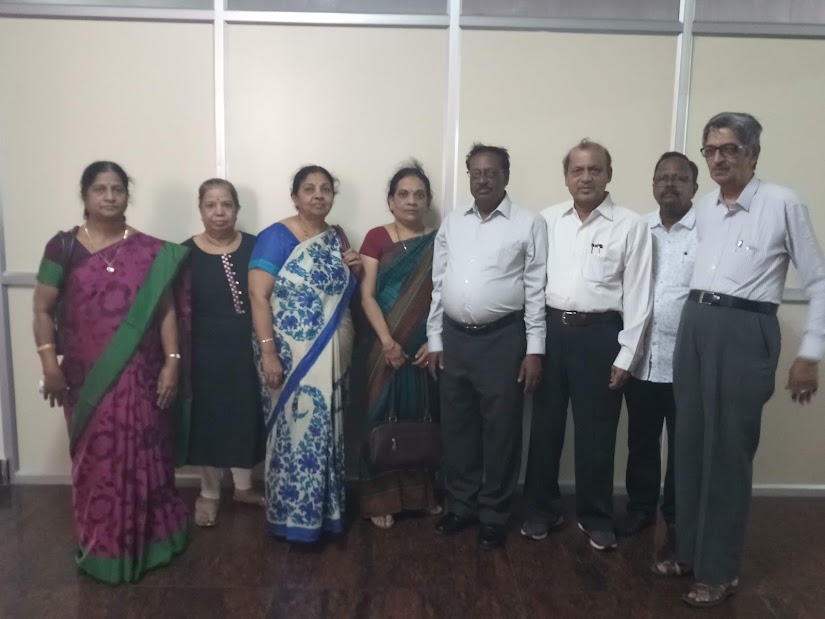
Indian Association for Science Fiction Studies (IASFS) was established on the birthday of Isaac Asimov on January 02, 1998 at Vellore, Tamil Nadu, India. It is relocated at Bangalore, Karnataka, India for administrative purposes. IASFS is a non-profitable registered association.
The motto of IASFS is to promote and develop research in the field of Science Fiction. It is trying to help the Ph.D researchers to get guidance and provide them a platform to present their scholastic works, to present scholarly papers in their areas of research and also in the allied fields. Provisions are also being made for reading self-authored science fiction short stories by respective authors during the conferences. It has organized annual and international conferences over the past 27 years.
Past conferences: List of Collaborators, VIPs, Guest Speakers, Chairpersons, Paper Presenters, Self-Authored Story writers- all in One:
Techno Fiction (from an Indian Perspective)
a paper published by Dr. Srinarahari Mysore in https://academia.edu; (2025).
Abstract: Techno Fiction (TF) is an offshoot of science fiction (SF). Science Fiction narrates a story of the far-fetched future time in an unseen part of the Universe.
With the Indian Mythology at its background, science as its primary concern, the technology of today has advanced much. Tomorrow has already arrived. It is desired to know the ‘future shock’ or how the changes will take place in the near future on our ‘only Earth’.
The paper has tried to deal with the impact of Indian myth, the advent of AI, and the Man vs Machine symbiosis and proposes to focus on the study of the change in the attitude of man to come with the advent of the new technology in this contemporary form of SF called TF.
Record your Research Details:
When I was invited to take part in the Levitation24/Eastercon24 at Telford,UK from March 29th to April 1, 2024 as a Guest of Honour, I was asked to choose and take part in two more sessions among the list provided with.
In addition to my guest of honour speech (text of which I have appended under the menu “Library” in this webisite), I mailed an article on “The Impact of Science and Technology on the Innovative/Research of the Futuristic Science & Technology” and
I was ready for presenting A PPT on “Science Fiction Scholarship Around the World from An Indian Perspective”. Perhaps due to the tight schedules minute by minute, both the programs could not find slots.
The association has a motto of development and promotion of research in the field of science ficiton. Please click on the link below, fill the form and submit to us. We shall all share with one another the details of the research scholars, resource persons and supervisors so that we can interact with one another.
https://forms.gle/v4JquoFDgLSBGUsS8;
((()))
In this section an attempt is made to provide the reference material like the reports of the past conferences; articles; interviews; published works; presentation of videos over YouTube links and reflections.
18th Conference: A Report
Indian Association for Science Fiction Studies®, Bangalore (IASFS), Indian Science Fiction Writers Association, Ayodhya (ISFWA), Marathi Vidnyan Parishad, Mumbai (MVP), Marathwada Shikshan Prasarak Mandal, Aurangabad (MSP) and Deogiri Institute of Engineering and Management (DIEM) had joined together with the host Mukthananda College, Gangapur, Aurangabad District, in organizing the 18th Science Fiction Conference at Aurangabad, Maharashtra state, India on January 10 & 11, 2020.
The celebration of Isaac Asimov’s Birthday Centenary; video speech by Michael Brotherton, U of Wyoming, the USA; Paper reading by 130 scholars and researchers; story reading sessions; keynote address and plenary sessions by eminent personalities in the field; a magic show entitled “SF and Mentalism” are the highlights of the event.
Drs. Madhusudan N Sarnaik and Balaji A Navale the conveners of the conference welcomed the gathering. Dr.Srinarahari the Secretary-General of IASFS with a power point presentation displayed how the growth of SF has taken place after the second wave of Indian SF from the sixties of the twentieth century. Also, he pointed out how India has been able to appear on the map of SF producing countries. He briefed about the conference theme: Science and Science Fiction: Interdisciplinary and Multidisciplinary Perspective. Further, he highlighted how the genre has influenced other branches of knowledge in their futuristic vision and vice versa.
Dr. Pramod Yeole the honorable Vice-Chancellor of Dr. Babasaheb Ambedkar Marathwada University, Aurangabad inaugurated the Conference by lighting lamp. Speaking on the occasion the VC pointed out the positive impact of Science and Technology in the life of common man in the street. He highlighted how the mobile being a communication gadget has been providing multiple services for booking cabs, ordering food, and carrying on banking transaction. Being a Professor of Pharmaceutical Sciences for thirty-two years, he cited a number of instances to explain how the theme was relevant in the current context to churn out solutions for many complex issues. He called for the translation of global works to the vernacular and regional languages to enable the local people to know the current trends in this direction.
Dr. Arvind Mishra the secretary of ISFWA spoke about the association and its activities explaining how the association could provide a platform for the Hindi writers to publish their works regularly in Vignyan Katha magazine.
Mr. Mohanrao Savant Member of the Executive Council, and Mr. Deshmukh College Development Committee of MSP joined the dignitaries while releasing the peer-reviewed – online and print version of International Science Journal during the inaugural session.
While giving the keynote address Mr.AP Deshponde the honorary Secretary of MVP traced the development of the genre from the times of the Vedas, the Ramayana and the Mahabharata. He traced the contributions of the British, and the boom in the growth of the genre in the American continent. He also pointed out how the MVP could conduct the short story writing competitions during the seventies and how the writers in Marathi could align themselves to the emerging trends of popularizing Science and Science Fiction along with the stalwarts like Jayanth Narlikar, Bal Phondke and others. Mr.Deshponde added that MVP has been conducting a number of short story writing workshop thereafter till date. He gave an account of the growth of the genre in other vernacular languages like Hindi, Bengali, Kannada, Malayalam, and Tamil. He stressed upon the point that the publication of It Happened Tomorrow (1993) edited by Bal Phondke is a proof to show how the authors of different locations in India could align with one voice and one India. The selection of Laxman Londhe’s “Einstein the Second” as the best Indian Science Fiction story from the sub-continent by Dr.Srinarahari for its publication in The Road to Science Fiction edited by James E Gunn has brought a global flavor for the Indian SF works. The impact could be seen in the present day with 120 Marathi Science Fiction Writers publishing SF stories in 400 magazines during Deepavali (The festival of lights during October- November) every year.
Professor of astronomy at the University of Wyoming, the USA, Michael Brotherton who is a Science Fiction writer and editor of anthologies gave a video talk on the “Synergies of Science and Science Fiction”. He remarked that Science and SF are complementary to each other. Quoting Carl Sagan he conveyed that Science is a way of thinking rather than a body of knowledge. Then he quoted Albert Einstein who said that imagination is more important than knowledge. Quoting Bernard Baruch he said that the spirit of enquiry is essential as in the case of Newton alone who questioned why the apple falls. Citing the idea of flying cars, he demonstrated how telescope, spacecraft, and the time machine are interconnected. He drew conclusion that Science requires speculation as much as skepticism, Science Fiction can educate, inspire and entertain. Hence, he concluded that Science Fiction is the crucial imagination of Science.
During one of the plenary sessions Dr.Ashok Thorat the Director Center for Digital Humanities, Pune, India explained its concept, scope and highlighted how it can encompass the whole of humanities, Science and other branches of knowledge. He brought out the point how Science Fiction and Digital Humanism go hand in hand in their methodology.
Arvind Mishra speaking on Indian SF scenario highlighted how the social media has provided a platform to unite every writer in the genre and interact over a particular topic in recent days. Also speaking about Asimov he recalled the “Park Avenue Pact” between Isaac Asimov and Arthur C Clarke.
Dr. YH Deshponde brought out facts how the Science Fiction has its roots in Indian mythology right from the days of Veda Vyas the pioneer writer of the Mahabharata. Mr. Harish Yadav presented a paper on “Magic and Mentalism in Science Fiction”. He dealt with the definition of SF, magic, mentalism, and magic in SF in print and movies.
Speaking on the occasion of the birth centenary celebration of Isaac Asimov, Dr. Srinarahari drew out a few anecdotes from the life of Asimov. His long hours of stay at the candy stores, the expression of surprise of his father over his production of a few books, his acknowledgement of gratitude to his father for he who inspired for his writing as he “valued learning”; how excited they were when they could get a telephone connection to their home and an extension to the kitchen; returning to full time authorship like Jules Verne; described space travel vividly being an acrophobic; considering reading news paper as a change of work in the hospital when he had heart surgery; creative writing and personal habits and aspirations. The speaker described Asimov’s writing his own biographies; authenticity of matter, appealing language, narration techniques, lucidity, and others.
The speaker on the occasion categorized Asimov’s four hundred works and focused on his Science Fiction works: He spoke about the foundation series and robot novels and their culmination in the novel Robots and Empire (1995). Dr.Srinarahari being an Asimovian scholar dealt with his structure, plot, characterization point of view, themes and others. He highlighted that Asimov is alive here with us because of his extra-ordinary ability to sketch the character of Susan Calvin, Kelden Amadiro, Gladia Solaria, Harry Seldon, Elijah Bailey, Robot Giskard, R. Daneel Olivaw and others.
In addition to the speaker’s address in the past dealing with the impact of Asimovian works on Indian SF and the “Indian Response to American Science Fiction”, he enlisted the following Indian scholars who have done research on Asimovian works for which the doctoral degrees were awarded by various Indian Universities. The theses and dissertation works which have focused on Asimov’s works are Prakash S. Rao’s “Isaac Asimov’s Works of 60’s and 70’s: A Study in Scientific Humanism”; Veena’s “Paradoxes of Order in the Fiction of Isaac Asimov”; S.Guruswamy’s “Asimov’s Vision of Utopia in Foundation’s Edge and Foundation and Earth.”Fiat Homo- Let There be Man – Apocalyptic Renewal in Asimov’s Foundation Series” by K.S.Purushothaman; Panneer Selvam’s “Credibility Criterion in Asimov’s Foundation Trilogy”; The Robotistic Works of Isaac Asimov: A Study” by the speaker and the recent contribution of Anand Arul Das who has applied the theory of Post humanism in the works of Isaac Asimov.
Concluding his talk the he explained that Indian Association for Science Fiction Studies®, Bangalore, India was established on the birth day of Isaac Asimov on January 2nd, 1998. Now, the institution is celebrating its 22nd year of its establishment. Asimovian topics were chosen by many scholars in presenting their papers during the last 18 Science Fiction Conferences held in India. Thus, it acknowledges a tribute to the great giant of Science Fiction.
Dr. Yeshwant Deshponde is often referred to as Indian Asimov. Coincidentally, his birth day was on the second day of the conference. Hence, it was celebrated with all pomp. The celebrity was honored by the organizers and participants.
Apart from the presentation of one hundred and thirty papers by the participants, there was a magic show entitled “SF & Mentalism” by Harish Yadav. There was a festive mood, a sense of thrill, a sense of achievement, contentment and gratification among the delegates, participants and the host. This conference has paved way for the scheduled 19th Science Fiction Conference in India which will be organized by Bangalore University in collaboration with IASFS, ISFWA and others on 5, 6 and 7th of October 2020 at Bangalore, Karnataka, India.
(((())))
17th Science Fiction Conference (Aurangabad)
Host: Indian Instititute of Technology, Benaras, Uttar Pradesh.
17th Indian Science Fiction Conference was organized by Indian Association for Science Fiction Studies, Bangalore, India in collaboration with Indian Science Writers Association, Ayodhya, India and MCIIE, IIT, Benaras, India at Indian Institute of Technology, Benaras Hindu University, Varanasi, Uttar Pradesh, India on 15th and 16th of December 2018.
The theme of the conference was “Technology and Science Fiction”. Twenty-five papers were presented, two Science Fiction books were released; a session on the Introduction to Science fiction; a session on how to write science fiction script for broadcasting over the radio; an interactive session of Indian SF writers with Korean SF writers; celebration of the Bicentennial year of the publication of the first SF work Frankenstein by Mary Wollstonecraft; a show on mentalism and science fiction; beaming of a Tamil Science Fiction short movie and others.
The inauguration of the function took place with a prayer praising the goddess of knowledge Saraswati and lighting the lamp in Indian traditional style. Dr.Manoj Patairia the Director for Council of Scientific and Industrial Research – National Institute of Science Communication And Information Resources, New Delhi in his inaugural address highlighted how the present conference is coinciding with the 200th year of first science fiction novel Frankenstein (1818); the 500th Death anniversary of Saint poet Kabir who was in this city had worked against myth and always worked for scientific explanations. Speaking about the history of Indian SF, the eminent Scientist cited the contribution of physicist Dr J.C. Bose and the Vishwa Parichay by the Nobel laureate for literature Rabindra Nath Tagore in the past for the growth of Indian Science Fiction particularly in the field of astronomy. He concluded how the genre science fiction could foresee Future Shock.
In his Keynote address, the Secretary – General of Indian Association for Science Fiction Studies Dr. Srinarahari described two ways of approach to the philosophy of life. Formerly, the sages (Rishis) achieved the supreme power by means of penance. The modern Indian citizens have been practicing yoga by which the mind could reach status of blank. The Science Fiction of today is the science of tomorrow and in turn applies the principles of science to make technological gadgets, apps in the service of humanity. To elaborate the idea he gave an analogy of representation of a god or an eminent person’s sculpture. The Sculpture is made by chiseling the unwanted parts of a wood or stone ultimately to make a sculpture. Whereas in the case of technology one fills up color in making a portrait. Thus, he concluded how there is culmination of Indian philosophy, culture, tradition, way of life, myth and history on the one hand and the adoption of technology on the other go hand in hand in the development of what he christened as “Techno-Fiction”.
Dr. Rajiv Ranjan Upadhyaya the president of ISFWA in his address quoted how the Vedas and Upanishads of the ancient times have had dealt the science and technology.
Suhyeon Lee and Boyoung Kim the writers from Korea were on the dais and they were introduced to the audience. The former is a prolific writer of Korean SF and has bagged many honors at a young age. She has written about minority groups, terra-farming in outer space and under water cities. The latter has a base in game development, graphic designer and scenario writing. Further she has earned a name for extrapolation and for a vivid description of the protagonist’s psyche in her SF works.
The SF books Trends in Science Fiction in Tamil by Nellai S Muthu (former scientist at Indian Space Research Organization) and Dr. Archana Mirajkar’s Home were released. The youngest 21 year old Indian Science fiction writer Rishabh Dubey also introduced his Krikos during the conference.
Dr. Pramod Jain Director of Indian Institute of Technology, Benaras Hindu University in his presidential address, pointed out that the conference theme “Technology and SF” was the first of its kind in the history of the institute and hoped how the two communities would exchange ideas in their future positive ventures.
Dr. Arvind Mishra the convener of the event welcomed the dignitaries and participants. The vote of thanks was given by Dr.PK Mishra the Chairperson of the Malviya Center of Innovation Incubation and Entrepreneurship, IIT, Varanasi.
Immediately followed by the inaugural function, Dr.Srinarahari presented an “Introduction to Science Fiction with Special Reference to Indian Ambience”. Though, the target audience were the participants namely, a class of students who had represented local Varuna College, and to those who were new to genre SF, the session was attended by all the dignitaries and all the participants. During his presentation, he briefed about the origin, history, concept, definitions, themes, movements, representative world class writers, and kinds of SF in general. However, the focus was on Indian Science Fiction beginning with Indian states which have promoted SF studies; Universities, Colleges and organizations which have taken up research works at the higher education level by providing facilities to the scholars for pursuing their Master and doctoral degrees in SF; the SF writers in English, Hindi and vernacular languages; Indian SF visual media and others were also highlighted in his lecture.
The same pre-lunch session was made further interesting by beaming an Indian Tamil vernacular language Science Fiction short movie of thirty minutes duration which had the subtitles in English. It is based on SF novel Munusami 1.2.1 by Sujatha one of the stalwarts of Indian Science Fiction writer. The movie is entitled Mathi Mayanginen which is directed by Ramanan Purushothama.
The post – lunch session focused on the paper presentations. To begin with Mr.Abhishek Kumar Mishra presented a paper on “Hindi Cinema aur Vignyan Kathaye”. It was followed a paper “Deconstructing Myths: Narrating the Story of Sita” by Indrani Das Gupta. Sita is the wife of Lord Rama in the Epic the Ramayana. The paper was based on several modern Indian SF works which have overcome gender bias in characterizing Sita. Dr. Shiva Kumar Sonalkar’s “Jayant Narlikar’s Science Literature: A Study” served as a base for Meenal Kale’s paper on “Time and Space in Return of Vaman”. Both of them dealt with Astro-Physicist and the top SF writer Jayant Narlikar’s works. “The Concept of Avatar in Science Fiction” by Dr. Reema Sarwal and Arvind Mishra generated a long-term interaction among the group.
Ashish Kumar Yadav’s “Hindi Vignyan Katha Sahithya” further supplemented the ideas presented by Zeashan Zaidi’s paper which reflected on the application of futuristic technology by the impact of Science Fiction in Hindi SF in general and Zeashan’s stories and novels in particular.
The youngest SF writer Rishabh Dubey marveled by taking the audience a step ahead in introducing the latest ideas in the field which could bring about a drastic change in the technology of the near future.
In addition, young scholars who are carrying out doctoral research in the field of SF exhibited their ability to open up new horizons in terms of innovative ideas. The exemplary attempt in making novel interpretations were noticed in the papers presented by Indrajit Patra on “Impact of Science and Technology on Future Science Fiction”; Rishabh Dubey: “A Route to a Better Tomorrow: The Power of Science Fiction”; Kailash Atkare: “Post – Colonial Literature: A Critical Perspective”; Debraj Moulik: “Philip K Dick’s The Man in the High Castle: A post Colonial Study” and above all they were by Dr. Alpana Gupta’s “Science Fiction in the Post Truth Era” and Dr.Kalpana Kulashreshtra’s views on contemporary SF trends.
The sessions with Chairpersons Dr.Archana Mirajkar, Dr. YH Deshponde, Mr. Harish Yadav, Dr. Harish Goyal, Dr. Rajiv Ranjan Upadhyaya, Nellai S Muthu, Dr.PK Mishra, Arvind Mishra and the anchor persons Dr. Bhise Ram, Dr.Balaji A Navle, Kalpna Kulshreshtha have created an ever lasting impression upon the general public and media persons due to their spontaneous direction, monitoring, and spell bound remarks about the papers as well as for being democratic in providing equal opportunity for the open house audience to interact with the scholars who presented the papers.
Most popular All India Radio program makers Ms. Meenu Khare and Ms. Rajashree Banerjee addressed the SF writers about making a science fiction script for a radio show. The topic was “Science Fiction on Radio: How to see through ear?” Speaking about the Indian ambience, they pointed out that in spite of the advent of TV, the radio media continues to be accessible throughout the country and pointed out how FM radio has been preferred to Television media in recent days. They also gave hints for the SF writers how cautious they should be in writing the script that the listeners should be made to visualize the situation by mere audio effect. Also they stressed how catchy the title, loudness, pitch, pause, dialogues, background music, expression of the mental status {The Indians call them as Navaras – the nine types of emotions namely, Shringara (love), Hasya (laughter), Karuna (kind-heartedness or compassion), Raudra (anger), Veera ( courage), Bhayanaka (terror), Bheebhatsya (disgust), Adbutha (surprise), and Shantha (peace or tranquility)}. These are the emotions which are contextualized may aid the listeners to visualize the situations. In addition, they pointed out how editing and rehearsals help to improve the recording and enhancing the quality of the production.
Harish Yadav is a Guinness World Record participant under the Magic category. He gave a show on magic – mentalism. He could read the minds of the audience and made them public. In turn, the subjects acknowledged them as the rightful thought that they had which he could read. He also connected the matter to SF telepathy and suggested that an intensive study and practice could make perfect in their performance.
The year marks the completion of 200 years of the publication of Frankenstein or the Prometheus unbound by Mary Wollstonecraft. The celebration took place in dedicating an entire session during the conference. Dr. Balaji A Navle in his paper “The Origin of the Species” traces the storyline and also the criticism, reviews and the continuous flow of publication of works on the theme for the past 200 years. As Navle puts it, “…it is time tested and deals with the problems of artificial creation as well as deals with the revolt against the machine culture which have all immortalized Mary’s work”,
Reacting to the paper, Dr.Srinarahari, explained how intense was the industrial Revolution. He also dealt with the terms “Frankenstein complex” and tracked the works from Rossums’ Universal Robots till the 2018 December release Indian movie 2.0.
In addition, to mark its celebration, the organizers had conducted a writing competition for the students on Frankenstein theme. Winner of the prize was Smriti Raghuvanshi. She was given a cash prize with a certificate on the spot.
There was an interactive session with Indian Science Fiction writers and the Korean science Fiction writers. The writers on the Indian side were Dr.Arvind Mishra, Zeashan Zaidi, Nellai S Muthu, Dr. Y.H.Deshponde, Dr.Archana Mirajkar, Dr.Harish Goyal and Rishab Dubey, the Korean counter parts were Ms. Suhyeon Lee & Ms. Kim Bo Young. The former is a Korean writer and translator, her area of specialization is fantasy particularly extrapolation. Her protagonists are all perfect characters. She has introduced more than 100 SF/Fantasy works to Korean readers. The latter is excelled in the field of mythology and science. Evolutionary Myths which is published by Clarks World magazine – deals with the reinterpretation of Korean mythology and evolution.
In his introductory remarks, Dr.Srinarahari said, “we are one. Hence, we term all the countrymen belonging to Science Fiction producing Asian Countries as WE and US. The initiative taken up by the organizers of Chinese in holding the First SF con at Beijing in this year has made us to work together. The Asian countries have both myth and technologically advanced modernity. We are having ancient cultures which might be due to the impact of the ancient civilizations on the banks of prominent rivers of the respective countries.
We want to preserve our past and to adapt to the contemporary progress of the technologies and to foretell accurately the future through ‘Gedenken experiment’ that is, Science Fiction. We have a common understanding that today’s science fiction is tomorrow’s Science and Technology.”
The interaction covered the exchange of information, methods of writing, major themes dealt, the response of the media, publication, criticism, forums, organizations, research work carried out, upcoming events and accessible websites.
The 17th Indian Science Fiction Conference is not the end but it has paved way to the proposed 4th World SF Conference. In other words the 18th ISFC is proposed to be held at Aurangabad, Maharashtra state in India during 2019.
-Dr.Srinarahari
(((()))
A Report of the 16th Conference:
The sixteenth Indian Science Fiction Conference was organized by Indian Association for Science Fiction Studies and KMG college of Arts and Science, Gudiayattam, Vellore District, Tamil Nadu state, India at KMG College on March 25 & 26, 2017.
It was attended by one hundred participants comprising of students of KMG College, student delegates from Tamil Nadu, delegates from different parts of India, Resource Persons from Kerala, Maharashtra, Karnataka, Tamil Nadu and from California, the USA.
As per the Indian tradition, the invocation by undergraduate English major students of KMG College attracted the crowd. Dr.Peruvalluthi who is the Professor of English, Dean (CDC), Registrar in Charge, Thiruvalluvar University, Vellore inaugurated the conference by lighting the lamp spoke about the state of Science Fiction globally and cited from history how the writers like Tamil language Sujatha have contributed to the genre by producing a number of SF stories. The professor presented a paper on Arthur C Clarke’s work under the title “Childhood’s End: Mythology Revisited”. Initially, he highlighted the works of the author and then focused on analyzing the characters in the novel. Also, he said “In this novel of epic dimension, Clarke has attempted to address the predicament of humanity as a whole ranging from the past to the present and into the future.” The paper reader has observed that the entire novel is divided into three parts namely, the transition of the past, the golden age period of culmination in the present and the future is shown as the both spiritual and cultural era.
Further, the professor has explained the mythical aspect of the novel under the headings “the quest, water symbolism, color, shadow archetype, trickster, wise old man, the whale, archiypal woman, initiation, and others”. The interesting part of the study is that the paper reader has taken up the psychoanalytical method adopted by Carl Jung in substantiating his argument. The paper concludes by quoting the text, “the primordial experience is the source of his creativeness; it cannot be fathomed, and requires mythological imagery it give a form.” By which Childhood’s End has expanded the vision of humanity.
In his annual report the General Secretary of IASFS Dr.Srinarahari explained the numerous Indian Science Fiction activities which are taking place in the country like the establishment of online Marathi language Science Fiction fans club Sci-fi Khatta in Maharashtra state. He explained how three dozen active members are writing and posting the SF stories, the group interacting on the others’ stories commenting upon the structure, theme, characterization, point of view, relevance of the Gedenken experiment and highlighting the elements of science and others. The forum is active every day in discussion, modification, editing the stories. But it is limited to the interaction in the vernacular language Marathi. Identically, he added the activities of the Bengali language Science Fiction fans who are also contributing stories online website: www.kalpabishwa.com. He informed the gathering that he was negotiating both the language groups to make a common platform with English as a language of communication so that their thought process could be shared globally. The major hitches are that it lacks funding, resource persons and dedicated team.
The report highlights the efforts of Sami Ahmed Khan who has edited an online magazine Muse India which came out with a special feature on “Indian Science Fiction” on May 17, 2015. The special issue contained the works of Vandana Singh, Anil Menon, Arvind Mishra and Srinarahari. Meanwhile, Srinarahari is helping the Italian movie maker Matteo Primiterra in his study of Assamese Science Fiction at Guwahati. The report was concluded by complimenting Dr. Zeashan Heider Zaidi who was awarded the Best SF writer by Print Media Working Association on 10.02. 2017.
Science Fiction for Sci-fi Fans (SF in Print and Eye SF) by Dr. Srinarahari and an anthology of seven SF short stories Space Station by Mohan Sanjeevan were released during the event.
In his Presidential speech Dr. Purushothaman reiterated that there were only twelve participants in the first IASFS conference held in Chennai in 1998. The second conference had fourteen participants. Later the number improved gradually in the Pune conference to reach 400 hundred paper presentations in a span of four days.
Further, the President explained how Science Fiction stories are captivating the readers’ interest. It begins with the element of ‘sense of wonder’ and ‘amazement’ and then dealt with the element of answering to the question of what is human. He explained the sequences of incidents in “the Bicentennial Man” by Isaac Asimov. The protagonist Andrew robot had a desire to become ‘human’. It had to undergo an operation changing its form from metallic to organic form. But it realizes that it has to change its brain pattern. Ultimately, it realizes that to become human one has to become ‘mortal’.
A retired scientist Nellai S Muthu who has served in Indian Satellite Research Center in his keynote address traced the ideas and the concepts of science from the mythical epic Kamba Ramayana to the philosophy and vision of the ‘missile-scientist’ and the past President of India Dr. Abdul Kalam. He named the science popularization programs in the region and condemned the non-science advertisements in the name of science. The scientist also quoted science fiction anthologies written by him and the Tamil writer Sujatha’s works in highlighting the status of Tamil language Science Fiction. Furthermore, he dealt with the science ideas in Tamil movies including Endhiran. Dr.Jayashri Rani the Principal of the KMG College of Arts and Science welcomed the gathering and Dr.Gajapathy honored the chief guest Dr. Peruvalluthi.
During the first plenary session Dr.Ashish Mahabala who is a senior Data Scientist with the center for Data-Driven Discovery at Caltech, California, spoke on “American Science Fiction”. His presentation focused on Contemporary American movies, Television Serials, Science Fiction Organizations, Conferences, Writing, Editing and Markets. The Astro-Physicist gave a detail account of the SF & Politics, Climate Change: Fact and Fiction, Fancy Dress, Writing, Panel discussion, ideas to develop stories forum, Redy Player one by Ernest Clinets, Writers of the Future, the Expanse TV serial, the idea of inertia, the chief who took Thatcher and Indira Gandhi as models, a musical parody band upon Star Treck, the Los Angeles Science Fantasy Society, highlighting the presence of Larry Niven, Forest J, as well as described in detail about the huge library, fiction Trivia and others.
Mr. Sunil Sule who was a captain of a ship and now teaching Navigation in Mumbai Colleges is a prolific writer of Science Fiction. During the second plenary session he drew the point the wrong depiction of science in literature, advertisements, popular magazines, TV serials, in children’s program, and in whats app messages. He also pointed out that in these forms of communication how the names of NASA, AIMS, and a few eminent scientists to boost up the sale of certain products. He explained how pseudo-science and wrong depiction of the facts would create a negative impact on the people. He called for the experts to react to this kind of a wrong depiction where they come across.
Mr.Ponnivalavan screened his Tamil science fiction film Mr. Muniswami 1.2.4 during the post lunch session. It depicts the innocent security guard in a hospital named Raju falls in love with the beautiful lady doctor. Luckily he is chosen for an experiment by her and her senior Neuro surgeon. They assure him that by administering a medicine and by operation, he could become smart and the most intelligent man in the community. Raju agrees for proposal to become an intelligent man as he dreams that the act may yield him the benefit of possessing the lady doctor as his life partner. It is astonishing that he becomes over smart in all aspects as he could read a number of books, sets the Rubik Cube in 20 seconds, suggest diagnostic methods for complicated cases. Ultimately, he expresses his wish to the doctor. But she says discloses that the experiment has failed and the senior doctor is much worried about that. She demonstrates how he has begun to forget things. Reversing the process, he again becomes a security guard and daily he smiles at her whenever she passes the hospital gate. Though the theme is found in Tamil sf story of Sujatha in the sixties, often it reminds of Pygmalion by Bernard Shaw, English movie My Fair Lady, and a Marathi play Thi Phula Rani and Kannada play Hoo Hudugi.
Eight student delegates presented papers on various works of Global Science Fiction including two papers on the movies Transformers and Passengers. A group photo session of all the participants marked the end of the day.
The second day session began with the SF writers reading their stories. Mr. Sharad Puranik from Maharashtra state where Marathi is the spoken language read a story stressing the impact of science on the loss of human values and relationships. Mr. Sule read a story which is set in a college campus where the concern of each professor was innovative. By the coordination of Bio-Geo departmental heads, the story brings out that a possibility of a emergence of new species in combination of rats and pigs which could be made use of in substituting JCBs to demolish the buildings.
The chairperson Dr. Palanivel who has headed the English departments in various Universities of Tamil Nadu narrated a number of incidents how the reading of science fiction influences a reader in solving innumerable human problems. He dealt with Ray Bradbury’s Fahrenheit 451 in detail. Also, he highlighted how he had conceived the Asimovian foundation trilogy in a philosophical way. He explained elaborately about the research which is going on in English departments on various issues of science fiction. Dr. Sangeetha read her paper on Isaac Asimov’s “Three Laws of Robotics”. Mohan Sanjeevan read a paper about “Space Sync”. Meanwhile, to break the monotony of series of paper reading activity, Mr. Sule showed his creation of Sci-toons. He has made use of bats, astronauts and turtles in all his slides. After the feedback given by the delegates and participants, Dr.Purushothaman gave his valedictory address. Dr.Srinarahari in his vote of thanks thanked the management team, Administrators like Director, Principal and Vice-Principal, heads of the departments, faculty members, office staff, sub staff, food & accommodation committees of the KMG college of Arts and Science, media persons and above all the involvement of all the delegates in making the 16th Indian Science Fiction Conference of Indian Association for Science Fiction Studies a grand success.
– Dr Srinarahari M H
((()))
7th IASFS Conference was held at Mysore, Karnataka State during 2005.
The highlight is that the association had a Herculean task in transporting 200 delegates to two of the studios which were miles apart from each other where the first video conference were held with the authors, critics, publishers, science communicators of Mumbai, India.
The inaugural session on 9th December 2005 began with an Indian traditional invocation song sung by Ms. Harini. The Director of Center for Information Science & Technology Prof. Vasudeva welcomed the gathering. Dr. Srinarahari read the Annual Report. The report highlighted the following events: The award ‘Srilanka Abhimanyu’ to Arthur C Clarke is also an incentive for the promotion of SF worldwide. The efforts made by Institutions like Sahithya Academy, Sahitya Bhandar, and Prasaranga, in popularizing SF in India. The serialization of an SF novel Mahayudda by SJ Mehandale in a prominent magazine, bringing out special issues on SF by Taranga and Mayura (weekly and monthly magazines respectively), In scholastic studies, Geetha an executive member of the association and SF scholar received the Bursary Award instituted by SF Foundation UK. The report also congratulated Abdhut.com for the successful completion of two years. The year marked the publication of Jayantha Narlikar’s Tales of the Future–Ten Best Sci-Fi Stories and Y.H. Deshpande’s Eshwaracha Janma, Bhoosnurmath’s Naukaghatha.
Inaugurating the conference by lighting a lamp in an Indian traditional way, an eminent science writer Mr. GT Narayana Rao defined science as the knowledge man acquires when his curious mind interacts with the natural phenomena in the cause-effect plane. Defining Science fiction, he said it is the literature created by fanciful flight of imagination, based solidly on proven scientific theories. He said, “A creative mind ignited by a scientific discovery can raise several seemingly absurd questions.” While elaborating the idea, he linked to the idea of time travel concept. Further, in his speech GTN (as he is popularly known) quoted George Gamow to establish what would happen if one had traveled faster than light:
There was a young girl named Miss Bright
Who could travel much faster than light
She traveled one day
In an Einsteinian way
And arrived on the previous night!
Concluding his speech, he pointed out that a Science Fiction writer must possess a combination of three gifts namely a firm grip over scientific theories, masterly craftsmanship and unbounded enthusiasm for communication.
In his keynote address Panneer Selvam explained that information science is concerned with the gathering, manipulation, classification, storage, and retrieval of recorded knowledge. It also includes information processing and is related to database and software engineering. Tracing the history of printing back to the contribution of the Fifteenth century inventor Gutenberg, Steve Jobs of the mid 90s and of Paul Otlet (1868-1944) the father of bibliography to the field of information science, Panneer Selvam added that the vision of Otlet might have a great impact on the introduction of World Wide Web, hyperlinks, search engines, remote access and social networks. He had also pioneered in finding systems similar to the contemporary hypertext/ hypermedia systems. While elaborating the idea of hypertext, the note extends to the contribution of Xanadu Hypertext System by Ted Nelson also.
Later focusing on Information Technology, Panneer Selvam referred to the development, installation and implementation of computer systems and applications. In this regard he said, the discipline that analyzes information as an organizational resource covers the definition, uses, value and distribution of all data and information within an organization. Further the speaker linked to the everlasting contribution of the concept of www by Tim Berners-Lee.
Focusing on the most important objectives of Science Fiction he said that it is the study of the impact of new science and technology on human life. SF has to perform the duty of taking science and technology to people in an acceptable way and ward off the feared reactions: Frankenstein complex resistance to change and techno phobia. Looking at the various themes of SF and F, a movement from plausibility-possibility-living reality is clearly visible. The endeavor of every SF writer is to take science closer to people and vice versa. Fantasies of earlier days have become realities of today. While concluding he speculated that information science & Technology and SF together would grow in the days to come.
The editor of the Local Mysore English daily newspaper “Star of Mysore” Mr.K.B. Ganapathy released the current issue of the Indian Journal of Science Fiction Studies. Dr.K.S. Purushothaman in his presidential address pointed out that as the association has brought together people of all walks of life under a single umbrella the number of delegates went up gradually year after year.
Further, Purushothaman speaking about the difference in the attitude of human and machines, he pointed out that the genre Science Fiction has highlighted that human beings who have exhibited inhuman qualities whereas on the contrary, machines which are created by man have been displaying human quality. Hence, the shift in future studies may be shifted to consider the technology under humanizing conditions and socializing science and technology. Science fiction has shown the contrast of the contemporary life of man with that of the men in the future.
Disclosing the efforts made by the association in popularizing SF he described in detail regarding a project in which Dr. Srinarahari and himself have been involved in selecting and editing an anthology of Science Fiction in English to be prescribed for the post graduate and undergraduate Indian university students. He thanked the contributors to this anthology, who have donated liberally their stories for the promotion of Science Fiction in India. He added that preparing SF texts and prescribing them for students of different levels would probably be the immediate goal of the association.
S.R. Krishnamurthy the Technical consultant of the association proposed the vote of thanks and the local secretary C. Naganna was the master of the ceremony.
Unlike in other cities, here the organizers moved heaven and earth to arrange for the Video Conference. Since certain essential equipment like poly cam and others were not available at the venue, all the 200 participants, delegates, special invitees, distinguished guests, media persons, ladies and gentlemen were to be divided into two groups. It was a Herculean task in dividing all of them into two groups, briefing the proceedings and explaining their functions, to keep up the time schedule, transporting them from different lodging houses and taking back to the conference venue. VC, which was a dream a century back, became a reality. For all of them Interactive Video Conference was their first experience in life.
Video Conferencing took place exactly for one hour. As all the two hundred people could not be accommodated in a single hall, some were active and others were passive during the interactive session. After the VC was switched on by Professor K.C Belliappa at the studio located at Kalidasa Road, he introduced his team. They were Purushothaman president of IASFS, Bhoosnurmath Vice President, Panneer Selvam Secretary for South India, Pitchai Joint Secretary and Vasudeva Director of CIST. Naganna the local secretary introduced his teammates at the studio, which is located at Deveraj Urs Road. They were introduced as Srinarahari General Secretary, Yeshwanth Deshponde Secretary for western India, Mehandale Secreatary for Karnataka, Krishnamurthy technical consultant, and Niranjan Vanalli from the journalism department. AP Deshponde the Chairperson of National Centre for Science Communicators at the Mumbai studio introduced his team as Dr. Bal Phondke the Science & SF writer, Kumar Ketkar Group Editor “Lokasatta”, JB Joshi Director of the University Institute of Chemical Engineering, and KJ Purohith a science writer. Each one of the members of the Mumbai team spoke for a period of 5-6 minutes. Immediately after each presentation the time was allotted for asking one or two questions. After the presentation of all the papers, a discussion went on till the end. The VC came to an end with the concluding remarks of Niranjan Vanalli.
Dr. Bal Phondke confining his speech to Indian Science Fiction said that Science Fiction irrespective of the country, deals with the impact of Science on human beings. It deals with human problems and possible human solutions. SF in India differs with world SF when the cultural ambience is taken into account. Dr. Phondke explained that one of the gifts of Science is ‘surrogate motherhood’. The reaction in India to this Science idea is different from the rest of the world because, the emotional and ethical factors bar the Indians when they want to put into practice. He observes that the Indian SF works differ from each other depending upon the region (Indian states), language or whether the writer is belonging to urban to rural area. For validating his argument, he cited that he had the occasion to study the SF works, which he could gather from the nooks and corners of this country. His efforts were fruitful in editing an Indian SF anthology of nineteen short stories entitled It Happened Tomorrow (1993). He informed that of all the languages the ‘Marathi’ language (spoken in the state of Maharashtra) has a higher output of Science Fiction works. He complimented the contribution of Jayantha V Narlikar who has been the guiding spirit for this missionary zeal of popularizing science fiction in India.
AP Deshponde explained the role played by Marathi Vidnyan Parishad in the last four decades in popularizing science and science fiction. JB Joshi explained how Science has supplied different themes for the growth of Science Fiction. Mr. Kumar Ketkar hit hard on the media by highlighting the fact that in reality there is neither coverage of Science nor the science fiction in majority of print and electronic media in India. Most of them on the contrary have been bringing out regularly anti-science items like the yearly, monthly, weekly, daily and hourly forecasts and horoscopes. K G Purohith called for not to invent new superstitions hereafter. He added that anyone could be spiritual rather than religious. Science Fiction could provide a platform for propagating scientific temperament. A number of questions pertaining to the place of Indian myth in Science Fiction works, the reason for the sudden boom of Indian SF written works and scholarship from the year 1982, the progress done in the area of Marathi science fiction movies, the role of media for the propagation of Science fiction works in India. A deep concern was expressed for the thinness of Science facts in Science Fiction stories. The efforts made by different bodies for the sale of SF works, the impact of science fiction predictions in the field of Science and other relevant issues were discussed during the Video Conference.
Themes of the conference were Health Science, Popular Science, Science Fiction, Fantasy and Information Science and Technology. Following are the papers presented during the three-day conference:
Health Science
Chairperson: Dr.M.H. Srinarahari
1. N. Gopalakrishna “Popular Health Communication in Kannada.”
Popular Science
Chairperson: Dr. Panneer Selvam
1. Ramakrishna “Spinning Motion of Earth”
2. Ms. Nausheen Sadaf “Beware of the Tiny World- Nano Technology”
3. Dada Khalandar “Jatropha, the Fuel of the Next Generation”
4. H.S Ashrafulla” A Modified Technique for the Estimate of Chicory in Coffee –Chicory mixture”
5. Dr. C Amruthavalli “Fiction and Reality in Bio-informatics and Bio-technology”
Science Fiction:
I. Regional Language (Kannada) Section:
Chairperson: C. Naganna
1. Santhosh Kumar Mehandale – “An Analysis of Kannada Science Fiction”
2. Rajendra Baikadi “An Analysis of Kannada Science and Fiction Works”
3. Mallikarjunaiah “A study of the Liquid Barometer from a novel angle”
II English Section:
Chairperson: Dr. Yeshwanth H. Deshponde
4.Nellai S Muthu “Space Science”
5. Rajashekhara Bhoosnurmath “Futurology as Prophetic Science Fiction”
6. Ms. J.R. Sujatha “Frank Herbert and the Ecological Science Fiction: An Interpretation.”
7. Sr. Vinitha “Elements of Science Fiction in the Life of Pi”
8. Ms. Tenmozhi “Women in Science Fiction”
Fantasy
Chairperson: Dinker Charak
1. Dr. Ratnakar D Bhelkar “JG Ballard’s Vision of Reality in his Apocalyptic SF work Draught.”
2. Ms. Reema Kansal “Terry Pratt’s Disc World and the Genre Fantastic”
3. Prashant Chandrasekhar “An Analysis of the SF film Matrix “.
4. Ms. Gayatri Devi “Virtual World: Fiction and Reality”
Information Technology
1. Ms. Kalai Selvi” Fiction Becoming Fact in Information Technology”
2. N Dhana Bagyan” Object Oriented Principles in IT”
3. Ms.N. Pankaja” Kamaroopa Vidya – Changing the shape to any desired form”.
4. Karthik Kulkarni “Fire Walls –Internal Security”
5. Prakash Jagdale “Rural Development: Decision Support System Using Data warehouse”
During the Valedictory function a number of delegates expressed their happiness over the arrangements, organization, and the reactions during each presentation. Distinguished persons Mr. Bhoosanurmath, YH Deshponde, and others expressed their views. Valedictory address was given by Prof. Vasudeva the Director of CIST, Dr. Purushothaman presided over the function. Dr. Pitchai thanked the individuals and organizational men who were responsible for making the conference a great success. Mr. SR Krishnamurthy was the master of the ceremony.
You are cordially invited to take part in the ensuing 8th National Science Fiction Conference, which is scheduled to be held at Aurangabad (between the famous cave temples of Ellora and Ajanta) in Maharashtra during the second week of November 2006.
-Dr.Srinarahari
((()))
6th Annual Science Fiction Conference Report: Held at Pondicherry, India on 18th and 19th December 2004
The Annual SF conference of the Indian Association for Science Fiction Studies was held in collaboration with The Department of English, Pondicherry University, on December 18th and 19th, 2004 at the Newly constructed Seminar Hall, University campus, Pondicherry, India.
Inaugural Address:
The inaugural function of the sixth annual Science Fiction conference was held on 18th of December 2004 at the new seminar hall at Pondicherry University at 10.30 A.M. After the enrollment of the eighty delegates at the registration counter, the function began with an invocation by the faculty members of the Department of English. The Chairperson of the Department Dr. Balaswamy welcomed the gathering. In his welcome address he highlighted that the it is apt for the department of English to organize the conferences as the present one is bringing together the students, faculty members and the experts in the field to interact among one another. Further, he noticed that the participants were not confined to the department of English, but most surprisingly, they were representing various sections of the society.
In his Annual Report, Dr. Srinarahari the General Secretary of the association brought out a list of extensive activities out of which the effort in bringing the Indian Journal for Science Fiction Studies, the publication of SF workshop products namely 101 SF Stories Written by Children, the contributions of Upinder Mehan, Vandana Singh, Dinker Charak (of adbhut.com), Ashok Banker at the global level were highlighted. The support given by Jonathan Cowie (of Concatenation.org), Andy Sawyer of Liverpool, the reports published by emerald.com, Locus, infinite matrix have all created sufficient impetus for taking up new projects.
Delivering the President’s address, Dr. Purushothaman pointed out the gradual increase in the number of participants from the first conference to the present one. He recalled that there were exactly a dozen people for the first conference and the response is very much encouraging in recent years. The world has acknowledged the popularity of Harry Potter series and JRR Tolkien’s The Lord of the Rings. Hence, the association has included ‘Fantasy’ related topics with Science Fiction. The focus on Kalpana Chawla in the last conference has yielded much result. Hence, this time the theme GRAIN has caught the attention of the public. Also, he explained the relevance of the theme during the course of his address.
The Dean of Computer Science and Mathematics Dr. Kuppuswamy delivering the inaugural address expressed his happiness towards the choice of the theme for the conference. He iterated that the SF predictions of today are becoming the realities of the very next day. Life is becoming miserable without technology. Citing an example, he said that the present conference would have been a failure if something had gone wrong with the OHP/LCD gadgets. Further asserting the progress in the computer field, he said that the fifth generation of the computers is with us. The nature of human beings and could be studied with respect to their relationship with five other sectors namely, the human and the God, the human versus animals, human versus consciousness, Human versus computers and human versus genetic engineering. Considering the spheres of man’s activities, he called for the need to solve immediate problems posed by technologies such as traffic jams and others. Dr. Clement S Lourdes gave the vote of thanks.
Among the highlights, the Chairperson of a session Dr. Srinarahari (who is also the General Secretary, IASFS) emphasized that SF translation from regional language to English and vice versa is the need of the hour. Hence, in order to encourage the activity, he announced a prize money of Rupees five hundred for the best translation of a Tamil language SF novel Alexandarum Oru Koppai Theenirum (Alexander over a cup of tea) by M.G. Suresh into English (Which was one of the papers read by Dr. Clement), with a thumping applaud, the delegates came forward to contribute for the prize money to the extent of Rupees two thousand and five hundred.
Academic Sessions:
The focus of the conference was announced earlier as Genetic Engineering, Robotics, Artificial Intelligence, and Nanotechnology (GRAIN). Sixteen papers were presented during five sessions. They are:
18.12.04
Session 1.
Theme: Artificial Intelligence and Robotics.
Chairperson: Dr. Panneer Selvam
1.Ms. Gayathri: History of Artificial Intelligence.
2. Dr. Srinarahari M.H.: A Review of Goodbye to Earth by Bal Phondke.
3. Mr. Arvind Kumar: Robotics for Space: A Concept.
Session II
Theme: Science, SF and Fiction
Chairperson: Prof. R. Bhosanurmutt.
1.Dr. S. Murali: From Surprise to Satori: Fantasy, Fiction and Faction
2. Dr. Sujatha V: Fear in Fantasy Literature.
3. Dr. Kalpana H: Legitimizing Science: The Postmodern Condition in Sci-Fi Thrillers.
19.12.04
Session III
Theme: SF & Mainstream Fiction and Comparative Study.
Chairperson: Dr. Srinarahari. M.H.
1.Dr. Babu M. Abraham: Science Fiction and Mainstream American Fiction.
2. Mr. Santhosh K. Mehandale: SF Writing and Mainstream Literature from a Kannada perspective.
3. Dr. Clement Lourdes: Robot or Rabbi: The Future Man in H.G. Wells’ the Time Machine and M.G. Suresh’s Alexandarum oru Koppai Theenirum
Session IV
Theme: Print and Visual SF
Chairperson: Dr. K. Purushothaman.
1.Dr. Natarajan. N.: The Creational Fantasy/Politics between Science Fiction and Magic Realism –A Deconstructive Comparison.
2. Ms. Thenmozhi: Brave New World
3. Mr. Enoch: A Re-reading of Huxley’s Brave New World.
4. Ms. K. Rashmi: Michael Crichton’s Timeline: A Vision of Quantum Teleportation.
Session V
Theme: Nanotechnology. And Story reading Session:
Chairperson: Dr. Balaswamy
I. Prof. R. Bhoosanurmutt: Genesis of a Nanotechnology
II. Story Reading Session:
1. Dr. Usha Kalyani Hamilton’s story: Readers’ Response by the interaction from the audience.
2. Prof. Bhoosanurmutt: Reading of an SF story.
Valedictory:
The valedictory function was held on the evening of 19th December 2004 at the new seminar hall of the University. Dr. Purushothaman welcomed the gathering, the report of the conference was read by Prof. Bhoosanurmutt. Mr. Yeshwant Deshponde a writer from Maharashtra spoke about the experiences that he had during the conference. Prof. Anil K. Bhatnagar the Vice Chancellor of the University delivered the valedictory address. During his address he appreciated the team work which was responsible for the success of the program. Dr. Kalpana gave the vote of thanks.
An exhibition of books donated by various well-wishers was arranged in the premises. An announcement regarding the 63rd World Science Fiction Convention Glasgow, Scotland was also made for the benefit of the members of the association.
Safety:
Thus, the use of Hi-tech for the presentations, participants were from various professions and the encouragement for the translation activities are the highlights of the conference. It is reported that the ‘Tsunami waves’ hit the place on 25th December 2004 – the guest house where the delegates were lodged – exactly a week from the dates of the conference. The gratifying thing is that the visitors are all safe in their respective places.
Next Conference:
It is proposed to hold the next International SF conference at Mysore, Karnataka State, India on Friday, Saturday and Sunday the 9th, 10th and 11th of December 2005. Kindly, block these days so that you with your friends can partake in the conference.
-Dr.Srinarahari
((()))